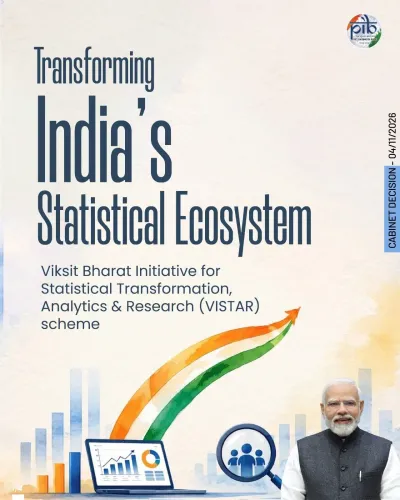
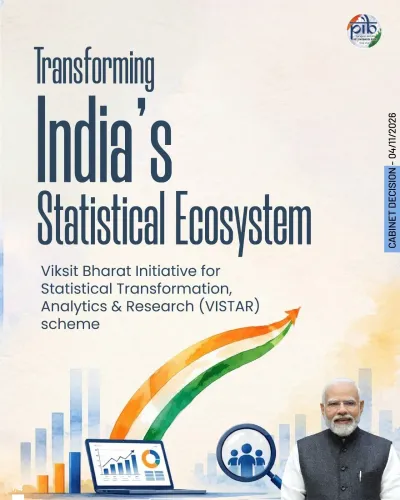
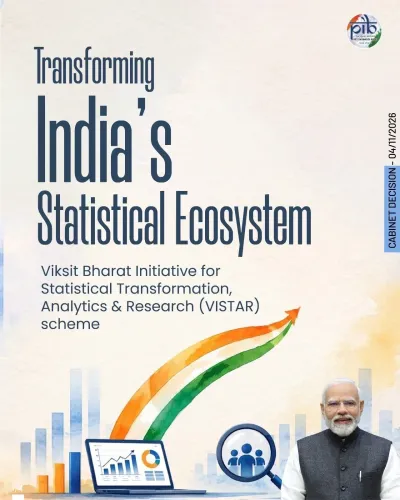
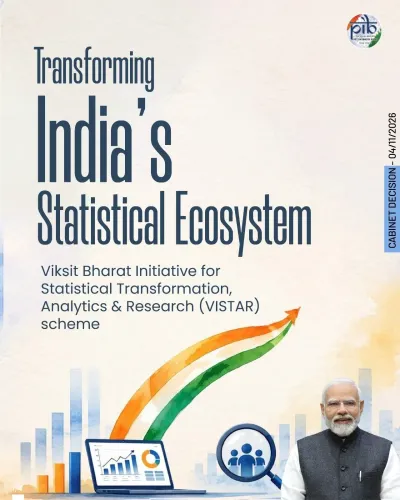
Piyush Goyal: Modi govt approves VISTAR statistics scheme
Synopsis
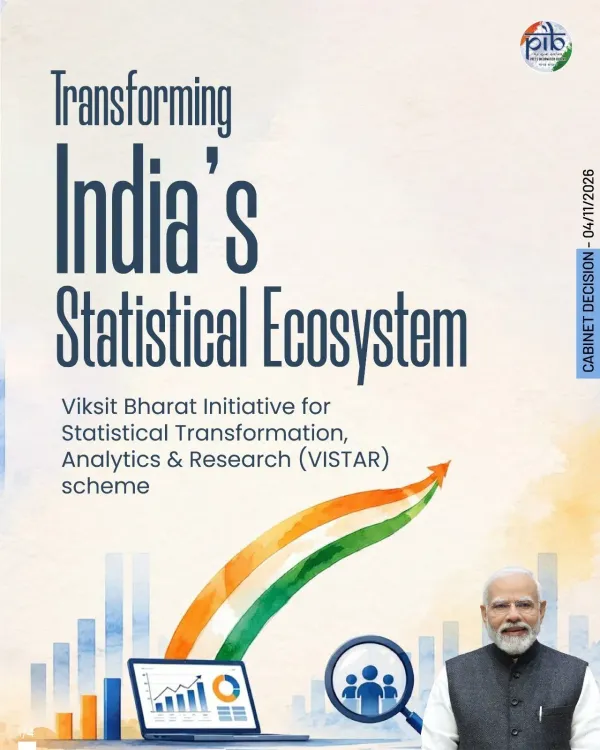
The Modi government has approved VISTAR, expanding India's official surveys from 43 to 59, mandating end-to-end digitisation for AI-ready real-time statistics, introducing district-level data granularity, and launching the 8th Economic Census to map the unorganised sector.
Key Takeaways
The VISTAR scheme has been approved by the Modi government to overhaul India's statistical infrastructure.
Official surveys will expand from 43 to 59 , covering wider economic and social ground.
The entire statistical process will be end-to-end digitised and built to be AI-ready with real-time data output.
District-level granular data will be generated to enable more precise, locally tailored welfare and policy decisions.
The 8th Economic Census will update and expand the mapping of India's large unorganised sector , last enumerated in 2019 .
VISTAR is positioned as a foundational enabler of the government's Viksit Bharat 2047 development vision.
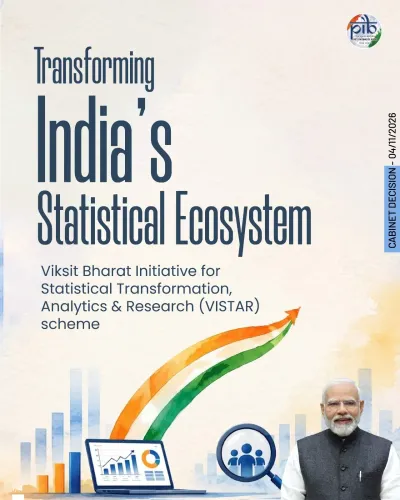
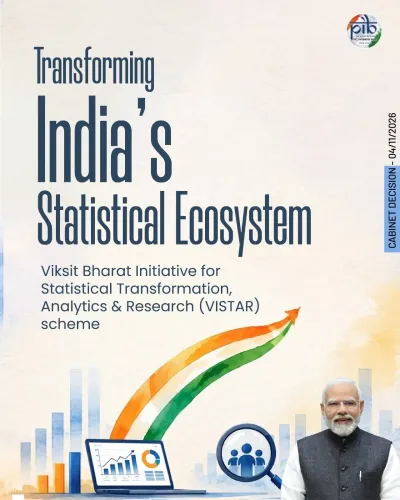
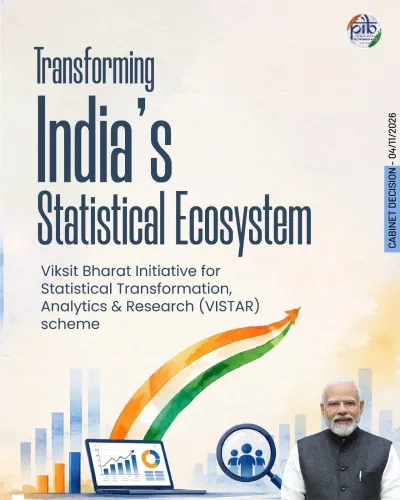
India's official data architecture is getting its most ambitious overhaul in decades. Union Commerce and Industry Minister Piyush Goyal announced on Wednesday, 4 November 2026 that the Modi government has approved the Viksit Bharat Initiative for Statistical Transformation, Analytics and Research (VISTAR) scheme — a sweeping upgrade to the country's statistical machinery aimed at making national data AI-ready, real-time, and granular enough to inform policy at the district level.
From 43 to 59: the survey expansion that changes the data map
The headline number is deceptively simple: surveys jump from 43 to 59. But the ambition behind that leap is structural. Under VISTAR, the entire statistical process — from data collection to dissemination — will be end-to-end digitised, moving India away from paper-heavy, lag-ridden reporting cycles toward a system capable of producing real-time official statistics. The scheme is designed to be AI-ready from the ground up, meaning machine-learning tools can be layered onto the data infrastructure as it matures.
India's survey framework traces its lineage to the National Sample Survey set up in the 1950s. Successive governments expanded it incrementally, but the core architecture remained largely analogue. VISTAR signals a generational break from that tradition.
District-level granularity: why local data is the missing link
Perhaps the most consequential element for welfare delivery is the push for district-level granular data. India's social programmes — from subsidised food to rural employment guarantees — have long struggled with targeting precision because national and state-level aggregates mask sharp local variation. A district in coastal Odisha and one in the Bundelkhand plateau may share a state average but face entirely different economic realities. VISTAR's district-level architecture is designed to close that gap, giving administrators the specific numbers they need to allocate resources where they actually matter.
The 8th Economic Census and India's invisible economy
Buried in the scheme's bullet points is a landmark undertaking: the 8th Economic Census, which will map India's vast unorganised sector. The 7th Economic Census was conducted in 2019, enumerating non-agricultural establishments across the country. The unorganised sector — which employs the overwhelming majority of India's workforce — has historically been the hardest to count and therefore the hardest to serve. An updated census, conducted through a digitised platform, would give policymakers their clearest picture yet of small traders, home-based workers, and micro-enterprises that formal data systems routinely miss.
Minister Goyal framed the approval in directly consequential terms: 'Better data means improved decision-making, smarter policies, targeted welfare and stronger growth for a Viksit Bharat [developed India].'
VISTAR inside the Viksit Bharat 2047 arc
The scheme fits neatly into the Modi government's overarching Viksit Bharat vision — the ambition to make India a fully developed economy by 2047, the centenary of independence. Evidence-based governance is the connective tissue of that project: without reliable, timely, fine-grained data, flagship welfare and infrastructure programmes cannot be efficiently targeted or evaluated. VISTAR is, in that sense, as much an enabler of every other policy as it is a standalone statistical reform. The key variables to watch now are the rollout timeline and the budget allocation for both the digitised survey platform and the 8th Economic Census — the two deliverables that will determine whether VISTAR's ambition translates into on-the-ground impact.
Point of View
AI-readiness, and an Economic Census under a single programmatic umbrella, the government is signalling that statistical reform is a first-order policy priority, not a technocratic afterthought. The district-level granularity push is particularly significant: it aligns with the Centre's broader thrust to push accountability and resource allocation closer to the local level. The real test will come in execution — rollout timelines and budgetary commitments will determine whether VISTAR becomes a genuine inflection point or another well-architected scheme that moves slowly through India's federal machinery.
NationPress
4 Nov 2026
Frequently Asked Questions
What is the VISTAR scheme approved by the Modi government?
VISTAR stands for Viksit Bharat Initiative for Statistical Transformation, Analytics and Research. It is a newly approved scheme that expands India's official surveys from 43 to 59, mandates end-to-end digitisation of the statistical process, enables AI-ready real-time data, introduces district-level granular statistics, and proposes the 8th Economic Census.
What is the 8th Economic Census and why does it matter?
The 8th Economic Census will enumerate and map establishments in India's unorganised sector — the vast portion of the economy employing most of the workforce but poorly captured in formal data. The last such exercise, the 7th Economic Census, was conducted in 2019.
How will VISTAR improve welfare delivery in India?
By generating district-level granular data, VISTAR will allow policymakers and administrators to target welfare programmes with far greater precision, addressing the variation in local economic conditions that national or state averages tend to mask.
What does 'AI-ready real-time statistics' mean under VISTAR?
It means the digitised data infrastructure will be built in a way that allows artificial intelligence and machine-learning tools to process and analyse official statistics as they are collected, enabling faster, more dynamic policy responses rather than waiting for annual or multi-year survey cycles.
What is Viksit Bharat and how does VISTAR connect to it?
Viksit Bharat is the Modi government's vision for India to become a fully developed economy by 2047, the centenary of independence. VISTAR supports that vision by building the reliable, timely data foundation needed to design, target, and evaluate the policies and welfare programmes that the vision depends on.