Rijiju: Cabinet clears VISTAR scheme to revamp India's stats
Synopsis
The Union Cabinet has approved VISTAR, a five-year scheme to transform India's official statistical ecosystem through analytics and research, running from 2026–27 to 2030–31 under PM Modi's Viksit Bharat vision.
Key Takeaways
The Union Cabinet approved the VISTAR Scheme on November 4, 2026 , covering the period 2026–27 to 2030–31 .
VISTAR stands for Viksit Bharat Initiative for Statistical Transformation, Analytics and Research .
The scheme is aligned with PM Modi's Viksit Bharat 2047 national development vision.
MoSPI is the central body expected to implement the programme across five years.
Specific fund allocations and detailed deliverables are yet to be formally announced.
The National Statistical Commission , set up in 2005, laid earlier groundwork for statistical reform that VISTAR aims to build on.
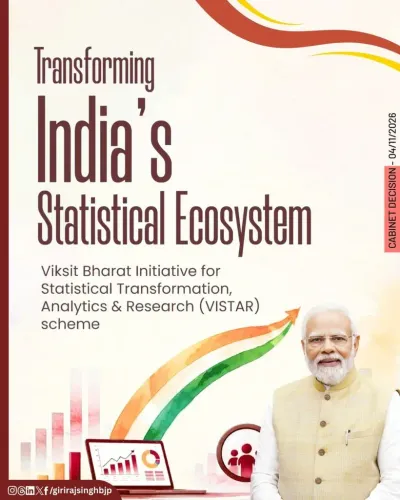
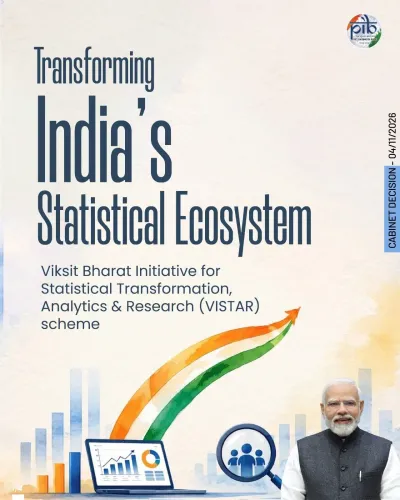
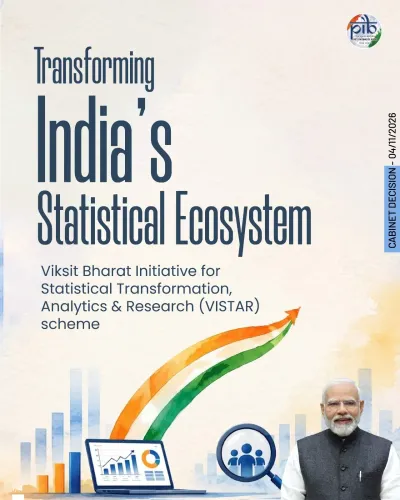
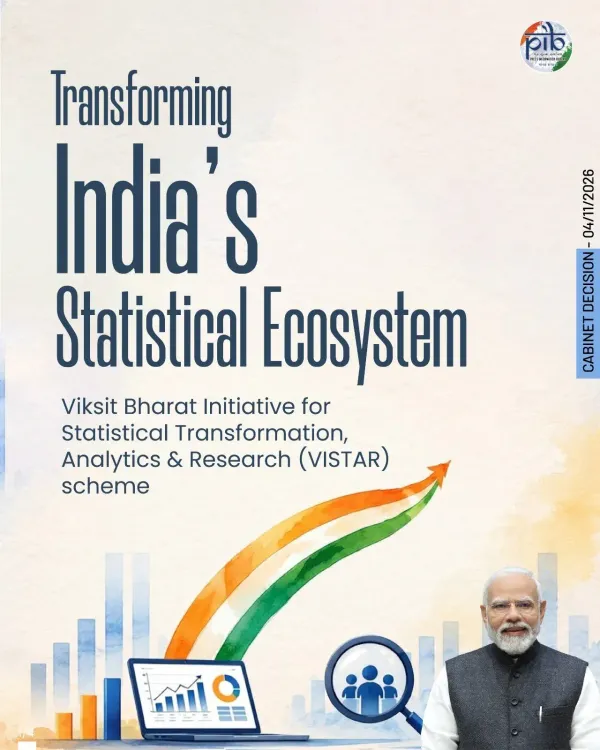
India's statistical backbone is getting a multi-year overhaul. Union Parliamentary Affairs and Minority Affairs Minister Kiren Rijiju announced on Wednesday, November 4, 2026 that the Union Cabinet, under Prime Minister Narendra Modi, has approved the Viksit Bharat Initiative for Statistical Transformation, Analytics and Research (VISTAR) Scheme — a five-year programme running from 2026–27 to 2030–31 aimed at modernising the country's official data infrastructure.
What VISTAR sets out to do
The scheme's full name telegraphs its ambition: transformation, analytics, and research — three pillars that together signal a push beyond routine data-collection toward building an evidence-driven governance machine. The Ministry of Statistics and Programme Implementation (MoSPI), the nodal body for official statistics in India, is expected to be the primary implementing agency, though specific fund allocations and delivery milestones are yet to be formally published.
Rijiju framed the approval as 'transforming India's official statistical ecosystem' — language that positions VISTAR not as a maintenance exercise but as a structural upgrade. The five-year horizon stretches to 2030–31, placing it squarely within the government's broader Viksit Bharat 2047 roadmap, which envisions a developed India by its centenary of independence.
A statistical system long overdue for modernisation
India's statistical architecture has deep institutional roots — the National Statistical Commission was constituted in 2005 to strengthen data credibility and recommend systemic improvements — but practitioners and policymakers have long flagged gaps in real-time data, subnational granularity, and inter-ministry harmonisation. VISTAR, if its mandate holds, addresses exactly that fault-line.
The pattern here is deliberate: multi-year cabinet-approved schemes give central agencies a budgetary and mandate runway long enough to recruit talent, procure technology, and build institutional muscle. Without that runway, reform efforts tend to stall when political priorities shift.
Why reliable data is a governance multiplier
Poor statistics don't just embarrass analysts — they distort resource allocation, slow court and regulatory decisions, and erode investor confidence. A stronger MoSPI pipeline means better inputs for everything from subsidy targeting to GDP revisions to climate-adaptation planning. Stakeholders range from government statisticians and planning ministries to academic researchers and multilateral institutions that benchmark India's development indicators.
The coming months will be critical: watch for the detailed scheme guidelines, the total outlay approved by the Cabinet Committee on Economic Affairs, and the specific deliverables — whether VISTAR prioritises real-time survey modernisation, administrative-data integration, or capacity-building in state statistical bureaus. Those details will determine whether this is a genuine systems upgrade or a rebranded continuation of existing programmes.
India is building toward 2047. The quality of the data it collects in the next five years will shape every policy bet it places along the way.
Point of View
However, will come in the scheme guidelines: whether VISTAR closes the persistent gap between central and state statistical capacity, or concentrates resources at the apex, will determine its legacy. For now, the cabinet approval represents political will translated into administrative architecture — a necessary first step, but far from the last.
NationPress
4 Nov 2026
Frequently Asked Questions
What is the VISTAR scheme approved by the Union Cabinet?
VISTAR stands for Viksit Bharat Initiative for Statistical Transformation, Analytics and Research. It is a five-year central government scheme approved by the Union Cabinet for the period 2026–27 to 2030–31, aimed at modernising India's official statistical ecosystem.
Which ministry will implement the VISTAR scheme?
The Ministry of Statistics and Programme Implementation (MoSPI) is expected to be the primary implementing agency for the VISTAR scheme, though detailed operational guidelines are yet to be published.
How is VISTAR connected to Viksit Bharat 2047?
The VISTAR scheme is part of the broader Viksit Bharat 2047 vision, which aims to make India a developed nation by its centenary of independence. Stronger statistical capacity is seen as essential for evidence-based policy planning toward that goal.
Who announced the VISTAR scheme cabinet approval?
Union Parliamentary Affairs and Minority Affairs Minister Kiren Rijiju announced the cabinet approval of the VISTAR scheme on November 4, 2026, via a post on X.
What was done before VISTAR to reform India's statistical system?
The National Statistical Commission was constituted in 2005 to recommend improvements in India's statistical system and enhance data credibility — an earlier institutional step that VISTAR now seeks to build upon.