Goyal Inaugurates Jaipur's Vanijya and Udyog Bhawan
Synopsis
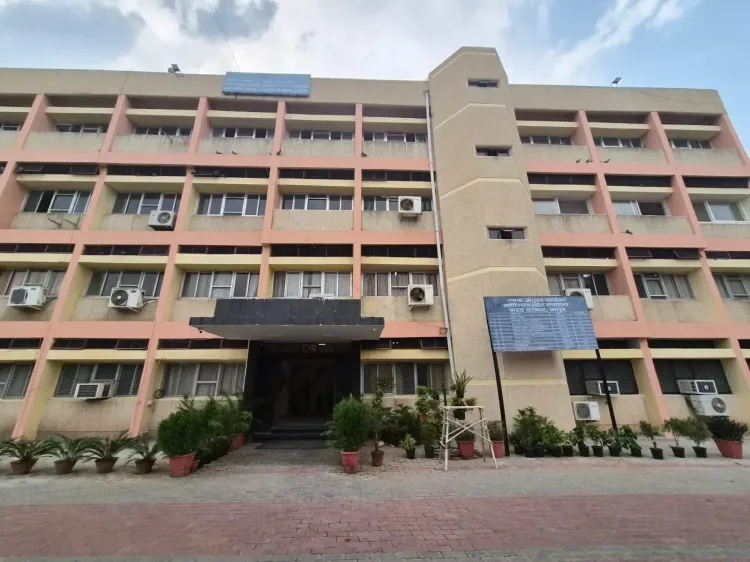
Union Commerce Minister Piyush Goyal virtually inaugurated the Vanijya and Udyog Bhawan in Jaipur on 4 November 2026 — India's first completed co-location commerce office hub — aiming to streamline services for MSMEs, exporters, and industry under a single roof in partnership with CM Bhajan Lal Sharma's Rajasthan government.
Key Takeaways
Vanijya and Udyog Bhawan in Jaipur is the first completed project under the Ministry of Commerce and Industry's co-location initiative.
Union Minister Piyush Goyal performed the virtual inauguration on 4 November 2026 .
The co-location model consolidates key central government commerce and industry offices under one roof to reduce operational costs and improve service delivery.
The initiative targets MSMEs, exporters, entrepreneurs, and industry as primary beneficiaries through faster approvals and easier government access.
CM Bhajan Lal Sharma's Rajasthan government played a key partnership role in completing the project.
Jaipur now serves as the template for the programme's planned rollout to other states.
A new nerve centre for trade and industry has opened in Jaipur — and it marks the first completed project under a quietly ambitious administrative reform. Union Commerce and Industry Minister Piyush Goyal virtually inaugurated the Vanijya and Udyog Bhawan on Wednesday, 4 November 2026, flagging it as a landmark in the Ministry of Commerce and Industry's co-location initiative, which aims to bring key central government offices under a single roof across the country.
India's first co-location commerce hub lands in Rajasthan
The Bhawan is the first completed project under the co-location programme — a scheme designed to end the administrative fragmentation that has long forced MSMEs, exporters, and entrepreneurs to shuttle between dispersed offices for approvals and services. By consolidating departments in one building, the initiative targets faster service delivery, reduced operational expenses, and a measurable lift in ease of doing business for industries across the state.
Goyal framed the inauguration within the Modi Government's 'Whole-of-Government' approach — a philosophy of breaking inter-departmental silos so that policy outcomes, not departmental turf, drive decision-making. The Bhawan, he said, will emerge as 'a vibrant centre for trade and investment promotion, creating new opportunities for businesses across the State.'
Centre-state partnership with CM Bhajan Lal Sharma
The project underscores a deepening partnership between New Delhi and the BJP-led Rajasthan government under Chief Minister Bhajan Lal Sharma. Goyal specifically credited Sharma's 'active cooperation' as central to the Bhawan becoming a reality — a pointed signal that the co-location model depends as much on state-level buy-in as on central policy design.
Rajasthan, with its significant MSME base and growing export sector in textiles, gems, and handicrafts, stands to gain from faster processing of trade-related approvals and a single-window environment for businesses seeking government interface. The model, if it delivers on that promise, becomes a template worth replicating.
What the rollout means for the broader co-location programme
With the first project now complete, attention shifts to whether other states will follow Rajasthan's lead. The co-location initiative is designed to cut duplication between central departments handling trade, investment promotion, and industrial policy — a persistent pain point for exporters and industry bodies. The Jaipur Bhawan provides the first real-world proof of concept, and its operational performance will determine how quickly New Delhi scales the model to other cities.
For MSMEs and exporters in Rajasthan, the promise is straightforward: fewer trips, faster clearances, and a single address for commerce-related government services. Whether that promise translates into measurable cuts in approval timelines will be the benchmark every subsequent co-location project is measured against.
Point of View
The Ministry is effectively putting a replicable model on the table, with Rajasthan as the proof-of-concept state. The timing matters too: Rajasthan, governed by a BJP ally in CM Bhajan Lal Sharma, provides the ideal political alignment to demonstrate centre-state synergy ahead of potential rollouts in states with more complex governing coalitions. If processing times for trade approvals in Rajasthan demonstrably improve, the co-location programme could become a significant, if unglamorous, pillar of the government's ease-of-doing-business pitch.
NationPress
4 Nov 2026
Frequently Asked Questions
What is the Vanijya and Udyog Bhawan in Jaipur?
The Vanijya and Udyog Bhawan is an office complex in Jaipur that houses co-located central government offices under the Ministry of Commerce and Industry. It is the first completed project under the Ministry's co-location initiative, designed to bring key trade and industry departments under a single roof.
Who inaugurated the Vanijya and Udyog Bhawan?
Union Commerce and Industry Minister Piyush Goyal virtually inaugurated the Bhawan on 4 November 2026.
What is the Ministry of Commerce's co-location initiative?
The co-location initiative is a programme by the Ministry of Commerce and Industry to consolidate multiple central government offices dealing with trade, investment, and industry into single buildings across states. It aims to cut duplication, reduce operational costs, and speed up services for MSMEs, exporters, and businesses.
How will the Jaipur Bhawan help MSMEs and exporters?
By bringing commerce-related government offices under one roof, the Bhawan is designed to reduce the need for businesses to visit multiple offices, enable faster approvals, and provide a single-window environment for trade and industry-related services in Rajasthan.
What role did the Rajasthan government play in the Bhawan project?
Chief Minister Bhajan Lal Sharma's BJP-led Rajasthan government partnered with the central Ministry of Commerce and Industry to facilitate the project. Goyal specifically cited the state government's 'active cooperation' as integral to the Bhawan's completion.