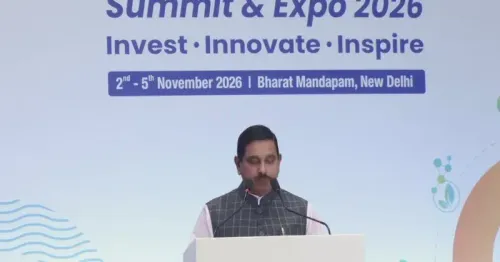
Pralhad Joshi Launches ISA Global Capability Centre at Bharat Renewable Summit
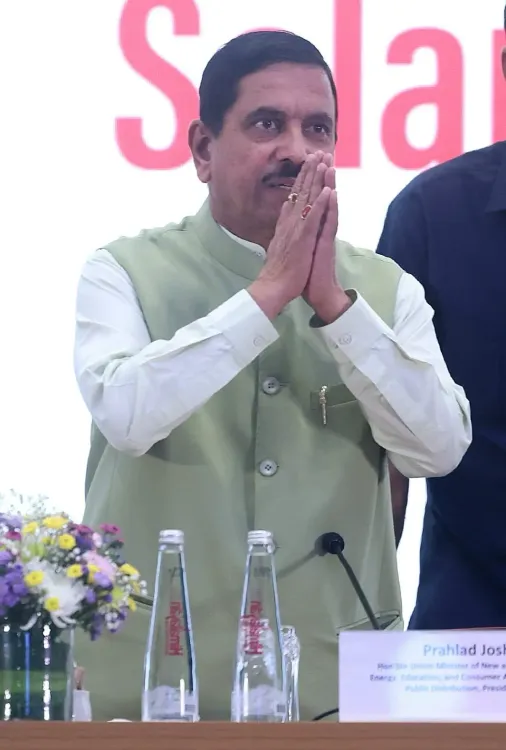
Synopsis
Union Minister Pralhad Joshi launched the ISA Global Capability Centre and ISA Academy at Bharat Renewable Energy Summit 2026, spotlighting AI-powered tools and hands-on training to help member countries accelerate solar deployment and bridge the gap between learning and implementation.
Key Takeaways
Union Minister Pralhad Joshi addressed the Bharat Renewable Energy Summit 2026 on 4 November 2026 .
The ISA Global Capability Centre (GCC) and ISA Academy were formally launched at the summit.
GCC SHINE integrates AI-powered digital tools , knowledge sharing, hands-on training and specialised expertise.
The initiative targets ISA member countries , equipping them with practical support to accelerate solar deployment.
The International Solar Alliance was originally launched at COP21 in Paris in 2015 by India and France .
The summit coincides with the 9th ISA Assembly , lending formal governance weight to the new institutions.
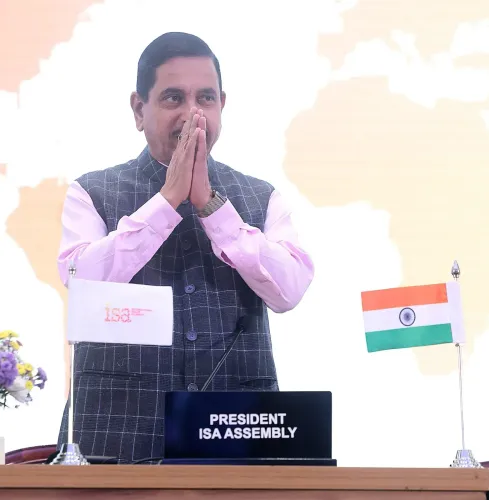
Two new institutions built to close the most stubborn gap in global solar expansion — the distance between knowing and doing — were launched on Wednesday, 4 November 2026, as Union Minister for New and Renewable Energy Pralhad Joshi addressed the Bharat Renewable Energy Summit 2026 and inaugurated the International Solar Alliance's Global Capability Centre (GCC) and the ISA Academy.
What GCC SHINE and the ISA Academy are built to do
The two platforms are designed to work in tandem. The GCC SHINE initiative bundles AI-powered digital tools, structured knowledge sharing, and specialised technical expertise into a single architecture aimed at ISA member countries — many of them sun-rich but capital- and skill-constrained developing nations. The ISA Academy complements it with hands-on training and practical implementation support, so that professionals trained on the platform can carry those skills directly into on-ground solar deployment.
Joshi framed the dual launch not as a training exercise but as a strategic infrastructure investment. The goal, he said, is to equip member countries with 'the knowledge, expertise and practical support required to accelerate solar deployment and advance a sustainable energy future' — a formulation that places capacity building at the same level of urgency as hardware and finance.
The ISA's decade-long arc from Paris to this summit
The International Solar Alliance was born at COP21 in Paris in 2015, a joint initiative by India and France to pool political will and mobilise investment in solar-rich countries that had been largely bypassed by global clean-energy capital flows. What began as a diplomatic compact has since evolved into a treaty-based institution with a growing member base.
The Bharat Renewable Energy Summit represents the latest inflection point in that arc. By anchoring formal institutions — an academy, a capability centre, AI-integrated toolkits — to the ISA's diplomatic framework, India is extending its model: not just promising solar investment, but building the human infrastructure to absorb and deploy it. That is a meaningfully different kind of international leadership.
India's solar-diplomacy playbook, sharpened
Joshi's emphasis on international collaboration at the summit echoes a pattern visible across India's renewable-energy diplomacy in recent years — using multilateral platforms to position New Delhi as a south-south knowledge hub, not merely a bilateral aid donor. The addition of AI-powered tools to the GCC SHINE framework signals a deliberate modernisation of that playbook, moving capacity building from workshops and manuals toward adaptive, data-driven learning systems.
The summit also runs alongside the 9th ISA Assembly — the alliance's principal governing body — adding a formal institutional weight to what might otherwise read as a ceremonial launch. Decisions on the GCC and Academy's mandates, funding structures, and rollout timelines will now have the assembly's imprimatur.
For the dozens of developing nations in the ISA fold, the question was never whether the sun shines. It was always whether the engineers, planners, and policymakers are ready when it does. With today's launches, that question has at least a formal answer.
Point of View
New Delhi is consolidating its role as a south-south knowledge anchor rather than a conventional aid provider. The timing alongside the 9th ISA Assembly ensures these institutions carry governing legitimacy from day one, not just ministerial endorsement. Whether the rollout reaches the most capacity-constrained member states will be the real test of whether the ambition outlasts the summit.
NationPress
5 Nov 2026
Frequently Asked Questions
What is the ISA Global Capability Centre?
The ISA Global Capability Centre, launched at Bharat Renewable Energy Summit 2026, is an International Solar Alliance initiative that provides AI-powered digital tools, knowledge sharing and specialised expertise to help member countries accelerate solar energy deployment.
What is the ISA Academy?
The ISA Academy is a training and knowledge platform under the International Solar Alliance, launched alongside the GCC, focused on practical solar capacity building and implementation support for ISA member countries.
When was the International Solar Alliance founded and by whom?
The International Solar Alliance was launched in 2015 at COP21 in Paris as a joint initiative by India and France to promote solar energy investment in solar-rich developing nations.
What is the Bharat Renewable Energy Summit 2026?
The Bharat Renewable Energy Summit 2026 is an India-hosted renewable energy summit at which the ISA Global Capability Centre and ISA Academy were launched; it also coincides with the 9th ISA Assembly.