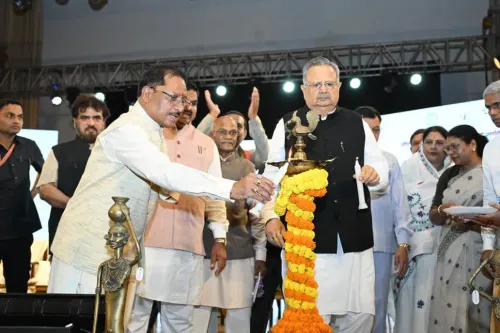
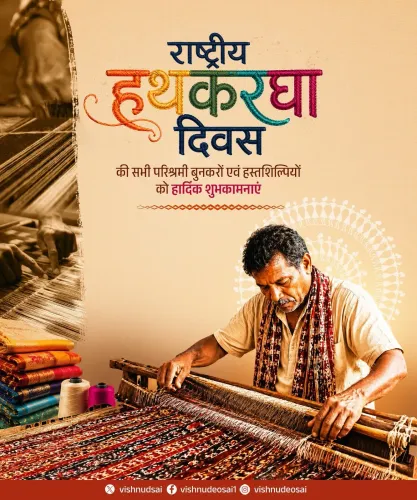
CM Vishnu Deo Sai honours Chhattisgarh weavers on National Handloom Day
Synopsis
Chhattisgarh CM Vishnu Deo Sai marked National Handloom Day on 7 August by celebrating the state's weaving heritage and urging citizens to adopt local, indigenous products to uplift artisan communities.
Key Takeaways
National Handloom Day is observed on 7 August every year, a date chosen to commemorate the 1905 Swadeshi movement .
CM Vishnu Deo Sai celebrated Chhattisgarh's weaving heritage and called on citizens to adopt local, indigenous handloom products.
Chhattisgarh is known for Kosa silk and tribal weaving traditions that serve as both cultural heritage and rural livelihood.
The day has been marked nationally since 2015 , when the Government of India instituted the observance.
CM Sai framed handloom as a symbol of Atmanirbhar Bharat — self-reliance anchored in millions of skilled artisan hands.
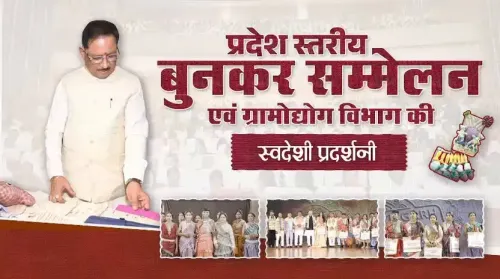
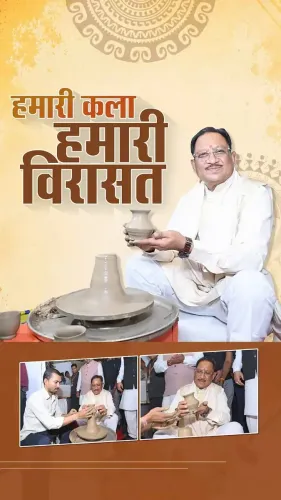
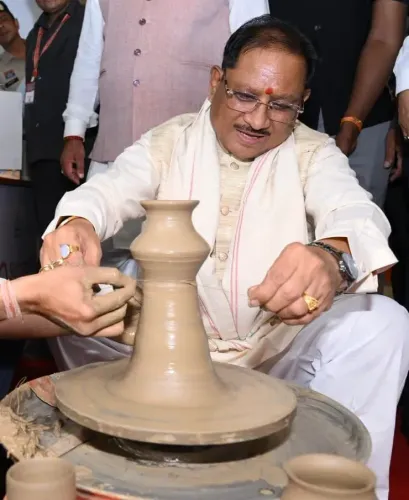
On National Handloom Day, 7 August, Chhattisgarh Chief Minister Vishnu Deo Sai called on citizens to honour the labour of the state's weavers by choosing local and indigenous products — framing the handloom not merely as cloth, but as the living pulse of cultural identity and self-reliance.
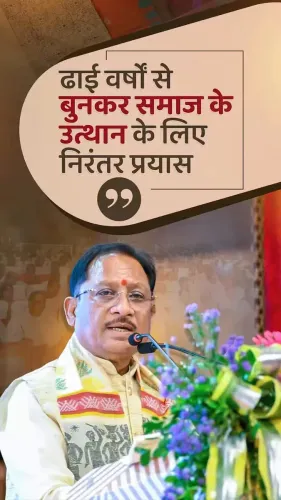
In his post, CM Sai wrote: 'स्वदेशी का सम्मान, बुनकरों का उत्थान' — 'Honour the swadeshi, uplift the weaver.' He celebrated Chhattisgarh's rich weaving tradition and the extraordinary skill of its artisans, describing the handloom as a symbol of culture, heritage, and the self-reliance of millions of hands.
A day rooted in the Swadeshi movement
National Handloom Day has been observed on 7 August every year since 2015, when the Government of India designated the date to mark the 1905 launch of the Swadeshi movement — the historic call to boycott British goods and embrace Indian-made products. The choice of date is deliberate: it ties every loom and every weaver directly to that founding act of economic resistance.
The day is now a focal point for state governments, artisan clusters, and handloom promotion bodies across the country to spotlight indigenous textiles and the rural households that depend on them.
Chhattisgarh's Kosa silk and the stakes for weavers
Chhattisgarh occupies a distinctive place in India's handloom map. The state is renowned for Kosa silk — a lustrous, naturally golden fabric woven from the cocoons of the Kosa silkworm — alongside a range of tribal weaving traditions that have been passed down through generations of artisan families. For these households, the loom is not a cultural artefact; it is a livelihood.
Successive central and state governments have linked handloom promotion to the broader Atmanirbhar Bharat framework, positioning indigenous textiles as both an economic engine for rural India and a soft-power expression of national identity. CM Sai, who took office in December 2023, has continued that alignment, using the day to urge citizens to become active participants — 'सहभागी' (partners) — in the weaver's prosperity, not just passive admirers of the craft.
The ask: buy local, pass it forward
The CM's message carried a specific, actionable appeal: adopt local and indigenous products, respect the weaver's labour, and carry these traditions forward to new generations. It is a call that lands with particular weight in a state where handloom weaving is woven into both the economy and the cultural fabric of tribal and rural communities.
The real measure of this day will not be in the posts it generates, but in the order books it fills for the weavers of Chhattisgarh.
Point of View
Where Kosa silk and tribal weaves are genuine livelihood anchors, the appeal is not purely symbolic. The real policy question is whether such observances translate into sustained budget allocations for handloom clusters or remain largely in the register of awareness campaigns.
NationPress
8 Aug 2026
Frequently Asked Questions
Why is National Handloom Day celebrated on 7 August?
7 August marks the anniversary of the 1905 Swadeshi movement launch, when Indians were called to boycott British goods and embrace indigenous products. The Government of India designated this date as National Handloom Day in 2015 to honour that legacy and promote the handloom sector.
What is Kosa silk and why is it significant for Chhattisgarh?
Kosa silk is a naturally golden fabric woven from the cocoons of the Kosa silkworm, and it is one of Chhattisgarh's most distinctive traditional textiles. It represents both a cultural heritage and a major source of rural livelihood for artisan families across the state.
What did CM Vishnu Deo Sai say on National Handloom Day?
CM Vishnu Deo Sai called on citizens to honour weavers by adopting local and indigenous products, describing the handloom as a symbol of culture, heritage, and self-reliance. He urged people to become partners in the weaver's prosperity and to carry these traditions forward to new generations.
When did Vishnu Deo Sai become Chief Minister of Chhattisgarh?
Vishnu Deo Sai became Chief Minister of Chhattisgarh in December 2023 after the BJP's victory in the state assembly elections.
How does the handloom sector connect to Atmanirbhar Bharat?
The Atmanirbhar Bharat initiative promotes self-reliance in Indian manufacturing and crafts. Handloom weaving, as a labour-intensive, indigenous industry supporting millions of rural artisan households, is consistently highlighted by both central and state governments as a core pillar of this self-reliance vision.