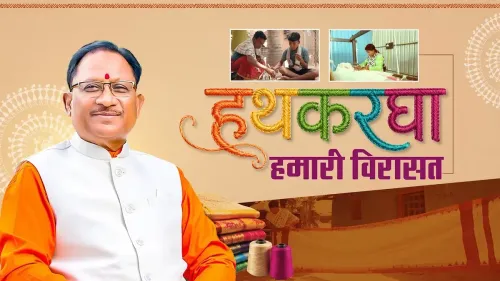
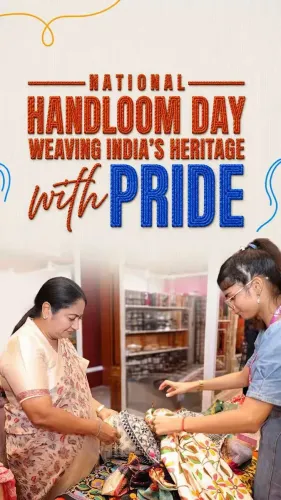
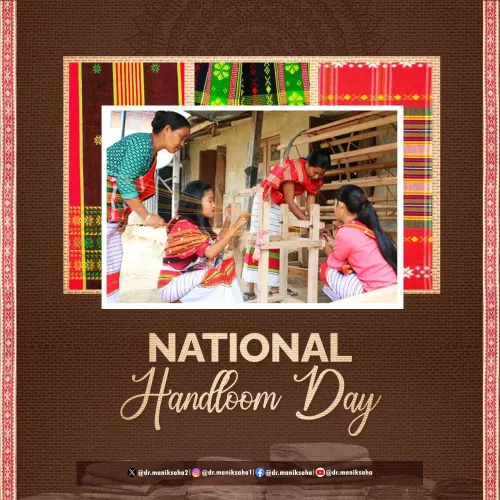
CM Sai honours weavers on National Handloom Day
Synopsis
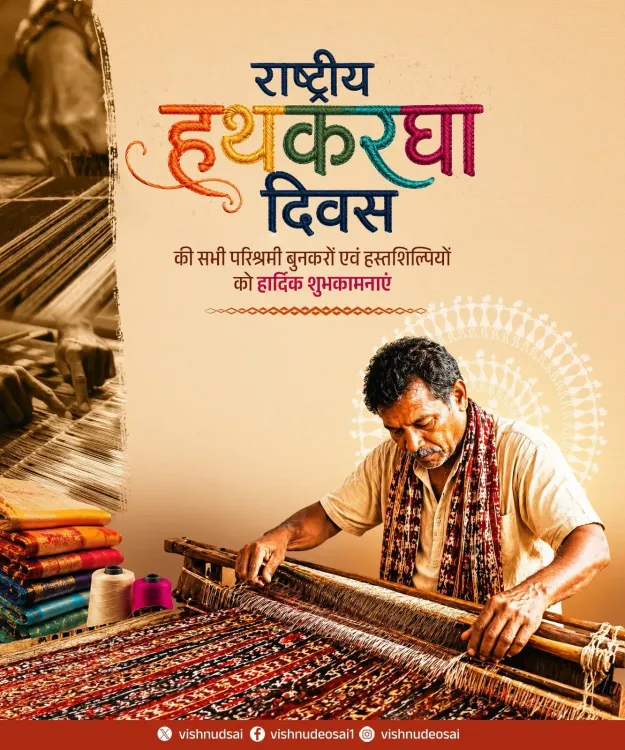
On National Handloom Day, 7 August 2026, Chhattisgarh Chief Minister Vishnu Deo Sai saluted India's weavers and handicraft artisans, calling handloom a living symbol of cultural heritage and urging citizens to embrace Vocal for Local and Atmanirbhar Bharat.
Key Takeaways
National Handloom Day falls on 7 August each year, instituted in 2015 to mark the anniversary of the Swadeshi Movement.
CM Vishnu Deo Sai extended greetings to weavers and handicraft artisans across India on behalf of Chhattisgarh.
He described handloom as a 'living symbol' of India's cultural heritage, traditional skill, and the Atmanirbhar Bharat spirit.
The message explicitly endorsed the Vocal for Local campaign, urging citizens to adopt indigenous products to support weavers.
Chhattisgarh is home to distinctive weaving traditions including Kosa silk from the Bastar and Champa regions.
BJP-governed states routinely align cultural observances with the Centre's Atmanirbhar Bharat economic messaging.
Every thread tells a story — and on National Handloom Day, 7 August 2026, Chhattisgarh Chief Minister Vishnu Deo Sai called on Indians to back the artisans who keep that story alive. In a message to the nation's weavers and handicraft workers, Sai invoked the twin pillars of Vocal for Local and Atmanirbhar Bharat, urging citizens to choose homegrown textiles and amplify the resolve of self-reliant India.
Posting in Hindi, CM Sai wrote: 'Rashtriya Hathkargha Divas par sabhi parishraami bunakaron evam hastashilpiyon ko hardik shubhkamnayein' — 'Heartfelt greetings to all hardworking weavers and handicraft artisans on National Handloom Day.' He described handloom as a 'living symbol of our rich cultural heritage, traditional skill, and the spirit of Atmanirbhar Bharat,' crediting the dedication and creativity of India's weavers with giving Indian textile traditions a 'distinctive identity across the world.'
Why 7 August carries weight for India's looms
National Handloom Day was instituted in 2015 by the Ministry of Textiles to commemorate the Swadeshi Movement — the 1905 mass mobilisation that made homespun cloth a symbol of resistance and economic independence. Choosing that date was deliberate: it anchors a modern industrial policy goal in a century-old act of collective will. The handloom sector remains one of India's largest rural employers, sustaining millions of weaver households across states including Chhattisgarh, where traditional tribal and folk weaving traditions form a significant part of the cultural fabric.
Vocal for Local meets the loom
Sai's message slots neatly into a pattern visible across BJP-governed states: aligning state-level cultural messaging with the Centre's Atmanirbhar Bharat campaign, launched in May 2020, which pushed domestic manufacturing and local consumption as economic strategy. 'Vocal for Local' — the consumer-facing slogan of that campaign — has found particularly resonant ground in the handloom sector, where every purchase directly supports an individual artisan rather than an industrial supply chain. The ask is simple and the impact traceable. That directness is why the slogan keeps returning.
For Chhattisgarh's weavers, the day is more than symbolic. The state's weaving communities — producing everything from Kosa silk, sourced from the forests of Bastar and Champa, to traditional tribal textiles — represent both a livelihood and a living archive of indigenous craft knowledge. Whether state budget allocations in the next financial year will translate this rhetorical support into concrete scheme funding remains the question worth watching.
The loom has outlasted empires. Whether it gets the policy muscle to outlast the market is the test India's weavers are still waiting on.
Point of View
Embedded in the date itself, gives the 'Vocal for Local' ask a historical legitimacy that purely economic arguments cannot. For Chhattisgarh specifically, where tribal weaving traditions intersect with forest-based livelihoods, the rhetorical alignment matters — but it will only convert into durable political capital if accompanied by budget-backed schemes for weavers in the next financial cycle.
NationPress
21 Sept 2026
Frequently Asked Questions
When is National Handloom Day celebrated in India?
National Handloom Day is observed every year on 7 August . It was established in 2015 by the Ministry of Textiles to commemorate the Swadeshi Movement of 1905 and to promote India's handloom sector.
Why did CM Vishnu Deo Sai post about National Handloom Day?
As Chief Minister of Chhattisgarh , Vishnu Deo Sai posted greetings to weavers and artisans on 7 August 2026 , calling handloom a symbol of cultural heritage and urging citizens to support weavers by choosing indigenous products under the Vocal for Local initiative.
What is the Vocal for Local campaign?
' Vocal for Local ' is the consumer-facing slogan of the Atmanirbhar Bharat campaign launched in May 2020 , encouraging Indians to prefer domestically made products to boost local industries and artisans.
What handloom traditions is Chhattisgarh known for?
Chhattisgarh is particularly known for Kosa silk , a prized fabric produced from cocoons found in the forests of the Bastar and Champa regions, alongside a range of traditional tribal and folk weaving styles.
What is Atmanirbhar Bharat and how does it relate to handloom?
Atmanirbhar Bharat — meaning 'Self-Reliant India' — is a campaign launched in May 2020 to promote domestic manufacturing and local consumption. The handloom sector is a key beneficiary of this push, as buying handloom products directly supports individual weaver households rather than industrial supply chains.