CM Fadnavis Leads Nagpur Padyatra, Hits Back at Rahul Gandhi
Synopsis
Maharashtra CM Devendra Fadnavis addressed the 'Lokshahi Vachava, Arajakta Hatava' padyatra in Nagpur on November 5, 2026, invoking Ambedkar's Constitution to counter Rahul Gandhi's call for street-level political battles and warning against what he called a 'Regime Change' agenda targeting India's democratic institutions.
Key Takeaways
Maharashtra CM Devendra Fadnavis addressed the 'Lokshahi Vachava, Arajakta Hatava' padyatra in Nagpur on November 5, 2026 .
Fadnavis directly named Rahul Gandhi , insisting all political battles must be fought inside Parliament under the authority of Ambedkar's Constitution.
He warned that a 'Regime Change' agenda concealed behind vague slogans is aimed at dismantling constitutional institutions.
Union Minister Nitin Gadkari and a broad cross-section of Mahayuti ministers, MPs, MLAs, and party leaders were present, signalling coalition unity.
Fadnavis repeatedly invoked Bharat Ratna Dr.
Ambedkar as the constitutional anchor, staking a symbolic claim in a state where Ambedkarite politics is electorally decisive.
The event marks a sharp escalation in BJP's rhetorical framing of opposition mobilisation as a threat to democratic order.
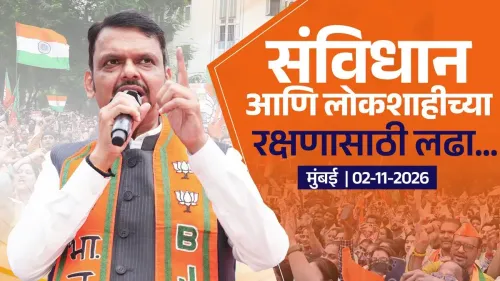
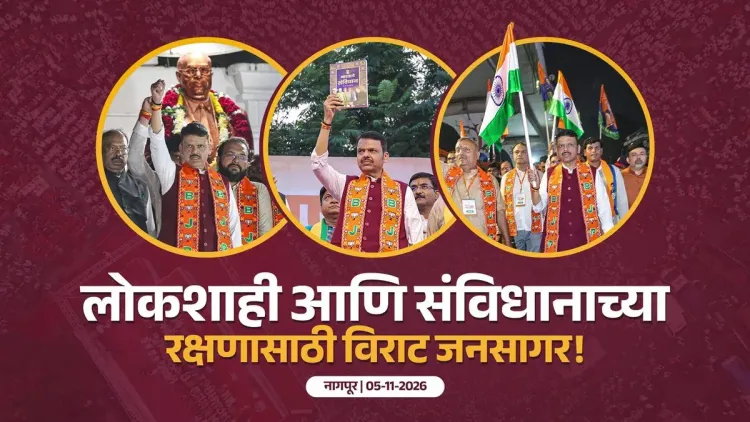
A padyatra through Nagpur on Thursday, November 5, 2026 became a stage for one of the sharpest constitutional arguments Maharashtra's political season has produced. Maharashtra Chief Minister Devendra Fadnavis addressed the 'Lokshahi Vachava, Arajakta Hatava' (Save Democracy, Remove Anarchy) march, drawing a hard line between parliamentary debate and what he called an organised attempt to dismantle India's constitutional order — and naming Rahul Gandhi directly in the process.
The Nagpur message: Parliament, not streets
Fadnavis anchored his remarks in the authority of Bharat Ratna Dr. B. R. Ambedkar, the Constitution's principal architect, arguing that as long as that document stands, all political disputes belong inside Parliament — not on the road. 'Rahul Gandhi has said that the fight will now take place on the streets,' the Chief Minister stated, responding to recent Congress rhetoric. 'But as long as the Constitution given to us by MahaManav Bharat Ratna Dr. Babasaheb Ambedkar stands firm, all debates and arguments will take place within Parliament.'
It was a pointed rebuttal — invoking Ambedkar's legacy to rebuff a Congress leader in a city that carries enormous symbolic weight for Ambedkarite politics. The choice of Nagpur as the site, home to Union Minister Nitin Gadkari and a Mahayuti stronghold, amplified the signal.
The 'Regime Change' charge and what Fadnavis says lies beneath it
The Chief Minister went further than simply defending parliamentary norms. He took aim at what he described as a 'Regime Change' agenda hiding behind vague slogans — a phrase that has circulated in opposition and civil-society discourse. 'Under the cover of vague slogans, an attempt is being made to disrupt the established political system laid down by the Constitution,' he said. 'These provocative statements are, in reality, aimed at dismantling government institutions.'
The framing is deliberate and familiar. Since 2014, BJP leaders have consistently recast opposition street mobilisations as threats to constitutional order rather than exercises in democratic protest — a rhetorical posture that shifts the terrain from policy grievance to civic patriotism. Fadnavis deployed it with renewed force here, insisting the stakes transcend party politics: 'This is not merely a fight for the BJP or NDA, it is a responsibility towards India and the future of our democracy.'
Gadkari, Mahayuti ranks, and the breadth of the turnout
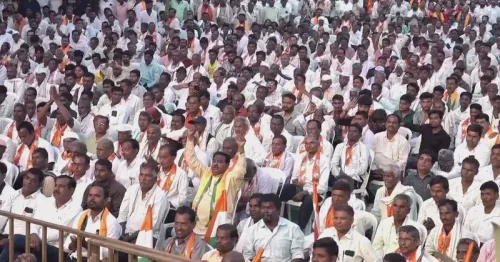
Union Minister Nitin Gadkari stood on the dais alongside a who's-who of the Mahayuti coalition — ministers Chandrashekhar Bawankule, Adv. Akash Fundkar, Dr. Ashok Uike, Ministers of State Dr. Pankaj Bhoyar and Adv. Ashish Jaiswal, BJP Yuva Morcha National President and MP Dr. Hemang Joshi, and People's Republican Party National Working President Jaydeep Kawade, among MPs, MLCs, and MLAs. BJP Nagpur City President and former Mayor Dayashankar Tiwari rounded out a display of local organisational depth.
The breadth of the platform — from a Dalit-linked Republican outfit to Union-level ministers — was itself part of the message: that the constitutional defence Fadnavis is articulating has cross-community, cross-tier backing inside the ruling coalition.
Ambedkar as the common ground Fadnavis is claiming
The repeated invocation of Ambedkar is strategically loaded. Both the BJP-led Mahayuti and the Congress-led Maha Vikas Aghadi have competed intensely for the moral inheritance of Ambedkar's legacy in Maharashtra, a state where Dalit voters and Ambedkarite organisations carry decisive electoral weight. By framing the Constitution — Ambedkar's creation — as the shield against 'anarchy,' Fadnavis is not just making a legal argument. He is staking a cultural claim.
The Congress and INDIA alliance's response to the Nagpur padyatra, and whether they contest that framing on Ambedkar's terms, will be the next chapter worth watching.
Point of View
But deploying it in Nagpur — Ambedkar's symbolic heartland — sharpens its edge considerably. By pulling Gadkari and multiple cabinet-rank leaders onto one platform, Fadnavis is also projecting intra-coalition discipline ahead of any state or national political tests. Congress's ability to contest the Ambedkar symbolism, rather than simply rebut the 'anarchy' charge, will determine how much oxygen this framing gets.
NationPress
6 Nov 2026
Frequently Asked Questions
What is the 'Lokshahi Vachava, Arajakta Hatava' padyatra?
It is a march organised under the banner 'Lokshahi Vachava, Arajakta Hatava' — meaning 'Save Democracy, Remove Anarchy' — held in Nagpur on November 5, 2026, addressed by Maharashtra CM Devendra Fadnavis and senior Mahayuti leaders to counter what they describe as opposition threats to constitutional order.
What did Fadnavis say about Rahul Gandhi at the Nagpur rally?
Fadnavis directly cited Gandhi's reported call for political battles on the streets, arguing that as long as Ambedkar's Constitution stands, all debates must take place within Parliament, not outside it.
Why did Fadnavis invoke Dr. B. R. Ambedkar in his speech?
Fadnavis invoked Ambedkar as the principal architect of India's Constitution to give his defence of parliamentary democracy moral and historical authority, and to stake a claim in Maharashtra's Ambedkarite political tradition, where both ruling and opposition coalitions compete for Dalit voter support.
Who attended the Nagpur padyatra with Devendra Fadnavis?
Union Minister Nitin Gadkari, ministers Chandrashekhar Bawankule, Akash Fundkar, Dr. Ashok Uike, Ministers of State Dr. Pankaj Bhoyar and Ashish Jaiswal, BJP Yuva Morcha National President Dr. Hemang Joshi, People's Republican Party National Working President Jaydeep Kawade, Nagpur City BJP President Dayashankar Tiwari, and numerous MPs, MLCs and MLAs attended.
What is the BJP's 'Regime Change' allegation against the opposition?
Fadnavis alleged that the Congress and its allies are using vague slogans including calls for 'Regime Change' as cover for a deeper attempt to disrupt the constitutional political system and dismantle government institutions — a charge the opposition has not publicly responded to as of this report.