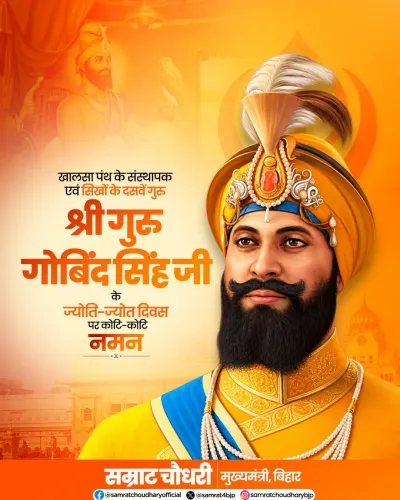
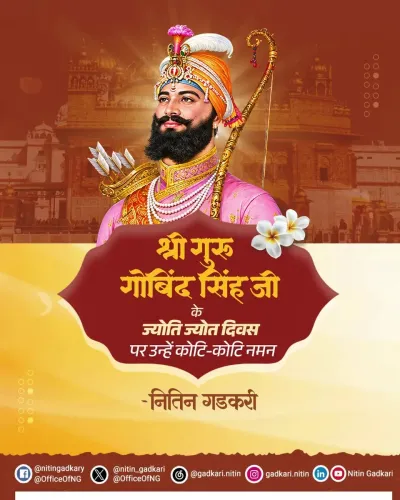
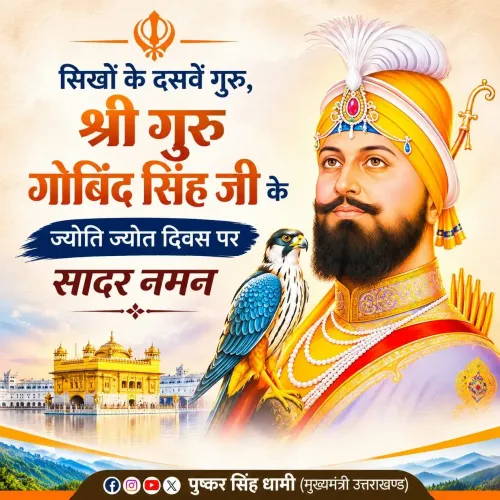
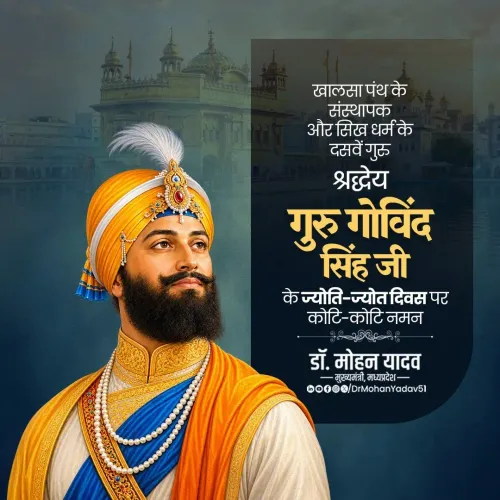
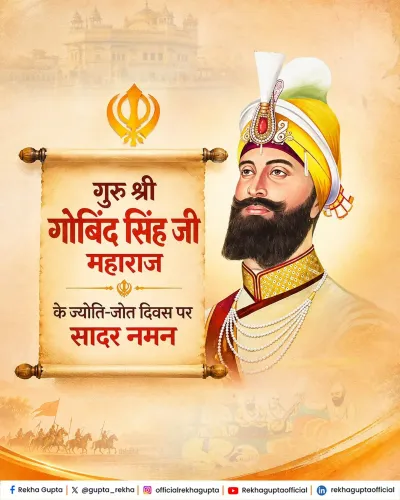
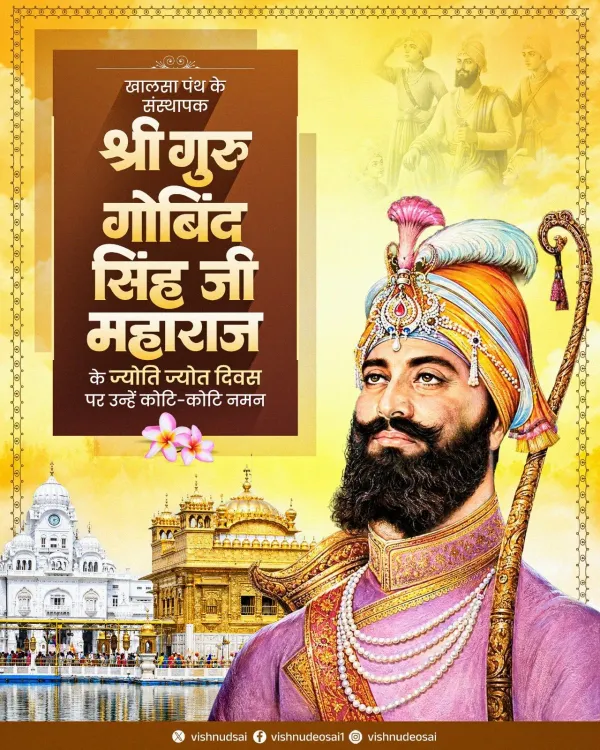
CM Vishnu Deo Sai pays tribute on Guru Gobind Singh's Jyoti Jyot Divas
Synopsis
Chhattisgarh Chief Minister Vishnu Deo Sai paid reverent tribute to Guru Gobind Singh Ji on Jyoti Jyot Divas, honouring the tenth Sikh Guru and Khalsa Panth founder's lifelong devotion to truth, service, and the protection of dharma and humanity.
Key Takeaways
CM Vishnu Deo Sai posted his tribute on 14 November 2026 , Guru Gobind Singh Ji's Jyoti Jyot Divas.
Guru Gobind Singh Ji was the tenth Sikh Guru and founded the Khalsa Panth in 1699 .
CM Sai offered ' koti-koti naman ' — salutations of infinite reverence — to the Guru.
The tribute highlighted three core values: Sat (truth), Seva (service) and Tyag (sacrifice) .
Jyoti Jyot Divas commemorates the Guru's passing and is observed with prayers and kirtan across gurdwaras worldwide.
On the solemn occasion of Guru Gobind Singh Ji's Jyoti Jyot Divas — the day marking the passing of Sikhism's tenth and final human Guru — Chhattisgarh Chief Minister Vishnu Deo Sai offered his reverence to the warrior-saint whose life continues to inspire millions across India and the world.
Posting on Saturday, 14 November 2026, CM Sai wrote in Hindi: 'कोटि-कोटि नमन' — a salutation of infinite reverence — to the founder of the Khalsa Panth, saying his courageous life dedicated to the protection of dharma and humanity 'inspires all of us to walk the path of truth, service and sacrifice.'
Who was Guru Gobind Singh — and why this day matters
Guru Gobind Singh Ji, the tenth Sikh Guru, is one of the most towering figures in Indian religious and martial history. In 1699, he established the Khalsa Panth — the initiated community of baptised Sikhs — an act that transformed a spiritual movement into a brotherhood bound by principles of courage, equality and selfless service.
His legacy is inseparable from sacrifice: he lost his father, Guru Tegh Bahadur Ji, to Mughal persecution, and all four of his sons gave their lives in defence of faith and community. Jyoti Jyot Divas — literally 'merging of the light' — marks the day he departed this world, observed each year with prayers, kirtan and community remembrance across gurdwaras everywhere.
A tribute rooted in the values of the Khalsa
CM Sai's message distils three values the Guru embodied: Sat (truth), Seva (service) and Tyag (sacrifice). These are not abstract virtues in the Sikh tradition — they were lived out on battlefields and in langar halls alike, shaping a community that has contributed enormously to India's national fabric.
Indian political leaders across the spectrum regularly mark Sikh Gurpurabs and commemorative dates as part of broad community outreach. For Chhattisgarh, a state in central India with a Sikh community among its diverse population, such observances carry both cultural and civic meaning.
The Guru's teaching — that true courage serves humanity, not personal power — remains as urgent a message today as it was three centuries ago.
Point of View
Service and sacrifice — echoes language frequently used by the ruling party to frame governance as a continuation of historical ideals. While the message is ceremonial in nature, its resonance with Sikh voters and diaspora networks gives such gestures a soft political currency that extends well beyond any single state boundary.
NationPress
14 Nov 2026
Frequently Asked Questions
What is Jyoti Jyot Divas of Guru Gobind Singh Ji?
Jyoti Jyot Divas marks the day Guru Gobind Singh Ji, the tenth Sikh Guru, departed this world. The phrase means 'merging of the light' and the occasion is observed with prayers, kirtan and remembrance at gurdwaras across India and globally.
Who founded the Khalsa Panth?
Guru Gobind Singh Ji founded the Khalsa Panth in 1699. It is the initiated community of baptised Sikhs, bound by principles of courage, equality and selfless service to humanity.
What did CM Vishnu Deo Sai say on Guru Gobind Singh's Jyoti Jyot Divas?
CM Vishnu Deo Sai offered 'koti-koti naman' — salutations of infinite reverence — to Guru Gobind Singh Ji, saying his life dedicated to the protection of dharma and humanity inspires everyone to walk the path of truth, service and sacrifice.
What is the significance of Guru Gobind Singh Ji in Sikh history?
Guru Gobind Singh Ji is the tenth and final human Sikh Guru. He founded the Khalsa Panth, championed religious freedom and embodied extraordinary personal sacrifice — losing his father and all four sons in defence of faith and community.
Why do Indian political leaders pay tribute to Sikh Gurus?
Indian political leaders across parties regularly mark Sikh Gurpurabs and commemorative dates as part of broad community outreach, recognising the profound contribution of the Sikh community to India's cultural, social and national life.