CM Vishnu Deo Sai Pays Tribute to Sri Aurobindo on Birth Anniversary
Synopsis
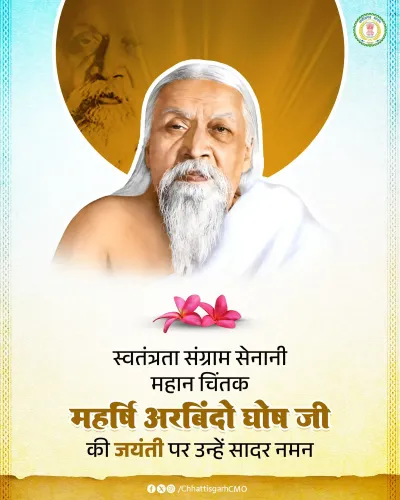
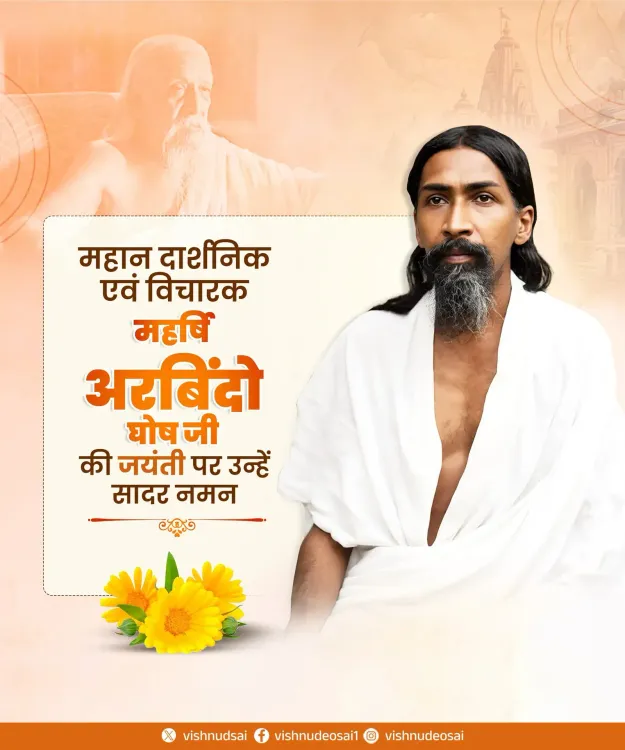
On 15 August 2026, Chhattisgarh Chief Minister Vishnu Deo Sai paid tribute to Sri Aurobindo Ghosh on his birth anniversary, honouring the philosopher-yogi's contributions to India's freedom struggle and spiritual thought.
Key Takeaways
Chhattisgarh CM Vishnu Deo Sai posted a tribute to Sri Aurobindo Ghosh on 15 August 2026 , his birth anniversary.
Sri Aurobindo was born on 15 August 1872 — the same date as India's independence in 1947, giving the day a dual national significance.
CM Sai's Hindi post honoured Aurobindo's dedication to India's freedom and his spiritual-philosophical legacy.
Aurobindo moved from revolutionary nationalism to founding the philosophy of Integral Yoga at his ashram in Pondicherry .
Tributes to Aurobindo on Independence Day are an annual ritual across Indian political leadership.
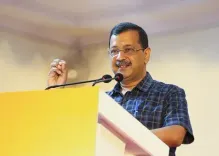
Born on the very day India won its freedom, Sri Aurobindo Ghosh carries a symbolic weight that no other figure in the nationalist canon quite matches — a revolutionary who traded the barricades for the inner life, and in doing so, shaped both India's independence movement and its spiritual imagination. On 15 August 2026, Chhattisgarh Chief Minister Vishnu Deo Sai joined the national chorus of remembrance, offering a respectful tribute to the philosopher-yogi on his birth anniversary.
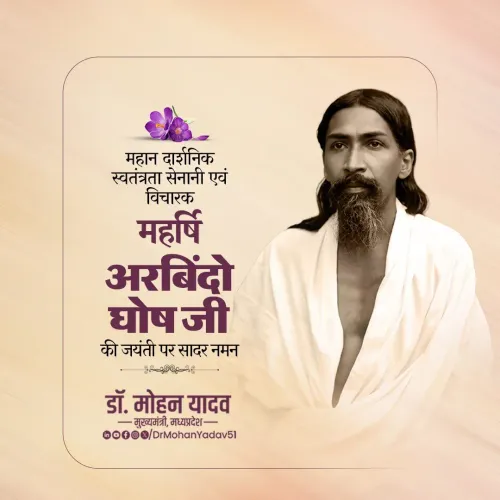
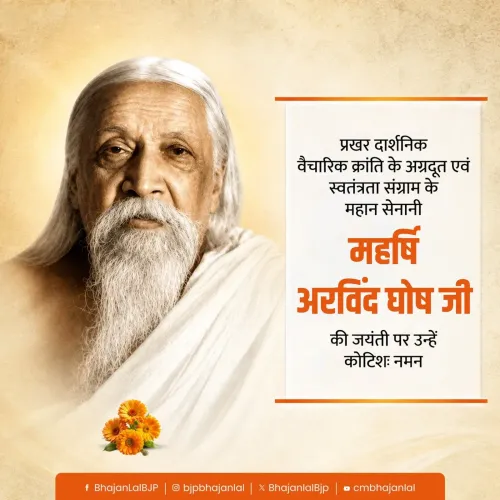
Posting in Hindi, CM Sai wrote: 'मां भारती की स्वतंत्रता और मानव कल्याण के लिए अपना जीवन समर्पित करने वाले महान दार्शनिक एवं विचारक महर्षि अरबिंदो घोष जी की जयंती पर उन्हें सादर नमन।' — 'Respectful salutations to the great philosopher and thinker Maharshi Aurobindo Ghosh, who dedicated his life to the freedom of Mother India and the welfare of humanity, on his birth anniversary.' He added that Aurobindo's thoughts, national vision, and spiritual perspective 'will always guide the people of this country.'
A Revolutionary Who Chose the Ashram Over the Armoury
Sri Aurobindo Ghosh, born 15 August 1872 in Calcutta, was among the most electric voices of early Indian nationalism. Educated at Cambridge, he returned to India and threw himself into the independence movement — writing incendiary prose, editing nationalist journals, and becoming a central figure in Bengal's anti-partition agitation of 1905. Arrested by British authorities and tried in the Alipore Bomb Case, his acquittal in 1909 became a landmark moment in colonial India's legal and political history. Then came the pivot that defined his legacy. Aurobindo withdrew from active politics and settled in Pondicherry, where he spent the rest of his life developing the philosophy of Integral Yoga — a synthesis of spiritual evolution and worldly engagement that drew seekers from across the globe. The Sri Aurobindo Ashram, founded there, endures as a living institution.Why 15 August Carries a Double Resonance
The date is not coincidence — it is convergence. That India chose to declare independence on 15 August 1947, the same date as Aurobindo's birth, has long been read by his followers as a profound alignment. In a radio address that evening, Aurobindo himself acknowledged the 'coincidence' and framed it as a spiritual signal. Every Independence Day therefore doubles as his birth anniversary, making tributes from political leaders a near-universal ritual across party lines. CM Sai's message fits that broader pattern — one shared by state and central leaders each year — but it also reflects the BJP's consistent effort to foreground figures who weave together nationalism and Hindu philosophical thought, a lineage in which Aurobindo occupies a singular place.Point of View
Making him a figure the party can claim across both registers. CM Sai's tribute, arriving from a state where tribal identity and cultural nationalism intersect in complex ways, underscores the party's broader project of anchoring its governance narrative in India's civilisational heritage. As Independence Day messaging grows more competitive across the political spectrum, the choice of which historical figures to foreground signals where a leader's ideological centre of gravity lies.
NationPress
15 Aug 2026
Frequently Asked Questions
When is Sri Aurobindo's birth anniversary?
Sri Aurobindo Ghosh was born on 15 August 1872 , which coincides with India's Independence Day, making annual tributes a dual celebration of the nation and the philosopher.
Why did Chhattisgarh CM Vishnu Deo Sai post about Sri Aurobindo?
CM Vishnu Deo Sai posted a tribute on 15 August 2026 to mark Sri Aurobindo's birth anniversary, honouring his role in India's freedom movement and his lasting spiritual and philosophical influence.
What is Sri Aurobindo's contribution to India?
Sri Aurobindo was a key figure in early Indian nationalism and later developed the philosophy of Integral Yoga in Pondicherry, blending spiritual evolution with human progress — a legacy that continues to influence Indian thought.
What is Integral Yoga associated with Sri Aurobindo?
Integral Yoga is the spiritual philosophy developed by Sri Aurobindo at his ashram in Pondicherry , which seeks a synthesis of inner spiritual development and active engagement with the world, rather than renunciation.
Why do Indian politicians tribute Sri Aurobindo on Independence Day?
Because Sri Aurobindo was born on 15 August 1872 — the same date India gained independence in 1947 — leaders across parties use Independence Day to simultaneously honour the nation and the philosopher-yogi's legacy.