Kejriwal on Independence Day: Children now fight for school rights
Synopsis
On Independence Day, Arvind Kejriwal reframed student protests over broken schools, absent teachers, and missing toilets as the truest expression of freedom — arguing that 75–80 years after Independence, children demanding basics from the state is not a failure to mourn but a civic awakening to celebrate. It is also, unmistakably, an AAP political pitch.
Key Takeaways
Arvind Kejriwal used his Independence Day message on 15 August to highlight student-led protests over government school conditions across India.
He cited protests in Hamirpur , Dehradun , and Barmer over missing roads, basic rights, and absent teachers respectively.
Kejriwal said government schools remain in poor condition 75–80 years after Independence, with broken walls, leaking roofs, no toilets, and no drinking water in many institutions.
AAP governments in Delhi and Punjab were cited as models of school reform, with students now clearing NEET and JEE .
Kejriwal called children demanding basic facilities the truest expression of 'true freedom,' framing the protests as a Gen Alpha civic awakening.
Aam Aadmi Party (AAP) national convenor Arvind Kejriwal on 15 August said children across India were increasingly demanding basic facilities in government schools — including desks, clean drinking water, toilets, and teachers — and described this as a reflection of 'true freedom' on Independence Day.
What Kejriwal Said
In an Independence Day post on X, Kejriwal called this year's August 15 'even more special,' noting that after Gen Z, it was now Gen Alpha taking up the cause of school reform. 'Our children have learnt to fight for their rights. That's what true freedom is,' he wrote, extending Independence Day wishes to his followers.
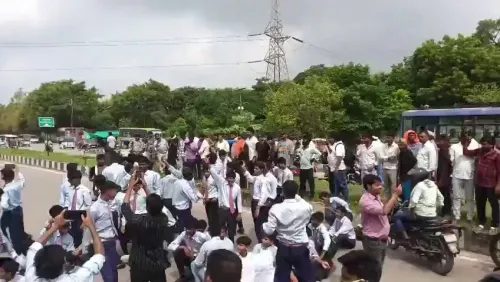
In an accompanying video message, Kejriwal cited specific instances of student-led protests across states. He pointed to children in Hamirpur protesting for a road in front of their school, students in Dehradun agitating for basic rights, and pupils in Barmer, Rajasthan demanding teachers. 'In Barmer, children are saying, give us teachers. There are no teachers there,' he said.
The State of Government Schools
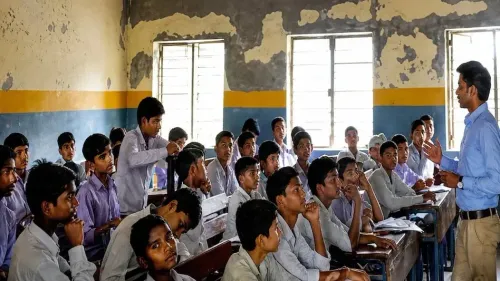
Kejriwal questioned the condition of government schools 75–80 years after Independence, arguing that children from economically weaker families — who depend on government schools — continue to face serious infrastructure deficits. 'Government schools are broken, walls are broken, roofs are falling. When it rains, water fills the classroom,' he said.
He further alleged that many government schools lack toilets, drinking water, teachers, and functional classrooms. 'There are no toilets, there is no drinking water. There are no teachers, there is no education. Children have no future,' he added, urging citizens not to normalise such conditions.
AAP's Record Cited
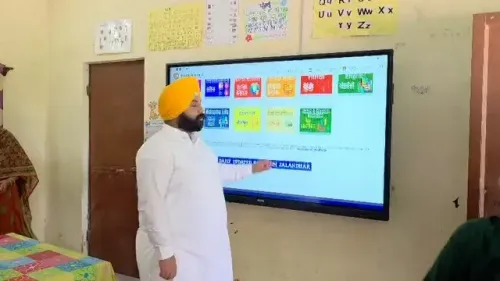
Kejriwal cited Delhi and Punjab — both states where AAP has governed — as examples of what he described as successful school transformation. He claimed that under AAP governance, government school students in both states had begun appearing for competitive examinations such as NEET and JEE and pursuing careers in engineering and medicine.
'When Aam Aadmi Party was the government in Delhi, we made government schools great in Delhi. Our government is in Punjab now. We have made schools great in Punjab,' he said, urging people to visit schools in both states to verify the change.
Broader Context
Kejriwal's remarks come as AAP attempts to rebuild its national profile following electoral setbacks, with education remaining a central pillar of the party's political identity. His Independence Day message — framing student protests as a civic awakening — also arrives amid wider public debate over the quality and funding of government school infrastructure across several Indian states. Notably, this is not the first time Kejriwal has used Independence Day to spotlight the education issue; the party has consistently positioned school reform as its defining governance legacy.
Whether the renewed spotlight on student-led protests translates into policy pressure on state governments beyond Delhi and Punjab remains to be seen.
Point of View
' he converts a governance failure — crumbling school infrastructure after eight decades — into a moral rallying cry. But the argument cuts both ways. AAP governed Delhi for a decade; if government schools elsewhere are still broken, the party's school-reform story is an argument for expansion, not an absolution of the broader system it has been part of. The references to Hamirpur, Barmer, and Dehradun — all in states governed by rival parties — make the political targeting explicit. What is missing from the message is any accountability framework: who is responsible, what specific policy changes are demanded, and how citizens can verify progress beyond a visit to AAP-governed states.
NationPress
30 Sept 2026
Frequently Asked Questions
What did Arvind Kejriwal say on Independence Day 2025?
Kejriwal said children across India demanding basic school facilities — desks, clean water, toilets, and teachers — represented 'true freedom' on Independence Day. He made the remarks in an X post and a video message on 15 August, citing student protests in Hamirpur, Dehradun, and Barmer as examples of a growing civic awakening among Gen Alpha.
Which states did Kejriwal highlight for student protests over school conditions?
Kejriwal cited protests in Hamirpur, where children demanded a road in front of their school; Dehradun in Uttarakhand, where students were fighting for basic rights; and Barmer in Rajasthan, where pupils were demanding teachers. All three are in states not governed by AAP.
What is AAP's claim about government schools in Delhi and Punjab?
Kejriwal claimed that under AAP governance, government schools in Delhi and Punjab were significantly improved, with students now appearing for NEET and JEE and pursuing professional careers. He urged citizens to visit schools in both states to see the change firsthand.
Why does Kejriwal say government school conditions matter for poor families?
Kejriwal argued that children from economically weaker families rely exclusively on government schools and are therefore most affected by poor infrastructure. He described conditions in many such schools as broken walls, leaking roofs, absent teachers, and no toilets or drinking water.
What is the significance of Kejriwal invoking Gen Alpha in his Independence Day message?
By invoking Gen Alpha — the generation born after 2010 — Kejriwal was signalling that the demand for school reform has moved beyond youth activism (Gen Z) to even younger children. The framing positions grassroots student protests as a natural continuation of civic consciousness, and reinforces AAP's long-standing focus on education as its core political identity.