White House Announces Operation TorNado, Largest Dark Web Drug Crackdown
Synopsis
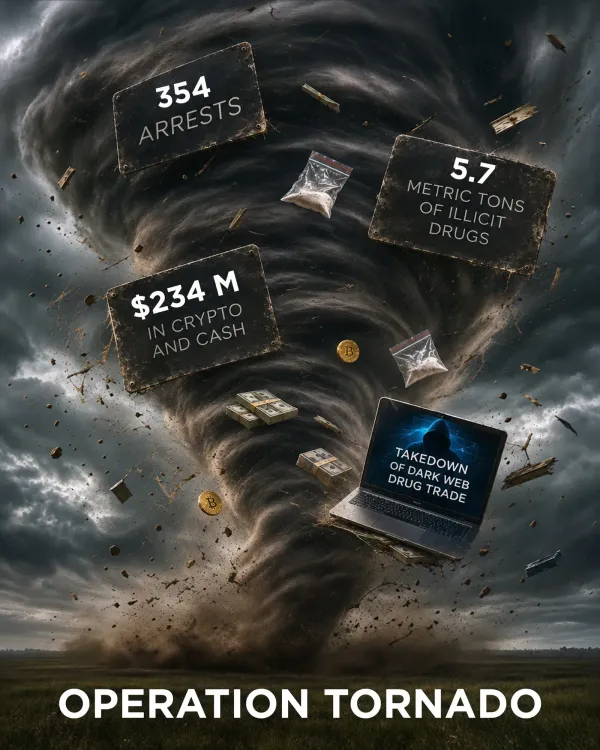
The White House has announced Operation TorNado as the largest-ever interagency crackdown on dark web drug vendors and buyers, warning that anonymising technology cannot shield criminals from justice. The operation follows a decade-long pattern of U.S. enforcement actions against encrypted online drug markets.
Key Takeaways
Operation TorNado has been declared the largest interagency dark web drug enforcement operation in U.S. history.
The crackdown targets both vendors and buyers on dark web platforms, going beyond simply shutting down marketplaces.
The operation targets users of the Tor network , which anonymises online activity and underpins most dark web commerce.
Prior landmark operations include the 2013 Silk Road seizure and the 2017 AlphaBay takedown, both of which involved the DEA, FBI, and DOJ.
Cryptocurrency tracing and international law-enforcement partnerships are central tools in operations of this type.
Charging documents, asset-seizure records, and congressional briefings are expected to follow the public announcement.
Justice has found its way into the darkest corners of the internet. The White House announced Operation TorNado on Sunday, November 15, 2026, declaring it the largest interagency crackdown on dark web drug vendors and buyers ever conducted by U.S. federal authorities — a direct warning to those who believed anonymity was armour.
The official White House post put it plainly: 'You can't hide behind technology, justice will find you.' The statement signals an operation sweeping in scale, involving multiple federal agencies coordinating to identify, track, and prosecute individuals who used encrypted, anonymised networks to traffic narcotics outside the reach of conventional law enforcement.
What Makes Operation TorNado Different From Past Dark Web Busts
The dark web's drug economy has been a persistent target of U.S. enforcement for over a decade. The 2013 shutdown of Silk Road — the original dark web bazaar — was a landmark moment, followed by the 2017 takedown of AlphaBay, then among the largest illegal online marketplaces in existence. Each operation exposed the same uncomfortable truth: dismantling one marketplace simply displaced buyers and sellers to the next hidden platform.
Operation TorNado, as described by the White House, positions itself as a step beyond those predecessors — not just shuttering a marketplace, but targeting vendors and buyers directly, suggesting an intelligence-driven approach that follows individuals rather than merely infrastructure. The name itself references Tor, the anonymising network that underpins most dark web activity, signalling that investigators have developed capabilities to pierce its protections.
The Agencies, the Tools, and the Method
Operations of this type have historically drawn on the combined firepower of the Drug Enforcement Administration (DEA), the Federal Bureau of Investigation (FBI), and the Department of Justice (DOJ), often supplemented by international partners and specialist cryptocurrency-tracing units. Blockchain forensics firms have become central to these efforts — following the money through Bitcoin and other digital currencies to strip away the anonymity that dark web users rely on.
The involvement of multiple agencies — the 'interagency' framing the White House chose deliberately — points to a coordinated operation with legal scaffolding already in place: warrants, charging documents, and likely international extradition arrangements built in advance of the public announcement.
What Follows the Announcement
Past operations of this scale have been followed by waves of public charging documents, asset-seizure disclosures, and congressional briefings laying out the full scope of arrests and confiscated proceeds. Those documents, when released, will reveal the true scale of Operation TorNado — the number of defendants, the jurisdictions covered, and the volume of narcotics and cryptocurrency seized.
For now, the White House has drawn the line in unambiguous terms: the size of the operation signals that the U.S. government views the dark web drug trade not as an unsolvable technical problem, but as a law-enforcement challenge it believes it can win — one indictment at a time.
Point of View
Interagency enforcement actions to signal that encrypted networks are not beyond the reach of the law — as much a deterrence exercise as a policing one. The deliberate White House-level announcement, rather than a quiet DOJ press release, suggests the administration wants maximum public visibility: a warning to would-be dark web participants and a domestic political statement on law-and-order. What sets this operation apart rhetorically is the explicit targeting of buyers alongside vendors, which could indicate a broader 'demand-side' enforcement shift. The real measure of success will come in the charging documents — the number of defendants and the geographic spread will determine whether TorNado marks a genuine inflection point or follows the familiar pattern of disruption without lasting dismantlement.
NationPress
15 Nov 2026
Frequently Asked Questions
What is Operation TorNado?
Operation TorNado is a U.S. interagency law enforcement operation announced by the White House in November 2026, described as the largest-ever crackdown on dark web drug vendors and buyers. It targets individuals who used the Tor anonymising network to traffic narcotics.
What is the dark web and how is it used for drug trafficking?
The dark web refers to encrypted, anonymised online networks — primarily Tor — that are not accessible through standard browsers. Drug traffickers use these platforms to buy and sell narcotics while concealing their identities and locations from law enforcement.
Which U.S. agencies are typically involved in dark web drug busts?
Operations against dark web drug markets have historically involved the Drug Enforcement Administration (DEA), the Federal Bureau of Investigation (FBI), and the Department of Justice (DOJ), along with cryptocurrency-tracing specialists and international law-enforcement partners.
What were previous major U.S. dark web drug operations?
The two most prominent predecessors were the 2013 shutdown of Silk Road and the 2017 takedown of AlphaBay, both of which were among the largest illegal online drug marketplaces at the time of their dismantlement.
How do investigators trace criminals on the dark web?
Federal investigators typically combine blockchain forensics to trace cryptocurrency payments, undercover online operations, and international cooperation with foreign law-enforcement agencies to identify and locate dark web drug traders.