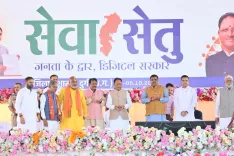
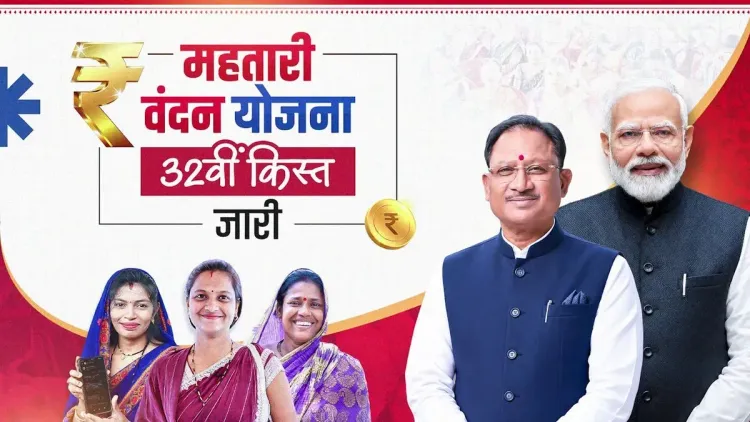
CM Vishnu Deo Sai releases 32nd Mahtari Vandan instalment
Synopsis
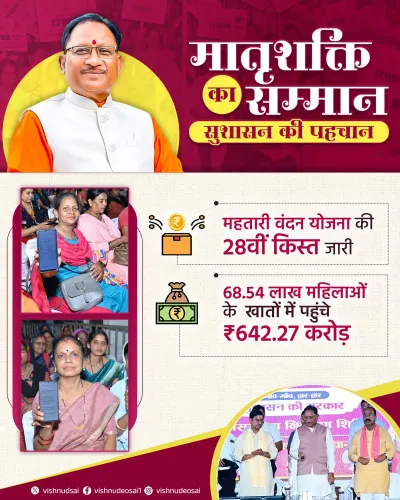
Chhattisgarh CM Vishnu Deo Sai transferred ₹632 crore to over 67 lakh women on 8 October 2026 as the 32nd Mahtari Vandan Yojana instalment, pushing cumulative payouts past ₹20,708 crore — timed just before Navratri.
Key Takeaways
₹632 crore transferred on 8 October 2026 as the 32nd monthly instalment of Mahtari Vandan Yojana.
Over 67 lakh women in Chhattisgarh received funds directly into their bank accounts.
Cumulative disbursement under the scheme has crossed ₹20,708 crore since its inception.
Transfer was made before Navratri , ensuring festival-period liquidity for beneficiary households.
CM Sai framed the scheme as advancing women's self-respect and self-reliance .
Thirty-two consecutive uninterrupted instalments highlight the state's consistent delivery infrastructure.
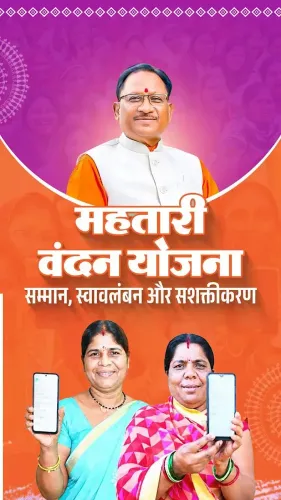
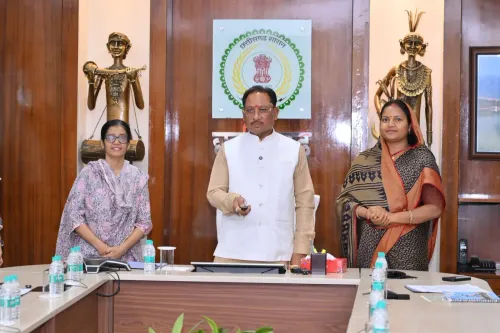
Just ahead of Navratri, Chhattisgarh Chief Minister Vishnu Deo Sai transferred more than ₹632 crore directly into the bank accounts of over 67 lakh women across the state on Thursday, 8 October 2026 — marking the 32nd consecutive monthly instalment of the Mahtari Vandan Yojana, the flagship direct-benefit scheme for mothers and sisters in Chhattisgarh.
₹20,708 crore and counting — what Mahtari Vandan has delivered
The cumulative transfer under Mahtari Vandan Yojana has now crossed ₹20,708 crore since the scheme's launch. That is a striking headline figure: more than twenty thousand crore rupees channelled directly to women's bank accounts, bypassing intermediaries, in under three years. CM Sai described the disbursement as a reaffirmation of the government's resolve — 'मातृशक्ति का सम्मान और सशक्तीकरण हमारी सरकार का संकल्प है' ('Respecting and empowering the power of mothers is the commitment of our government').
The scheme provides a fixed monthly cash transfer to eligible women, placing recurring income in their hands and reducing dependence on seasonal or agricultural cycles. With 67 lakh-plus beneficiaries receiving funds this month, the programme ranks among the largest women-focused direct-benefit transfers running at the state level in India.
The Navratri timing — deliberate and symbolic
The transfer was made before the auspicious festival of Navratri, a nine-day celebration centred on the worship of the goddess Durga — a timing the Chief Minister highlighted explicitly. Releasing funds immediately before a major festival is a well-understood policy choice: households gain liquidity precisely when expenditure on food, clothing, and worship peaks. For millions of women who manage household budgets, the extra cushion is concrete, not ceremonial.
Economic autonomy as the stated goal
CM Sai framed the transfer in terms of aatm-samman (self-respect) and aatm-nirbharta (self-reliance) — language that places the scheme within the broader national vocabulary of women's financial inclusion. Direct benefit transfers to women have been shown, across multiple Indian state programmes, to improve their bargaining power within households and increase their likelihood of opening and independently operating bank accounts.
Thirty-two uninterrupted monthly instalments is itself a governance signal: it points to a disbursement infrastructure that has been maintained without publicly reported breaks, a bar that several state schemes have struggled to clear. Whether the programme's design and targeting remain optimal is a separate question — but the consistency of delivery is the immediate political fact the government is underscoring today.
For the women of Chhattisgarh, the thirty-third instalment is already on the horizon — and the cumulative counter keeps climbing.
Point of View
708 crore across 32 months, the BJP government in Chhattisgarh is building a dense electoral record of consistent delivery — a counter-narrative to perceptions of governance gaps in the Hindi-belt state. The pre-festival disbursement timing is a studied move: it converts a routine instalment into a moment of visible relief, embedding the scheme in the cultural calendar. Analysts watching Chhattisgarh will note that sustaining 67-lakh-scale direct transfers without public disruption is a non-trivial administrative achievement — one the ruling party will almost certainly centre in the next electoral cycle.
NationPress
8 Oct 2026
Frequently Asked Questions
What is Mahtari Vandan Yojana in Chhattisgarh?
Mahtari Vandan Yojana is a Chhattisgarh government scheme that provides monthly financial assistance directly into the bank accounts of eligible women — mothers and sisters — in the state, aimed at improving their economic independence and self-reliance.
How much has been transferred under Mahtari Vandan Yojana so far?
As of the 32nd instalment on 8 October 2026, the cumulative amount transferred under the scheme has exceeded ₹20,708 crore since its launch.
How many women benefit from Mahtari Vandan Yojana?
Over 67 lakh (6.7 million) women in Chhattisgarh received the 32nd instalment, indicating this is the approximate active beneficiary base of the scheme.
How much was transferred in the 32nd Mahtari Vandan instalment?
₹632 crore was transferred in the 32nd instalment of Mahtari Vandan Yojana on 8 October 2026, just ahead of the Navratri festival.
Who announced the 32nd instalment of Mahtari Vandan Yojana?
Chhattisgarh Chief Minister Vishnu Deo Sai announced and released the 32nd instalment on 8 October 2026, highlighting the scheme's goal of honouring and empowering women.