CM Vishnu Deo Sai Vows Village-Level Growth Rooted in Guru Ghasidas
Synopsis
Chhattisgarh CM Vishnu Deo Sai pledged village-by-village development and social harmony on 22 October 2026, anchoring his governance vision in the equality teachings of 18th-century Satnami founder Baba Guru Ghasidas.
Key Takeaways
CM Vishnu Deo Sai invoked the teaching 'Mankhe-Mankhe Ek Samaan' of saint Baba Guru Ghasidas to frame his government's development agenda.
The government's stated three-pillar resolve covers social harmony, public welfare, and holistic development.
Guru Ghasidas , an 18th–19th century saint, founded the Satnami movement in Chhattisgarh, which preached absolute equality across caste lines.
CM Sai, in office since December 2023 , explicitly targets village-level delivery and equal opportunity for every citizen.
The messaging aligns with the BJP's national Sabka Saath, Sabka Vikas framework while drawing on distinctly local spiritual heritage.
The Satnami community's political and social significance in Chhattisgarh gives the invocation both cultural and electoral weight.
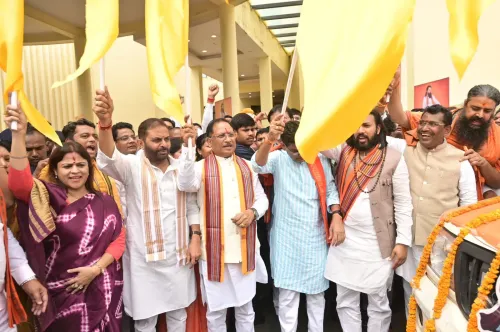
A saint's 200-year-old call for human equality — 'Mankhe-Mankhe Ek Samaan' (all human beings are equal) — is now the declared compass of Chhattisgarh's government. Chhattisgarh Chief Minister Vishnu Deo Sai invoked the teaching of Sant Shiromani Baba Guru Ghasidas on Thursday, 22 October 2026, pledging to carry the state's development to every village and dignity to every citizen.
Guru Ghasidas's message becomes a governance pledge
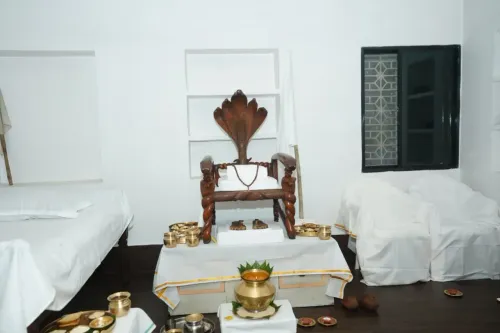
In his post, CM Sai wrote that his government, internalising the sacred message of Guru Ghasidas, is advancing steadily with a resolve for samajik samarasata, jankalyan aur samagra vikas — social harmony, public welfare, and holistic development. The invocation is deliberate: Baba Guru Ghasidas, born in the late 18th century in present-day Chhattisgarh, founded the Satnami movement, which challenged caste hierarchy and preached the absolute equality of all human beings. His legacy commands deep reverence across the state, particularly among Scheduled Caste communities.
By anchoring governance language in this spiritual tradition, the BJP government is signalling both cultural rootedness and social intent — a calculated blend of local identity and inclusion-centred administration.
The village as the unit of Chhattisgarh's development push
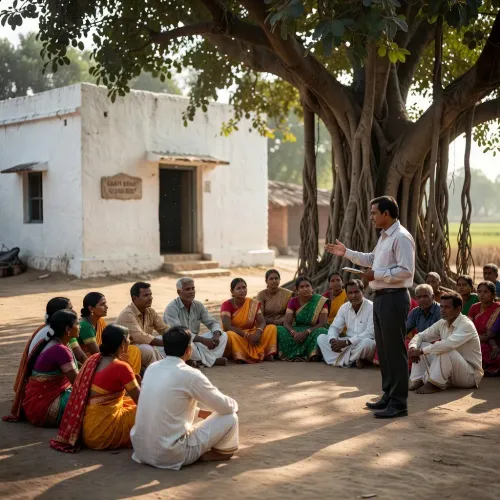
The Chief Minister's stated resolve is unambiguous: 'Let the stream of development reach every village, let happiness enter every family, and let every citizen of Chhattisgarh move forward with dignity, equal opportunity, and better facilities.' The emphasis on gaon-gaon — village by village — places rural outreach at the centre of his government's agenda.
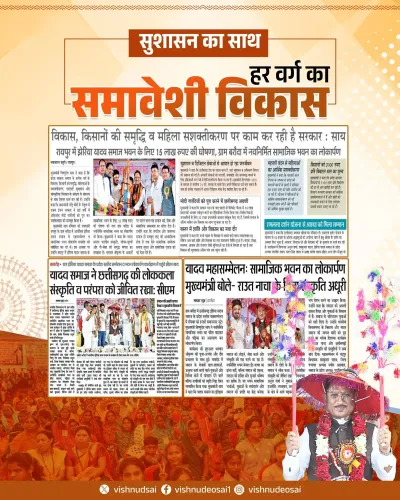
Chhattisgarh, a state where agriculture and forest-based livelihoods dominate, has historically seen uneven infrastructure reach. Vishnu Deo Sai, who took office in December 2023 after the BJP's return to power, has framed rural delivery and social equity as the twin pillars of what his administration calls 'Sushasan Sarkar' — good governance. The framing mirrors the national BJP's Sabka Saath, Sabka Vikas framework, but is grounded here in distinctly Chhattisgarhi spiritual vocabulary.
Why the Satnami tradition carries political weight
The Satnami community constitutes a significant share of Chhattisgarh's population and has historically shaped the state's social and political landscape. Invoking Guru Ghasidas is not merely rhetorical — it speaks directly to communities who see his teachings as a continuing claim to dignity and equality. For a BJP government seeking to consolidate its social coalition in a state with a large tribal and Dalit electorate, the message carries both cultural sincerity and political resonance. The watch now is on whether welfare schemes and rural infrastructure rollouts match the ambition of the words.
Point of View
CM Sai is pursuing a form of cultural legitimacy that top-down policy alone cannot buy. The Satnami movement's historical claim to dignity and equality maps neatly onto the BJP's inclusion narrative — but it also raises the stakes: invoking Guru Ghasidas creates a moral benchmark against which rural welfare delivery will be measured. If village-level infrastructure and welfare rollouts lag, the spiritual reference risks becoming a political liability. The broader pattern here is a state BJP attempting to own both development and identity — a dual bet that has defined the party's Chhattisgarh playbook since it returned to power.
NationPress
22 Oct 2026
Frequently Asked Questions
Who is Baba Guru Ghasidas and why is he significant in Chhattisgarh?
Baba Guru Ghasidas was an 18th–19th century saint from Chhattisgarh who founded the Satnami movement, which preached social equality and challenged caste discrimination. He is one of the most revered spiritual figures in the state, with a large following especially among Scheduled Caste communities.
What does 'Mankhe-Mankhe Ek Samaan' mean?
'Mankhe-Mankhe Ek Samaan' is a Chhattisgarhi phrase meaning 'all human beings are equal.' It is one of the central teachings of Baba Guru Ghasidas and is widely quoted in the context of social harmony and anti-discrimination movements in the region.
When did Vishnu Deo Sai become Chief Minister of Chhattisgarh?
Vishnu Deo Sai became Chief Minister of Chhattisgarh in December 2023 after the BJP won the state assembly elections.
What is the Satnami movement?
The Satnami movement is a socio-religious reform movement founded by Baba Guru Ghasidas in Chhattisgarh in the early 19th century. It emphasised equality of all human beings, rejected idol worship, and stood against caste-based discrimination, drawing a large following from marginalised communities.
What is Chhattisgarh government's Sushasan Sarkar agenda?
Sushasan Sarkar, meaning 'good governance government,' is the term the Vishnu Deo Sai-led BJP administration in Chhattisgarh uses to describe its governance model, which centres on rural development, welfare delivery, social harmony, and equal opportunity for all citizens.