CM Mohan Yadav Launches Free Property Title Scheme for 48 Lakh Rural Families

Synopsis
Madhya Pradesh Chief Minister Dr. Mohan Yadav has announced the Swamitva Adhikar Abhilekh Nishpadan evam Panjeeyan Yojana-2026, a state scheme to provide free legal property ownership documents to over 48 lakh rural households, waiving all stamp duty and registration fees.
Key Takeaways
Over 48 lakh rural property holders in Madhya Pradesh will receive legal ownership documents under the new scheme.
The Swamitva Adhikar Abhilekh Nishpadan evam Panjeeyan Yojana-2026 waives all stamp duty and registration fees for beneficiaries.
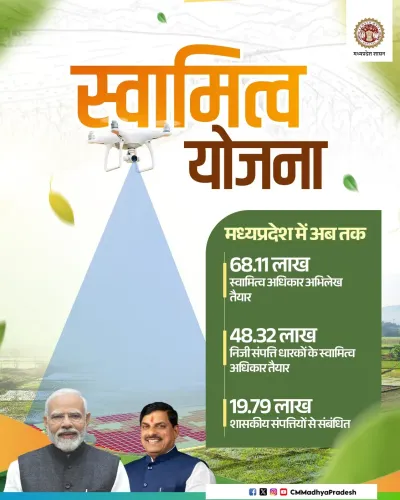
The scheme builds on the central government's SVAMITVA Scheme (2020) , which uses drone surveys to map rural land.
Madhya Pradesh has participated in the Digital India Land Records Modernization Programme since the early 2010s, providing a digitised foundation for this initiative.
Formalised title documents are expected to improve rural households' access to institutional credit and government welfare schemes .
The announcement was made by CM Dr.
Mohan Yadav on June 7, 2026, under the hashtag #ViksitMadhyaPradesh .
Madhya Pradesh Chief Minister Dr. Mohan Yadav on Sunday, June 7, 2026, announced a state scheme to grant legal property ownership to over 48 lakh rural property holders across Madhya Pradesh, with no stamp duty or registration fees charged to beneficiaries.
Posting on X under the tagline 'सुरक्षित अधिकार, सशक्त नागरिक, समृद्ध मध्यप्रदेश' ('Secure rights, empowered citizens, prosperous Madhya Pradesh'), the Chief Minister said the Swamitva Adhikar Abhilekh Nishpadan evam Panjeeyan Yojana-2026 would deliver legally recognised ownership documents to rural residents — entirely free of cost.
Context
Rural property rights have long been a contested space in Madhya Pradesh, where a large share of the population lives in villages and a significant portion of land parcels lack formal legal documentation. Without registered title deeds, rural households face barriers to accessing bank credit, government welfare schemes, and legal recourse in property disputes.
The 2026 scheme directly addresses this gap by converting de-facto occupancy into de-jure ownership through formal document execution and registration — at zero cost to the beneficiary.
Policy Backdrop
The announcement builds on the SVAMITVA Scheme, a Government of India programme launched in 2020 that uses drone surveys to map rural abadi (residential) land and issue property cards to households. Madhya Pradesh has been a participant state in that programme.
The state has also been part of the Digital India Land Records Modernization Programme since the early 2010s, which digitised village maps and revenue records to reduce litigation. The Swamitva Adhikar Abhilekh Nishpadan evam Panjeeyan Yojana-2026 appears to take the next step: converting digitised records into registered, legally enforceable title documents.
The move aligns with the broader Viksit Bharat 2047 framework, which positions formalised property rights as a pillar of citizen empowerment and rural economic inclusion.
Stakeholders and Impact
The primary beneficiaries are over 48 lakh rural property holders in Madhya Pradesh who currently lack registered ownership documents. Village panchayats are expected to play a frontline role in identifying eligible households and facilitating the documentation process.
By waiving stamp duty and registration fees — costs that have historically deterred low-income rural families from formalising ownership — the scheme lowers the single biggest procedural barrier to legal title. Formalised ownership typically unlocks access to institutional credit, crop insurance, and direct benefit transfers linked to land records.
What's Next
The scheme is titled with a 2026 year designation, suggesting a defined implementation window. Details on the technology platform, the role of revenue officials, and integration with central land record portals are yet to be publicly specified.
Budget allocations, district-level rollout timelines, and any convergence with the central SVAMITVA infrastructure will be closely watched as the scheme moves from announcement to execution. The scale — 48 lakh-plus beneficiaries — makes this one of the larger rural titling exercises undertaken by any state in recent years.
Point of View
Moving from record digitisation to full legal registration at state expense. By absorbing stamp duty and fee costs, the Yadav government removes the financial friction that has historically kept rural titling efforts incomplete. The scheme fits a pattern visible across BJP-governed states of anchoring welfare delivery to property formalisation — a strategy that simultaneously builds administrative data assets and creates a tangible, verifiable benefit for rural voters. The 48-lakh scale, if achieved, would rank among the largest single-state rural titling exercises in India's post-SVAMITVA era.
NationPress
26 Sept 2026
Frequently Asked Questions
What is the Swamitva Adhikar Abhilekh Nishpadan evam Panjeeyan Yojana-2026?
It is a Madhya Pradesh state scheme announced by Chief Minister Dr. Mohan Yadav to provide legal property ownership documents to over 48 lakh rural property holders, free of stamp duty and registration charges.
Who will benefit from this MP property scheme?
Rural property holders in Madhya Pradesh — numbering over 48 lakh — who currently lack registered legal title documents for their properties will be the primary beneficiaries.
Is there any fee to get property registered under this scheme?
No. The scheme explicitly waives all stamp duty and registration fees, making the entire process free of cost for eligible rural beneficiaries.
How is this scheme related to the central government's SVAMITVA scheme?
The central SVAMITVA Scheme, launched in 2020, used drone surveys to map rural land and issue property cards. The Madhya Pradesh 2026 scheme builds on that foundation by converting those records into formally registered, legally enforceable ownership documents.
When will the scheme be implemented?
The scheme carries a 2026 designation, indicating a current-year rollout. Specific district-level timelines and operational guidelines have not yet been publicly detailed.