CM Mohan Yadav Slams Kharge Over Remarks on PM Modi's Father

Synopsis
MP Chief Minister Dr. Mohan Yadav publicly attacked Congress President Mallikarjun Kharge on October 25, 2026, accusing him of making undignified remarks about PM Modi's late father and describing Congress leaders as spreading anarchy through repeated personal attacks.
Key Takeaways
Mohan Yadav on October 25, 2026 publicly condemned Congress President Mallikarjun Kharge over alleged remarks about PM Modi's late father.
Yadav described the statement as 'indecent and deeply condemnable,' accusing Congress of tearing apart the dignity of democratic office.
He labelled Congress leaders' conduct a product of a 'perverted and feudal mindset' ( विकृत और सामंती मानसिकता ).
Yadav invoked Congress's consecutive electoral defeats since 2014 as evidence that voters have rejected such behaviour.
The BJP has consistently framed personal attacks on Modi and his family as a deliberate opposition strategy to spread political disorder.
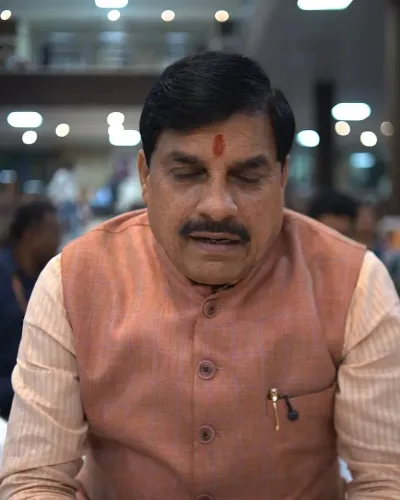
A sharp new fault line opened in Indian political discourse on Sunday, October 25, 2026, when Madhya Pradesh Chief Minister Dr. Mohan Yadav publicly condemned Congress National President Mallikarjun Kharge for what he called a deeply undignified remark directed at Prime Minister Narendra Modi's late father — accusing the principal opposition party of systematically corroding the dignity of democratic office.
In a post on X, CM Yadav wrote: 'आदरणीय प्रधानमंत्री श्री नरेंद्र मोदी जी के परिवार का कांग्रेस नेताओं द्वारा निरंतर अपमान किया जा रहा है' — 'The family of respected Prime Minister Shri Narendra Modi is being continuously insulted by Congress leaders.' He charged that Kharge had made an 'indecent and deeply condemnable statement' about Modi's revered father, calling it an act that 'tears apart the dignity of office in a democratic system.'
Kharge's Alleged Remark and the BJP's Escalating Pushback
The BJP has built a consistent political narrative around what it frames as Congress's pattern of personal attacks on Modi and his family — statements the party argues cross from political criticism into deliberate humiliation of a public figure's private lineage. CM Yadav did not quote Kharge's exact words but described them as the product of a 'perverted and feudal mindset' (विकृत और सामंती मानसिकता). The phrasing is pointed: 'feudal' is a loaded charge in Indian politics, conjuring the dynastic culture the BJP has long attributed to Congress.
Such exchanges are not new. Indian political history is dotted with personal barbs traded across the aisle, but the BJP has increasingly chosen to amplify and formalise its objections — using state-level leaders like Yadav to keep the counter-offensive alive between news cycles. The strategy places the moral frame not on policy disagreement but on standards of democratic conduct itself.
Ten Years of Electoral Defeats — and the Argument Yadav Is Making
CM Yadav tied the rhetoric directly to electoral outcomes, arguing that the country's voters have understood Congress's 'cheap rhetoric' and have delivered the party 'crushing defeats continuously for more than a decade.' Since 2014, Congress has lost two consecutive Lok Sabha elections to the BJP-led NDA, shrinking to its lowest seat tallies in independent India's history — a track record the BJP never misses an opportunity to invoke.
The argument is structurally familiar but carries real resonance: if voters keep rejecting a party, its statements carry less democratic authority — that is the implicit sting in Yadav's framing. He is not just calling out a remark; he is asking whether Congress's leadership has earned the standing to make it.
Whether Kharge or Congress respond formally — in a press conference, in Parliament, or through their own social media — will determine how long this particular exchange echoes. In an era when political discourse moves at the speed of a retweet, the louder question is not what was said, but whether either side will step back from the edge.
Point of View
The challenge is that each such exchange reinforces the BJP's preferred storyline regardless of what Kharge actually said. The electoral record the BJP cites — three national election cycles since 2014 — gives Yadav's argument teeth that a purely rhetorical counter cannot easily blunt.
NationPress
25 Oct 2026
Frequently Asked Questions
What did CM Mohan Yadav say about Mallikarjun Kharge?
CM Mohan Yadav accused Congress President Mallikarjun Kharge of making an indecent and deeply condemnable statement about PM Narendra Modi's late father, calling it an act that undermines the dignity of democratic office.
What exactly did Kharge say about PM Modi's father?
The exact wording of Kharge's alleged remark has not been independently verified. CM Yadav's post described it as undignified and condemned it without quoting it directly.
Why does BJP keep raising personal attacks on PM Modi's family?
The BJP has built a political narrative framing such remarks as evidence of Congress's 'feudal mindset' and disregard for democratic norms, using them to contrast its own conduct with the opposition's.
How has Congress performed in elections since 2014?
Congress lost the 2014 and 2019 Lok Sabha elections to the BJP-led NDA by large margins, recording its lowest seat tallies in India's post-independence history.
Who is Dr. Mohan Yadav?
Dr. Mohan Yadav is the Chief Minister of Madhya Pradesh and a senior BJP leader, appointed to the role in December 2023 after the party's emphatic victory in the state assembly elections.