Goyal Highlights Indian Ownership of Netherlands' Only Steel Plant
Synopsis
Commerce Minister Piyush Goyal highlighted that Tata Steel's IJmuiden plant — acquired through the landmark 2007 Corus deal — is the only operating steel facility in the Netherlands, underlining India's enduring industrial footprint in Europe.
Key Takeaways
Tata Steel's IJmuiden plant in the Netherlands is, according to Minister Goyal, the country's only currently operating steel facility.
Tata Steel acquired the plant as part of its 2007 purchase of Anglo-Dutch steelmaker Corus — India's largest overseas acquisition at that time.
IJmuiden is a fully integrated steelworks serving European automotive, construction, and packaging industries.
The acquisition was a flagship moment in India's outward FDI wave in capital-intensive sectors.
The post aligns with periodic government efforts to spotlight Indian-owned overseas assets as markers of economic transformation.
India-EU trade negotiations , in which steel tariffs remain a sensitive chapter, add a strategic dimension to the minister's highlighting of this asset.
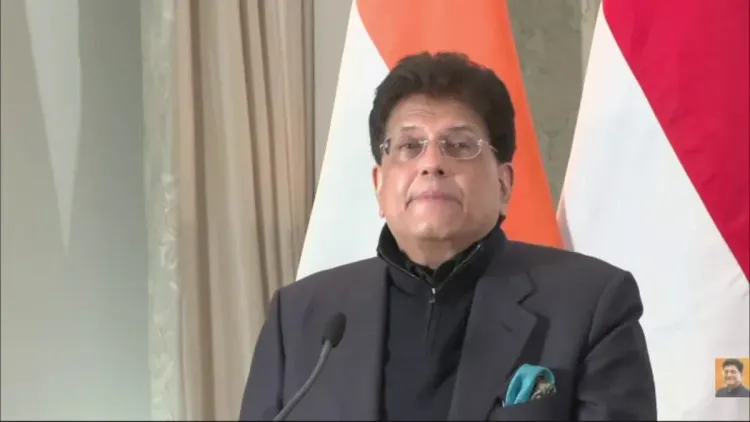
India's industrial reach into the heart of Europe has a name, a postcode, and a flag — and Union Commerce and Industry Minister Piyush Goyal made sure the country knew it on Sunday, 25 October 2026. Pointing to Tata Steel's IJmuiden steelworks in the Netherlands, Goyal posted a simple, sharp declaration: 'The only steel plant operating in the Netherlands is INDIAN! 🇮🇳'
From Corus to Crown Jewel: The IJmuiden Story
The plant Goyal is celebrating did not come cheap. In 2007, Tata Steel completed what was at the time India's largest overseas acquisition — the purchase of Anglo-Dutch steelmaker Corus — bringing with it the IJmuiden integrated steelworks on the Dutch North Sea coast. At a stroke, an Indian company became one of Europe's most significant steel producers. Nearly two decades later, the plant remains the only major steel-making operation on Dutch soil.
IJmuiden is not a legacy curiosity. It is an advanced, fully integrated facility that produces steel from raw materials to finished product, serving European automotive, construction, and packaging industries. That an Indian firm owns and operates it is a point of quiet but enduring national pride — and, increasingly, of strategic relevance as India and the European Union navigate a complex trade relationship that includes steel tariffs and market-access talks.
India's Metals Outreach: A Pattern, Not a Fluke
The IJmuiden plant sits inside a broader story about Indian capital going global. Since the mid-2000s, Indian firms have moved aggressively into capital-intensive sectors in Europe — steel, pharmaceuticals, information technology services — using acquisitions to gain access to technology, established markets, and raw-material supply chains. The Corus deal was a landmark moment in that wave, demonstrating that Indian conglomerates could absorb large, complex, unionised Western manufacturers.
Goyal's post fits a pattern the government has consciously cultivated: periodically flagging Indian-owned overseas assets as proof of the country's economic transformation and rising global weight. As India-EU trade negotiations continue — with steel a perennially sensitive chapter on both sides — reminders of Indian industrial presence in Europe carry a quiet diplomatic subtext too.
Why This Matters Beyond the Tricolour Moment
Steel is not a sentimental commodity. It is an industrial bellwether — a proxy for manufacturing ambition, energy policy, and geopolitical supply-chain strategy. The fact that the Netherlands' sole operating steel plant flies under Indian ownership speaks to how far outward foreign direct investment from India has travelled since liberalisation. Tata Steel's European operations have faced their own pressures — restructuring, green-transition costs, energy prices — making the minister's confident flag-plant a reminder that the foothold, despite headwinds, endures.
For a minister whose portfolio spans trade, industry, and export promotion, the message is pointed and deliberate: India builds, India acquires, India operates — on European ground, at European scale. That is a credential worth naming out loud.
Point of View
Verifiable fact to narrate India's industrial ambition to a domestic audience. The timing, amid ongoing India-EU trade talks where steel is a fault line, is unlikely to be accidental. By anchoring national pride in a real asset rather than a projection, the messaging sidesteps rhetoric and lands with credibility. It also quietly reinforces a negotiating posture: India is not merely a market to be accessed, but a producer already embedded in Europe's industrial fabric.
NationPress
25 Oct 2026
Frequently Asked Questions
Which Indian company owns the steel plant in the Netherlands?
Tata Steel owns and operates the IJmuiden steelworks in the Netherlands, which it acquired as part of its 2007 takeover of Anglo-Dutch firm Corus .
When did Tata Steel acquire the Netherlands steel plant?
Tata Steel completed the acquisition of Corus , including the IJmuiden plant, in 2007 . It was India's largest overseas acquisition at the time.
What did Piyush Goyal say about Tata Steel Netherlands?
Minister Piyush Goyal posted on X on 25 October 2026 stating that the only steel plant operating in the Netherlands is Indian, referencing Tata Steel's IJmuiden facility.
Why is the IJmuiden steel plant significant for India?
The IJmuiden plant is significant because it represents one of India's most prominent industrial assets in Europe, demonstrating the scale of Indian outward foreign direct investment in capital-intensive global manufacturing.
How does Indian steel ownership in Europe relate to India-EU trade talks?
With India-EU trade negotiations ongoing and steel tariffs a sensitive topic, Tata Steel's operational presence in the Netherlands through IJmuiden reinforces India's position as an embedded industrial player in Europe, not just an export market.