CM Yogi Spotlights Balini Milk Model for Women SHGs in Bundelkhand
Synopsis
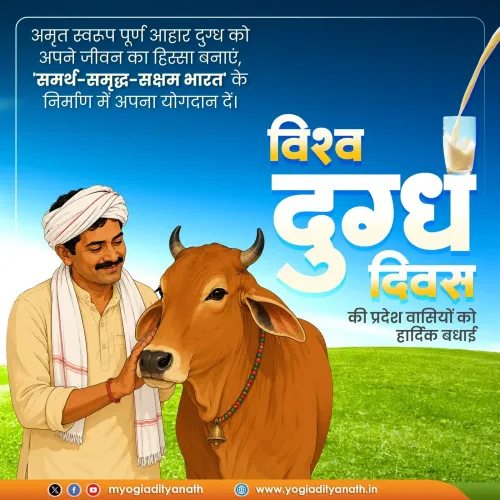
Chief Minister Yogi Adityanath has highlighted the 'Balini Milk Producer' initiative as a model of income growth and self-reliance for women's SHGs, pointing to Jhansi and Lalitpur in Bundelkhand as the strongest examples of the approach in action.
Key Takeaways
CM Yogi Adityanath has publicly endorsed the 'Balini Milk Producer' initiative as an income and self-reliance model for women's self-help groups in Uttar Pradesh.
The model is described as most visibly successful in Jhansi and Lalitpur districts within the Bundelkhand region.
Bundelkhand is a semi-arid belt long targeted for special livelihood and drought-mitigation interventions due to historically low rural incomes.
The initiative builds on the National Rural Livelihoods Mission (NRLM) SHG framework, launched in 2011 , and the state's dairy development programmes rooted in the Operation Flood cooperative model.
The CMO's public spotlight on the model suggests the state may be preparing to replicate it across additional backward districts in Uttar Pradesh.
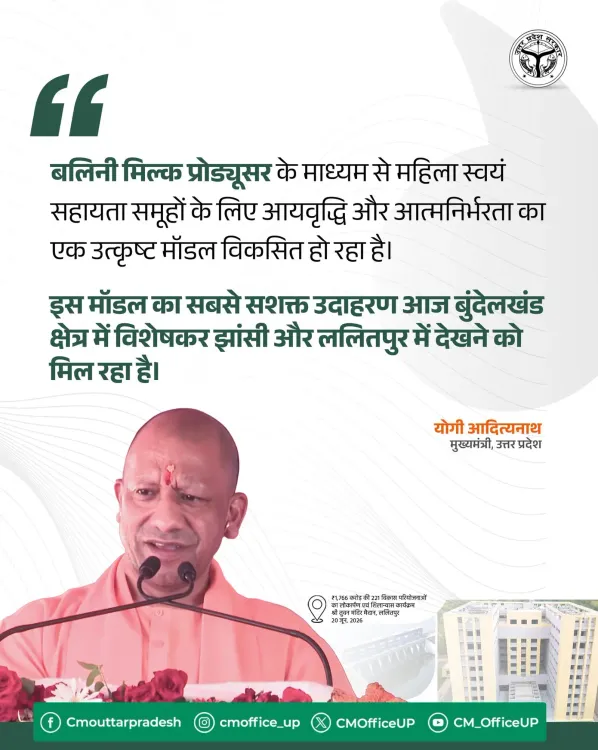
The Chief Minister's Office of Uttar Pradesh on Saturday, 20 June 2026, shared a statement by Chief Minister Yogi Adityanath highlighting the 'Balini Milk Producer' initiative as an emerging model of income generation and self-reliance for women's self-help groups (SHGs) across the state, with Jhansi and Lalitpur in the Bundelkhand region cited as its most compelling examples.
Context
The post, shared from the official CMO account, quotes CM Yogi Adityanath as saying: 'Balini Milk Producer ke madhyam se mahila swayam sahayata samuho ke liye aayvriddhi aur aatmanirbharta ka ek utkrisht model viksit ho raha hai' — 'Through Balini Milk Producer, an excellent model of income enhancement and self-reliance is developing for women's self-help groups.' The statement singles out Bundelkhand, and specifically the districts of Jhansi and Lalitpur, as the strongest demonstration of this approach in action.
The Bundelkhand region, a semi-arid belt straddling parts of Uttar Pradesh and Madhya Pradesh, has long been identified for targeted livelihood and drought-mitigation interventions due to its historically lower agricultural productivity and rural income levels.
Policy Backdrop
The 'Balini Milk Producer' model sits within a broader architecture of women-led dairy collectives that Uttar Pradesh has been building for over two decades. The state's Dairy Development Department has supported milk producers' organisations and women's collectives since the early 2000s, drawing on the national Operation Flood cooperative framework.
At the national level, the National Rural Livelihoods Mission (NRLM), launched in 2011, provided the structural backbone for scaling women's SHGs into viable economic collectives across Uttar Pradesh. The Balini initiative appears to channel this SHG infrastructure specifically toward dairy-based income, linking rural women producers to organised milk marketing.
CM Yogi Adityanath, who has served as Chief Minister since 2017, has consistently promoted rural livelihood and women's empowerment programmes as central planks of the state's welfare agenda, frequently spotlighting district-level models through official communications.
Stakeholders and Impact
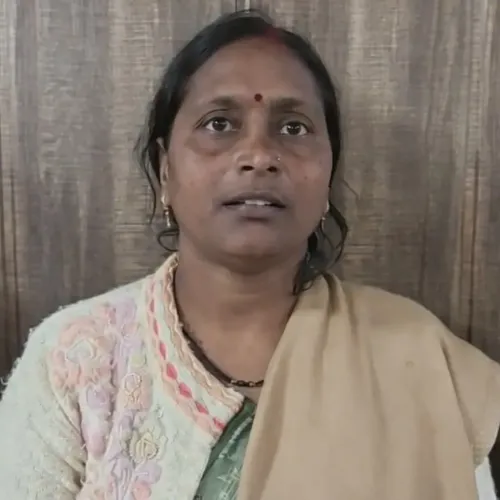
The primary beneficiaries of the Balini model are women members of rural SHGs in Jhansi and Lalitpur districts, households that depend on dairy as a supplementary or primary income source. By connecting these groups to an organised milk producer entity, the model aims to reduce dependence on informal middlemen and improve price realisation for raw milk.
For the broader Bundelkhand region, where livelihood options have historically been limited by erratic rainfall and low agricultural yields, a functioning dairy-collective model carries significance beyond individual household income — it points to a replicable structure for rural income diversification.
What's Next
The Chief Minister's public endorsement of the Balini model at this stage signals that the state government may be positioning it as a template for wider replication across other districts facing similar agrarian stress. Progress metrics — including SHG income data and milk procurement volumes from Jhansi and Lalitpur — will be closely watched as indicators of whether the model delivers sustained gains.
If outcomes in Bundelkhand prove robust, the state government is likely to use this model as a reference point in future welfare and rural-economy announcements, potentially extending it to other backward districts in Uttar Pradesh.
Point of View
Making any visible success there a useful proof point. Framing the Balini model as an 'excellent model' rather than a pilot also suggests the state is signalling readiness to scale, not merely experiment. The emphasis on women's SHGs as the vehicle aligns with a broader national policy arc that treats women-led collectives as the preferred delivery mechanism for rural welfare.
NationPress
19 Sept 2026
Frequently Asked Questions
What is the Balini Milk Producer initiative in Uttar Pradesh?
Balini Milk Producer is an initiative in Uttar Pradesh that links women's self-help groups to organised milk production and marketing, aiming to increase rural household incomes and promote self-reliance, with Jhansi and Lalitpur in Bundelkhand cited as key implementation districts.
What did CM Yogi Adityanath say about women SHGs and dairy in Bundelkhand?
CM Yogi Adityanath stated that through the Balini Milk Producer model, an excellent framework for income enhancement and self-reliance is developing for women's self-help groups, and that Jhansi and Lalitpur in Bundelkhand are the strongest examples of this model.
Which districts in Bundelkhand are part of the Balini Milk Producer model?
Jhansi and Lalitpur, both in the Bundelkhand division of Uttar Pradesh, have been specifically highlighted by Chief Minister Yogi Adityanath as the districts where the Balini Milk Producer model is most visibly succeeding.
How does the Balini model connect to national SHG schemes?
The Balini model builds on the National Rural Livelihoods Mission (NRLM), launched in 2011, which scaled women's self-help groups across Uttar Pradesh, and draws on the state's dairy development programmes rooted in the Operation Flood cooperative framework.
Why is Bundelkhand a focus for women's livelihood programmes in UP?
Bundelkhand is a semi-arid region with historically low agricultural productivity and rural incomes, making it a priority zone for targeted livelihood and drought-mitigation interventions by both the central and Uttar Pradesh state governments.