CM Yogi Backs LexQ Centre at UPSIFS to Fuse Quantum Tech with Law

Synopsis
Chief Minister Yogi Adityanath has pledged to strengthen the LexQ Centre of Excellence at UPSIFS, positioning quantum technology as a tool for law, security, forensic science and public welfare in Uttar Pradesh — a move that aligns with India's National Quantum Mission launched in 2023.
Key Takeaways
CM Yogi Adityanath announced on 24 October 2026 that UP will push ahead with the LexQ Centre of Excellence at UPSIFS .
The Centre is designed to connect quantum technology with law, security, forensic science and public welfare.
UPSIFS (Uttar Pradesh State Institute of Forensic Science) is the state's primary body for forensic training and investigation support.
The initiative aligns with India's National Quantum Mission , approved in 2023 , which targets state-level deployment of quantum capabilities.
Key indicators to watch: MoUs with national quantum research bodies and funding allocations in upcoming state budgets.
If realised, UP could become the first Indian state to formally institutionalise quantum technology within its forensic and legal framework.
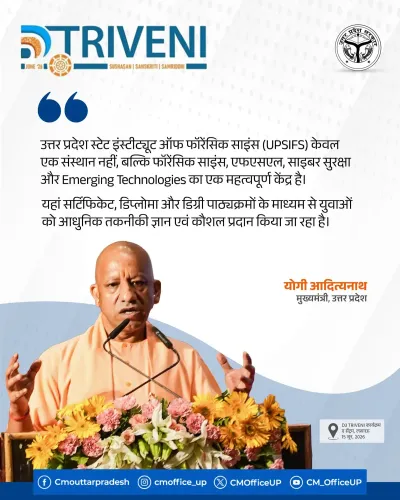
Quantum technology is no longer a laboratory abstraction in Uttar Pradesh — it is being pointed directly at courtrooms, crime scenes, and public safety. On Saturday, 24 October 2026, the Chief Minister's Office of Uttar Pradesh quoted Chief Minister Yogi Adityanath pledging to vigorously advance the establishment of the LexQ Centre of Excellence at the Uttar Pradesh State Institute of Forensic Science (UPSIFS).
Translating from the original Hindi, CM Yogi stated: 'UPSIFS mein LexQ Centre of Excellence ki sthapna ki disha mein prarambh kiye gaye prayason ko hum mazbooti ke saath aage badhayenge.' — 'We will carry forward, with full strength, the efforts initiated towards establishing the LexQ Centre of Excellence at UPSIFS. This Centre will play an important role in connecting quantum technology with law, security, forensic science and public welfare.'What UPSIFS and LexQ Are Being Built to Do
The Uttar Pradesh State Institute of Forensic Science is the state's nodal body for forensic training, research, and criminal investigation support. Embedding a dedicated quantum centre inside it signals an unusually ambitious leap: rather than upgrading conventional forensic tools, the state wants to wire next-generation quantum capabilities — think quantum encryption, quantum sensing, and quantum-accelerated data analysis — into the legal and security pipeline from the ground up.
The LexQ Centre's stated mandate is to bridge quantum technology with four domains: law, security, forensic science, and public interest (lokhit). That four-way linkage is significant. Most quantum-in-governance pilots focus narrowly on cybersecurity or communications encryption; anchoring the initiative inside a forensics institution forces a concrete, evidence-chain application from day one.
Where UP's Push Fits India's National Quantum Mission
The Centre's momentum draws wind from the top. India's National Quantum Mission, approved in 2023, set out to accelerate domestic research across quantum computing, communications, sensing and materials. The mission explicitly envisioned state-level adoption and real-world deployment scenarios — precisely the gap a state-run LexQ Centre can fill.
Uttar Pradesh has simultaneously pushed to modernise its forensic infrastructure and policing apparatus over the past several years. Pairing that investment with quantum research creates a rare convergence: a state institution that could, in theory, test quantum forensic tools in live investigative conditions rather than in isolated academic settings. That makes it a potential national proof-of-concept, not merely a state initiative.
What Comes Next for the LexQ Rollout
The immediate test will be operational detail. Analysts watching this space will look for MoUs with national quantum research bodies — institutions working under the National Quantum Mission framework — and for any funding earmarks in the next Uttar Pradesh state budget. The Chief Minister's phrasing — 'we will carry this forward with strength' — suggests existing groundwork rather than a first announcement, meaning institutional scaffolding may already be in place.
If the LexQ Centre delivers on its mandate, UP would become the first Indian state to formally institutionalise quantum technology as a forensic and legal tool — setting a template that other large states are almost certain to study.
Point of View
The administration converts an abstract technology mission into a tangible law-enforcement asset, which carries both administrative and political capital in a high-crime-spotlight state. The move also puts UP ahead of most Indian states in operationalising the Centre's 2023 National Quantum Mission at a sub-national level, giving the BJP government a credible 'tech-forward' credential ahead of future electoral cycles. The real measure of ambition, however, will be whether institutional funding and inter-agency partnerships follow the announcement.
NationPress
24 Oct 2026
Frequently Asked Questions
What is the LexQ Centre of Excellence at UPSIFS?
The LexQ Centre of Excellence is a proposed facility at the Uttar Pradesh State Institute of Forensic Science (UPSIFS) aimed at integrating quantum technology with law, security, forensic science and public welfare. CM Yogi Adityanath pledged on 24 October 2026 to advance its establishment.
What is UPSIFS and what does it do?
UPSIFS stands for the Uttar Pradesh State Institute of Forensic Science. It is the state's nodal institution for forensic training, research and criminal investigation support.
How does this relate to India's National Quantum Mission?
India's National Quantum Mission was approved in 2023 to accelerate quantum research in computing, communications and security. The LexQ Centre represents a state-level initiative that directly aligns with the Mission's goal of real-world deployment of quantum capabilities across governance sectors.
What will quantum technology actually do in forensic science?
Potential applications include quantum encryption to secure evidence chains, quantum sensing for more precise physical analysis, and quantum-accelerated data processing for investigative databases. The LexQ Centre is intended to develop and test these applications within a live forensics and legal framework.
What should we watch for next in the LexQ Centre rollout?
Key developments to track include formal memoranda of understanding with national quantum research bodies, specific funding allocations in the Uttar Pradesh state budget, and announcements on the Centre's operational timeline and staffing.