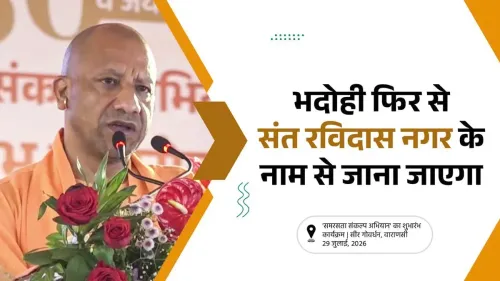
CM Yogi: Bhadohi to be renamed after Sant Ravidas
Synopsis
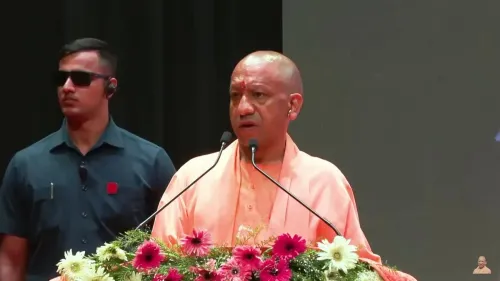
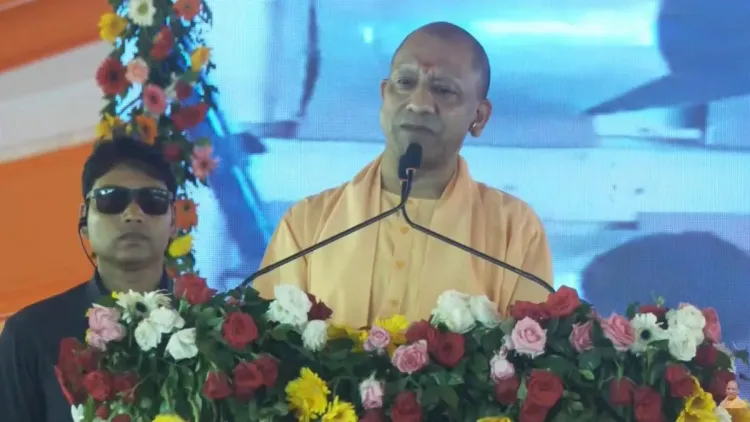
Uttar Pradesh Chief Minister Yogi Adityanath announced on October 4, 2026, that Bhadohi — the carpet-weaving district near Varanasi — will be renamed in honour of 15th-century Bhakti saint Sadguru Ravidas Ji Maharaj, a move laden with cultural, social, and political significance.
Key Takeaways
CM Yogi Adityanath announced on 4 October 2026 that Bhadohi district will be renamed after Sadguru Ravidas Ji Maharaj .
Sant Ravidas was a 15th–16th century Bhakti movement poet-saint whose hymns are enshrined in the Guru Granth Sahib and who is deeply revered by Dalit communities.
Bhadohi is situated in the Varanasi division of eastern Uttar Pradesh and is known as India's carpet export capital .
The renaming follows a pattern of place-renaming in UP under the Yogi government, including Allahabad to Prayagraj and Faizabad to Ayodhya .
The change will require formal clearance from the Union Home Ministry before taking legal effect.
The move carries significant political resonance as a gesture of outreach toward Dalit and Bahujan communities in India's most electorally important state.
A name carries history — and Uttar Pradesh Chief Minister Yogi Adityanath has just announced that Bhadohi, the carpet-weaving district in eastern UP, will be renamed in honour of Sadguru Ravidas Ji Maharaj, the 15th-century saint-poet revered across India and the world as a symbol of spiritual equality and social dignity.
Posting on Sunday, 4 October 2026, the Chief Minister wrote in Hindi: 'Sadguru Ravidas Ji Maharaj ke naam par Bhadohi jaana jaega' — 'Bhadohi will be known by the name of Sadguru Ravidas Ji Maharaj.' The announcement, brief but consequential, signals a formal administrative renaming that would give the district an identity rooted in the legacy of one of India's most celebrated Bhakti-movement saints.
Who was Sadguru Ravidas — and why this name carries weight
Sant Ravidas, also venerated as Guru Ravidas, was a poet-saint of the Bhakti movement who lived roughly between the late 15th and early 16th centuries. Born into a community considered low in the caste hierarchy, he composed devotional verses — many of which are enshrined in the Guru Granth Sahib — that challenged caste oppression and proclaimed the oneness of the divine across all human beings. His philosophy carries the weight of centuries of aspiration for social justice, and he is deeply revered by Dalit communities across Uttar Pradesh, Punjab, Rajasthan, Maharashtra, and the Indian diaspora worldwide.
Naming a district after him is not merely a geographic act. It is a declaration of cultural and political intent: placing a saint who transcended caste at the front door of one of UP's most economically significant districts.
Bhadohi — a district with an identity already built on craft
Bhadohi, formally known as Sant Ravidas Nagar in official records since a prior administrative renaming, sits in the Varanasi division of eastern Uttar Pradesh. It is internationally recognised as the carpet capital of India, home to a hand-knotted carpet industry that exports to markets across Europe, the United States, and the Middle East. Tens of thousands of weavers — many from historically marginalised communities — sustain their livelihoods through this craft. The district's economy, its artisan communities, and its geography near Varanasi — itself the city most associated with Sant Ravidas's life and teachings — make the renaming a convergence of culture, commerce, and community identity.
Renaming as a political and cultural statement in UP
The announcement fits a broader pattern in Uttar Pradesh, where the Yogi Adityanath government has pursued a series of place-renaming decisions as a way of reshaping the state's cultural narrative. Allahabad was renamed Prayagraj, Faizabad became Ayodhya, and Mughalsarai station was rechristened Deen Dayal Upadhyaya Junction. Each renaming has carried symbolic freight — connecting the present administration to a particular reading of history, heritage, and community honour. Renaming Bhadohi after Sant Ravidas extends that political vocabulary toward the Dalit and Bahujan communities for whom the saint is a living spiritual and social anchor.
For the BJP, outreach to Dalit voters has been a persistent strategic priority in Uttar Pradesh, the state that sends the largest number of members to the Lok Sabha. A gesture of this kind — formalising the name of a Dalit icon on a district's official map — carries electoral resonance as much as cultural significance.
The formal renaming will require clearance from the Union Home Ministry, which must approve state-level district renaming proposals — a procedural step that typically follows political announcement. Until that clearance arrives, Bhadohi waits at the threshold of a new name. But the direction, as of this Sunday afternoon, is unmistakable.
Point of View
It signals a deliberate bid to deepen its Dalit outreach in the state that anchors its national electoral arithmetic. The gesture also has genuine emotional resonance: Sant Ravidas was born near Varanasi, and naming the adjacent district after him closes a long cultural loop. The procedural step of Union Home Ministry approval means the announcement is a political commitment, not yet a gazetted fact — but in UP's political economy, that announcement alone carries substantial weight.
NationPress
4 Oct 2026
Frequently Asked Questions
What is the new name of Bhadohi district in UP?
Chief Minister Yogi Adityanath announced that Bhadohi will be renamed after Sadguru Ravidas Ji Maharaj. The formal name has not yet been gazetted and awaits Union Home Ministry approval.
Who was Sant Ravidas and why is he significant?
Sant Ravidas was a 15th–16th century Bhakti movement poet-saint revered for his devotional verses challenging caste discrimination. His hymns appear in the Guru Granth Sahib, and he holds deep spiritual significance for Dalit communities across India.
Has Bhadohi been renamed before?
Yes. Bhadohi was previously given the official name Sant Ravidas Nagar in an earlier administrative renaming, reflecting the district's historic connection to the saint.
What is Bhadohi known for?
Bhadohi is internationally known as India's carpet capital, with a major hand-knotted carpet industry that exports to Europe, the United States, and the Middle East, employing tens of thousands of artisans.
What is the process for renaming a district in India?
A state government passes a proposal to rename a district, but the change must be formally approved by the Union Home Ministry before it takes legal effect and is gazetted.