CM Yogi Declares Ayodhya a Solar City
Synopsis
Chief Minister Yogi Adityanath declared Ayodhya a Solar City on 10 July 2026, invoking the city's Suryavansha lineage to frame solar energy as both a developmental milestone and a civilisational statement for the ancient pilgrimage capital of Uttar Pradesh.
Key Takeaways
The Chief Minister's Office of Uttar Pradesh announced on 10 July 2026 that Ayodhya has been declared a Solar City .
CM Yogi Adityanath linked the solar initiative to Ayodhya's identity as the capital of the ancient Suryavansha (Solar Dynasty).
The announcement builds on Ayodhya 's ongoing infrastructure modernisation that accelerated after the 2019 Supreme Court verdict on the Ram Janmabhoomi site.
Uttar Pradesh is aligning religious-city redevelopment with national renewable energy targets under the Jawaharlal Nehru National Solar Mission framework.
Pilgrims, residents, and the local tourism economy are the primary beneficiaries of solar-powered public infrastructure.
The Solar City model may be extended to other UP pilgrimage towns including Varanasi , Mathura , and Prayagraj .
The Chief Minister's Office of Uttar Pradesh announced on Friday, 10 July 2026 that Ayodhya has officially been declared a Solar City, with Chief Minister Yogi Adityanath framing the milestone as a fulfilment of the city's ancient solar heritage.
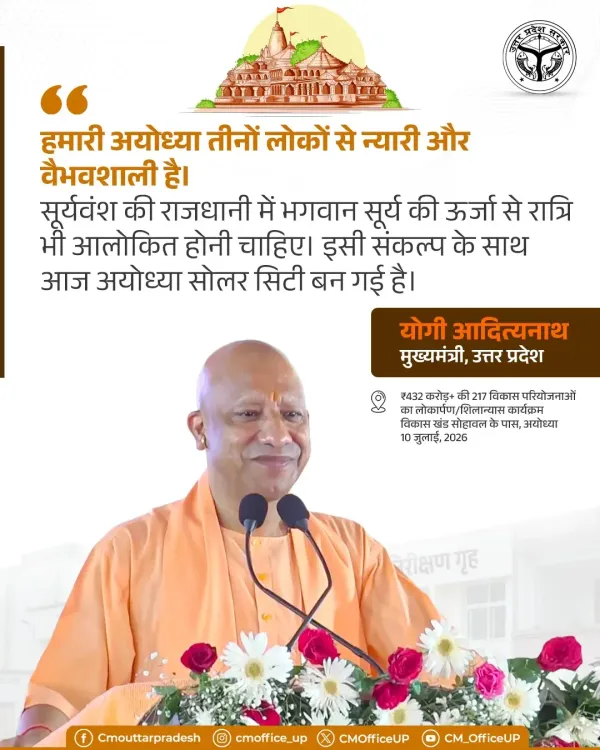
Quoting CM Yogi Adityanath, the post stated: 'Hamari Ayodhya teenon lokon se nyari aur vaibhashali hai' ('Our Ayodhya is unique and glorious beyond all three worlds'). The Chief Minister added that as the capital of the Suryavansha (Solar Dynasty), the city's nights too must be illuminated by the energy of Lord Surya, and declared that this resolve had now been fulfilled with Ayodhya becoming a Solar City.
Context
Ayodhya holds a singular place in Indian civilisational memory as the birthplace of Lord Ram and the ancient capital of the Suryavansha lineage — the solar dynasty from which Ram is believed to descend. The CM's framing deliberately draws on this mythological identity, positioning solar energy not merely as a utility upgrade but as a symbolic homecoming of solar power to the city that has always claimed the sun as its dynastic ancestor. The announcement comes as Ayodhya continues a sweeping infrastructure transformation that accelerated following the 2019 Supreme Court verdict on the Ram Janmabhoomi site. Heritage restoration, road widening, airport upgrades, and modern utilities have all been pursued in parallel, with the Solar City declaration representing the latest milestone in that arc.Policy Backdrop
India's push for solar cities traces back to the Jawaharlal Nehru National Solar Mission, launched in 2010 by the Central government to scale up grid-connected solar capacity and encourage municipalities to meet a significant share of their energy demand through renewables. The Solar Cities programme under this mission has incentivised urban local bodies across the country to invest in rooftop solar, solar street lighting, and distributed generation. Uttar Pradesh has aligned its religious-city redevelopment agenda with national renewable energy targets, treating pilgrimage centres as flagship sites for visible green infrastructure. Ayodhya now becomes the most high-profile example of this dual strategy — pairing heritage identity with sustainability credentials. Similar intentions have been signalled for other major temple towns in the state.Stakeholders and Impact
The Solar City status is expected to benefit Ayodhya's permanent residents, the large floating population of pilgrims, and the growing tourism economy that has expanded significantly since the consecration of the Ram Mandir. Solar-powered street lighting and public infrastructure reduce dependence on the conventional grid, which can be strained during peak pilgrimage seasons when visitor numbers surge into the lakhs. Renewable energy developers and project implementers stand to gain from the contracts and capacity additions that a Solar City designation typically entails. For the Yogi Adityanath government, the announcement reinforces a political narrative that marries religious pride with developmental governance — a combination that has been central to its identity since 2017.What's Next
Attention will now turn to the specifics of implementation: the total installed solar capacity commissioned, the extent of grid integration, maintenance frameworks, and independent audits of energy generation. The Uttar Pradesh government is also expected to face questions about whether the Solar City model will be extended to other major pilgrimage destinations in the state such as Varanasi, Mathura, and Prayagraj. If Ayodhya's solar infrastructure delivers measurable outcomes in reduced power cuts and lower municipal energy costs, it could serve as a replicable template for India's broader ambition of greening its heritage urban centres — cities that carry enormous symbolic weight but have historically lagged in modern utility provision.Point of View
The Chief Minister transforms a renewable energy project into a narrative about restoring Ayodhya's ancient glory — a framing that resonates deeply with the city's core constituency of pilgrims and Hindu nationalist voters. The move also positions Uttar Pradesh as a state that can reconcile heritage conservation with green infrastructure, a balance that most Indian states have struggled to strike. The real test, however, will be in verifiable outcomes: installed capacity, uptime, and tangible reductions in energy costs for residents and local bodies.
NationPress
10 Jul 2026
Frequently Asked Questions
What does it mean for Ayodhya to become a Solar City?
A Solar City designation means Ayodhya is committed to meeting a significant share of its municipal energy demand through solar power, including solar street lighting, rooftop installations, and distributed generation, reducing reliance on the conventional electricity grid.
When did CM Yogi declare Ayodhya a Solar City?
Chief Minister Yogi Adityanath declared Ayodhya a Solar City on 10 July 2026 , as announced by the official Chief Minister's Office of Uttar Pradesh on X.
Why did CM Yogi connect solar energy to the Suryavansha dynasty?
Ayodhya is traditionally regarded as the capital of the Suryavansha, the ancient solar dynasty of Lord Ram. CM Yogi used this mythological connection to frame solar energy as a culturally resonant choice, arguing that the city of the solar lineage should naturally be illuminated by the sun's energy.
What is the Jawaharlal Nehru National Solar Mission and how does it relate to Ayodhya?
The Jawaharlal Nehru National Solar Mission, launched in 2010 , is a Central government programme to scale up solar power and encourage Solar Cities across India. Ayodhya's Solar City status aligns with this national framework, which provides policy and financial support for urban renewable energy projects.
Will other UP pilgrimage cities also become Solar Cities?
The Uttar Pradesh government has signalled intentions to extend the Solar City model to other major pilgrimage towns such as Varanasi, Mathura, and Prayagraj, though formal announcements for those cities are yet to be made.