CM Yogi Warns UP: Fact-Check Before You Share
Synopsis
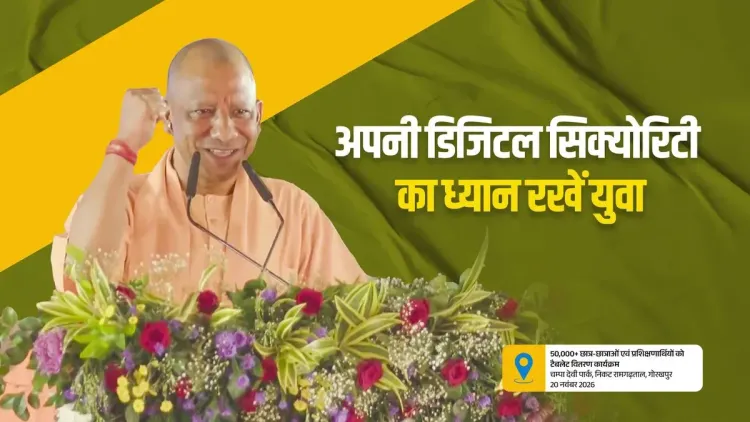
The Chief Minister's Office of Uttar Pradesh, on behalf of CM Yogi Adityanath, issued a public advisory on 20 November 2026 urging citizens to fact-check viral social-media content before sharing it and to stay vigilant about their digital security.
Key Takeaways
The Chief Minister's Office of Uttar Pradesh posted a digital advisory on 20 November 2026 under CM Yogi Adityanath's name.
The advisory states that not all viral content on smartphones is accurate and that reels must not be confused with real life.
Citizens are urged to fact-check any content before reading, viewing, or sharing it on social media.
The post also calls for heightened digital security awareness beyond just misinformation.
The advisory aligns with India's broader Digital India framework and the IT Rules 2021 governing digital misinformation.
UP's large smartphone-user base makes it a critical state for digital-literacy outreach by Indian governments.
In an era when a single viral reel can travel faster than a correction, Chief Minister Yogi Adityanath's office issued a pointed public advisory on Friday, 20 November 2026, urging every citizen of Uttar Pradesh — and beyond — to pause before they tap 'share'.
The message, posted by the Chief Minister's Office of Uttar Pradesh, cuts straight to the point: 'हर वायरल कंटेंट सही नहीं होता' — 'Not every viral piece of content is true.' It draws a sharp line between the curated world of social-media reels and real life, reminding smartphone users that visibility is not the same as veracity. The advisory explicitly calls for fact-checking any content before reading, watching, or sharing it, and pairs that with a call for greater vigilance around personal digital security.
Why UP's top office is weighing in on your scroll habits
The advisory lands against a well-documented backdrop. India's short-video ecosystem has exploded in scale, and Uttar Pradesh — with one of the country's largest smartphone user bases — sits at the centre of that surge. The pattern is familiar: a rumour circulates as a reel, picks up thousands of shares before anyone questions it, and by the time a correction appears, the original has already done its damage.
Indian governance has been alive to this risk for years. The Information Technology (Intermediary Guidelines and Digital Media Ethics Code) Rules, 2021, notified by the Government of India, set a regulatory framework for digital content and misinformation. State governments across the country have periodically layered on their own advisories — particularly around elections and public-health moments — as part of the broader Digital India programme launched in 2015.
CM Yogi's social-media advisory tradition
Chief Minister Yogi Adityanath, in office since 2017 and re-elected in 2022, has consistently used the state's official digital channels as a direct-to-citizen governance tool. Public safety alerts, scheme announcements, and civic advisories have all flowed through the CMO's X account, making this platform a credible amplifier for messages that might otherwise get lost in legacy communication channels.
What gives this particular advisory its edge is its dual focus. It is not simply a 'don't believe fake news' boilerplate. By explicitly flagging digital suraksha — digital security — alongside misinformation, the message extends its reach into the territory of phishing, scams, and data-harvesting content that often rides viral trends to find new victims.
The next logical step, one that digital-literacy advocates have long pushed for, would be integrating fact-checking habits into school curricula and community outreach programmes across the state. Whether this advisory marks the beginning of a structured campaign or stands as a standalone caution, the message itself is unambiguous: in the attention economy, the most dangerous click is the unreflective one.
Point of View
Bypassing traditional media. By pairing the misinformation warning with a digital-security caution, UP's CMO signals an awareness that the two risks — false content and online fraud — often travel together on the same viral rails. This positions the advisory within the broader Digital India narrative while also serving as a low-cost, high-visibility public-service gesture ahead of any potential state-level digital-awareness campaign. The real test will be whether this translates into structured, ground-level fact-checking programmes across UP's vast semi-urban and rural smartphone-user base.
NationPress
20 Nov 2026
Frequently Asked Questions
What did CM Yogi Adityanath say about viral content?
CM Yogi Adityanath's office posted an advisory stating that not all viral content on smartphones is true, urging people to fact-check content before reading, watching, or sharing it, and to remain alert about their digital security.
Why is the UP government issuing a digital literacy advisory?
The advisory aligns with India's broader Digital India programme and the IT Rules 2021, as state governments periodically remind citizens to verify online information, especially amid the rapid growth of short-video platforms.
How should I fact-check viral content on social media?
Cross-check information against multiple credible sources, look for official government or verified institutional statements, and use dedicated fact-checking platforms before sharing anything you receive online.
What does digital security awareness mean in this context?
Beyond spotting misinformation, digital security awareness involves being cautious about phishing links, scam messages, and data-harvesting content that often masquerades as viral news or entertainment.
Is the Uttar Pradesh government running a formal fact-checking campaign?
As of this advisory, no formal state-run fact-checking campaign has been announced; the post is a public advisory from the CMO, though digital-literacy advocates expect it could precede a structured programme.