CM Yogi flags Gorakhpur's industrial surge across 7 sectors
Synopsis
Chief Minister Yogi Adityanath highlights Gorakhpur's expanding industrial base — fertiliser, sugar mills, distilleries, dairy, ethanol, steel, and cement — alongside the launch of a Software Technology Park and Ayush University, marking a broad sectoral push in eastern Uttar Pradesh.
Key Takeaways
Seven manufacturing sectors — fertiliser, sugar mills, distilleries, dairy, ethanol plants, steel plants, and cement factories — are noted as being established in Gorakhpur .
The Software Technology Park (STPI) in Gorakhpur has become operational , opening an IT employment pathway in eastern UP.
Ayush University in Gorakhpur has commenced activities, adding a knowledge and healthcare anchor to the city.
The industrial push is rooted in the state's post-2017 strategy to shift Purvanchal from a migration-dependent economy to a diversified manufacturing and services hub.
The One District One Product (ODOP) scheme, launched in 2018 , identified Gorakhpur for specific manufacturing clusters underpinning this wave of investment.
Detailed plant capacities, investment amounts, and employment figures have not yet been officially disclosed.
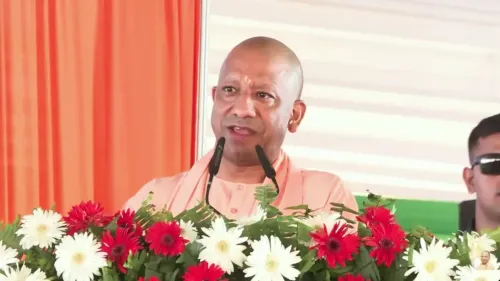
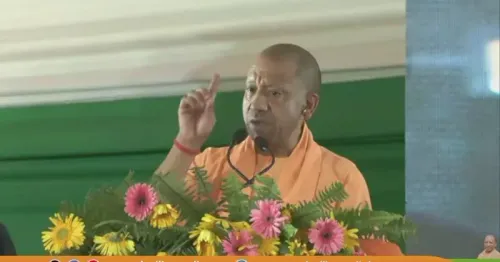
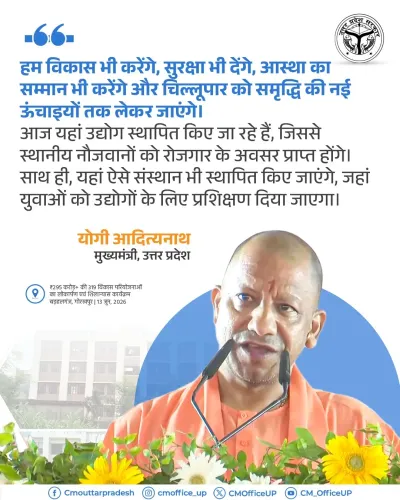
Gorakhpur is no longer just eastern Uttar Pradesh's largest city — it is fast becoming one of its most ambitious industrial corridors. The Chief Minister's Office of Uttar Pradesh quoted Chief Minister Yogi Adityanath on Sunday, 1 November 2026, cataloguing a sweeping wave of new industry taking root across the city, from heavy manufacturing to knowledge infrastructure.
The Chief Minister's statement, shared via the official CMO account, listed the sectors driving this transformation: 'फर्टिलाइजर, चीनी मिल, डिस्टिलरी, डेयरी, इथेनॉल प्लांट, स्टील प्लांट और सीमेंट फैक्ट्री' — fertiliser, sugar mills, distilleries, dairy units, ethanol plants, steel plants, and cement factories. Two institutional milestones were also highlighted: the Software Technology Park in Gorakhpur has become operational, and Ayush University has commenced its activities.
Purvanchal's long-awaited industrial pivot
Gorakhpur sits at the heart of the Purvanchal region, historically one of the most migration-dependent belts in India, where generations of young men left for Delhi, Mumbai, or the Gulf in search of factory work unavailable at home. That structural reality has been the central challenge the state government has sought to reverse since 2017, when Yogi Adityanath took office and flagged eastern Uttar Pradesh as a priority zone for industrial investment.
The policy architecture behind this push has several layers. The One District One Product (ODOP) scheme, launched in 2018, identified Gorakhpur for specific manufacturing clusters, aligning local agricultural produce — sugarcane, in particular — with downstream value chains like ethanol and distilleries. Successive state budgets and investor summits have steadily channelled both public and private capital into fertiliser, cement, and steel capacities in the region, with the agro-processing sector treated as a bridge between the farming economy and industrial employment.
Software Technology Park and Ayush University: the services layer
What makes the current moment distinct is the parallel build-out of services and knowledge infrastructure alongside heavy industry. The Software Technology Park of India (STPI) facility becoming operational in Gorakhpur signals an intent to pull IT and software services employment into Purvanchal — a sector that has historically clustered in Noida and Lucknow within the state. If the park gains traction, it offers a pathway for engineering graduates from eastern UP to find tech employment locally rather than migrating west.
Ayush University, focused on traditional medicine education and research, adds an institutional anchor in the healthcare and wellness space — aligning with both the national AYUSH policy push and the state's strength in herbal and traditional medicine practice. Together, these two institutions represent the 'talent-retention' logic that underpins the broader industrial strategy: build jobs first, build the institutions to fill them second.
What investors and farmers are watching
The sectors named — ethanol, dairy, fertiliser — speak directly to Gorakhpur's agricultural hinterland. Ethanol plants and sugar mills create direct demand for sugarcane, offering farmers a more diversified revenue stream beyond the traditional mandi system. Dairy infrastructure opens a similar channel for milk producers across the surrounding districts. Steel and cement, by contrast, serve the construction boom that large-scale industrial and infrastructure development itself generates — a self-reinforcing cycle when it reaches critical mass.
Precise investment figures, plant capacities, and employment projections for the individual units have not been disclosed in the official statement, and detailed numbers are expected to emerge in upcoming state economic surveys and investor summit readouts. What the Chief Minister's enumeration does confirm is the breadth of the sectoral spread — seven distinct manufacturing categories plus two institutional anchors — suggesting a strategy designed to avoid over-dependence on any single industry.
For Purvanchal, the question has always been whether the investment announcements translate into operational units, jobs, and wages at scale. The listing of plants that are already functioning — not merely promised — marks a meaningful step in answering it.
Point of View
Yogi Adityanath's own parliamentary constituency, as the proof-of-concept for the state's Purvanchal turnaround narrative. The pairing of heavy industry with IT and AYUSH institutions reflects a conscious effort to rebrand the city beyond its agro-industrial identity and position it as a diversified regional hub. For the broader UP growth story, Gorakhpur's trajectory carries outsized symbolic weight: if eastern UP can sustain this industrial momentum, it validates the argument that investment-led governance can restructure even the most entrenched migration economies. The absence of specific employment and investment figures, however, means the full impact remains to be quantified in upcoming economic surveys.
NationPress
1 Nov 2026
Frequently Asked Questions
What new industries are being set up in Gorakhpur?
According to Chief Minister Yogi Adityanath, fertiliser plants, sugar mills, distilleries, dairy units, ethanol plants, steel plants, and cement factories are among the new industries being established in Gorakhpur, alongside a Software Technology Park and Ayush University.
Has the Software Technology Park in Gorakhpur started working?
Yes, the Chief Minister's Office confirmed on 1 November 2026 that the Software Technology Park (STPI) in Gorakhpur has started operations.
What is Ayush University in Gorakhpur?
Ayush University in Gorakhpur is a state university focused on traditional medicine education and research; the Chief Minister's Office confirmed its activities have commenced.
What is the One District One Product scheme and how does it relate to Gorakhpur?
The One District One Product (ODOP) scheme, launched in 2018 by the Uttar Pradesh government, identified Gorakhpur for specific manufacturing clusters to boost local industry and agro-processing, forming a policy backbone for the current industrial expansion.
Why is Gorakhpur important for UP's industrial development?
Gorakhpur is the largest city in the Purvanchal region of eastern Uttar Pradesh, historically a high-migration zone; the state government has targeted it as a priority area to create local manufacturing and services employment and reduce dependence on out-migration.