CM Yogi Highlights Jalaun's Rise as Development Model in UP
Synopsis
The UP Chief Minister's Office quoted CM Yogi Adityanath praising Jalaun district as a new development model, spotlighting river rejuvenation, ODOP-backed handmade paper promotion, and an initiative to brand the district's peas — part of UP's push to transform aspirational Bundelkhand districts.
Key Takeaways
CM Yogi Adityanath described Jalaun district as establishing itself as a 'new benchmark of development' in Uttar Pradesh .
The ODOP scheme , launched in 2018 , has identified handmade paper as Jalaun's signature product for market scaling and branding.
A river rejuvenation campaign is underway in Jalaun, addressing water security critical to both agriculture and small-scale manufacturing in the Bundelkhand region.
The state is pursuing a distinct identity for Jalaun's local peas , potentially through GI tagging or formal state branding.
Key stakeholders include local artisans , pea farmers , and district residents who stand to benefit from improved market access and water availability.
The post reflects UP government's broader strategy of showcasing aspirational district progress as evidence of decentralised economic governance.
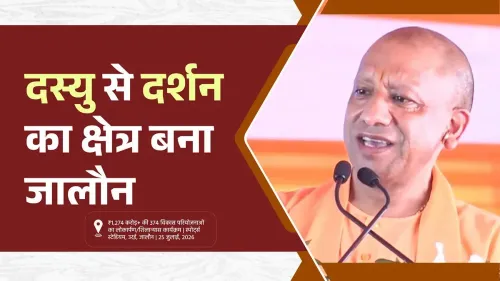
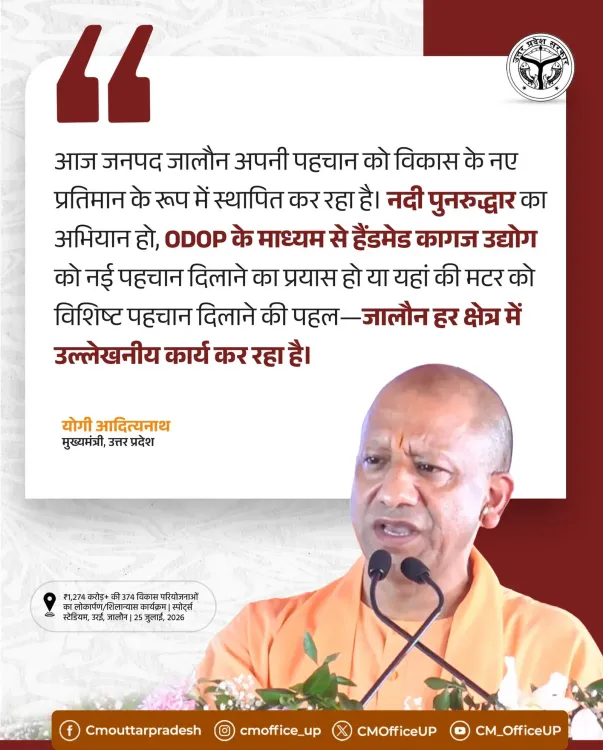
The Chief Minister's Office of Uttar Pradesh on Saturday, 25 July 2026 shared remarks by Chief Minister Yogi Adityanath lauding Jalaun district as an emerging benchmark of development, citing river revival, handmade paper industry promotion under the One District One Product (ODOP) scheme, and a push to give the district's local peas a distinct identity on the national stage.
In his remarks, CM Yogi Adityanath stated: 'Aaj janpad Jalaun apni pehchaan ko vikas ke naye pratimaan ke roop mein sthapit kar raha hai' — 'Today, Jalaun district is establishing its identity as a new benchmark of development.' He specifically highlighted three pillars: a river rejuvenation campaign, efforts to give the handmade paper industry a fresh identity through ODOP, and an initiative to secure a distinct recognition for the district's peas.
Context
Jalaun is a district in the Bundelkhand region of Uttar Pradesh, historically categorised among the state's aspirational or backward districts. The region has long faced challenges related to water scarcity, limited industrial activity, and agricultural distress. The state government's recent emphasis on Jalaun reflects a broader push to transform such districts into visible success stories of targeted governance.
River rejuvenation efforts in Bundelkhand carry particular significance given the region's recurring drought cycles. Restoring local water bodies directly supports both farming communities and small-scale manufacturing units dependent on consistent water access.
Policy Backdrop
The ODOP scheme was formally launched by the Uttar Pradesh government in 2018 with the mandate to identify one signature product per district, scale it through state support, and link it to wider markets. For Jalaun, handmade paper has been identified as the district's ODOP product — a traditional craft with potential for value-addition and export linkages.
The scheme sits within a larger framework of decentralised economic development championed by the Yogi Adityanath administration since 2017, aiming to revive cottage industries, generate local employment, and reduce migration from rural districts. ODOP products from across Uttar Pradesh have been showcased at national trade fairs and international expos as part of the state's MSME promotion drive.
The mention of Jalaun's peas signals a possible push for a Geographical Indication (GI) tag or similar branding exercise — a tool increasingly used by Indian states to protect and market distinctive agricultural produce at premium prices.
Stakeholders and Impact
The primary beneficiaries of these initiatives are local artisans engaged in handmade paper production, pea farmers across Jalaun's agricultural belt, and the broader district population that stands to gain from improved water security through river rejuvenation. Artisans linked to ODOP receive access to design support, credit facilitation, and market linkages that would otherwise be out of reach for individual micro-enterprises.
For farmers, any formal recognition — whether a GI tag or state-level branding — for Jalaun's peas could translate into better price realisation and access to organised retail and export channels. River restoration, meanwhile, underpins both agricultural productivity and the sustainability of water-intensive craft industries in the district.
What's Next
Attention will now turn to the concrete rollout of ODOP-linked marketing and export support for Jalaun's handmade paper, as well as any formal GI tagging proceedings or state branding campaigns for the district's peas. Progress on river rejuvenation projects in Bundelkhand — including timelines and funding allocations — will be closely watched as indicators of whether the stated development momentum translates into measurable outcomes.
The broader pattern suggests that Uttar Pradesh will continue to use district-level showcases as a political and administrative tool ahead of key review cycles, with CM Yogi Adityanath's office amplifying success narratives from aspirational districts to demonstrate the reach of state programmes beyond urban centres.
Point of View
Which has historically been associated with drought, distress migration, and agrarian unrest. Bundling river revival, ODOP, and agricultural branding into a single communication signals an attempt to project holistic, multi-sector progress rather than isolated interventions. The reference to a distinct identity for Jalaun's peas hints at a GI tag push, which, if formalised, would add a concrete, verifiable milestone to what is currently a political statement. Sustaining this narrative will depend on whether the ODOP marketing pipeline and river projects deliver visible outcomes before the next electoral cycle.
NationPress
24 Oct 2026
Frequently Asked Questions
What is the ODOP scheme and how does it apply to Jalaun?
The One District One Product (ODOP) scheme, launched by the Uttar Pradesh government in 2018, identifies one signature product per district for promotion and market linkage. For Jalaun, the identified product is handmade paper, which the state is working to scale and brand through ODOP support.
Why is river rejuvenation important for Jalaun district?
Jalaun lies in the Bundelkhand region, which faces recurring water scarcity and drought. River rejuvenation efforts aim to restore local water bodies, which are critical for agricultural productivity and for sustaining water-dependent craft industries like handmade paper manufacturing.
What recognition is being sought for Jalaun's peas?
CM Yogi Adityanath's remarks indicate an initiative to secure a distinct identity for Jalaun's local peas, which could involve a Geographical Indication (GI) tag or state-level branding to help farmers access better markets and price realisation.
What is Bundelkhand and why is development there significant?
Bundelkhand is a region spanning parts of Uttar Pradesh and Madhya Pradesh, historically marked by poverty, drought, and agrarian distress. Development initiatives here carry political and administrative significance as the region has been a focus of special central and state government packages for over a decade.
What did CM Yogi Adityanath say about Jalaun?
CM Yogi Adityanath stated that Jalaun district is today establishing its identity as a new benchmark of development, citing river rejuvenation, ODOP-backed handmade paper promotion, and efforts to give the district's peas a distinct national identity.