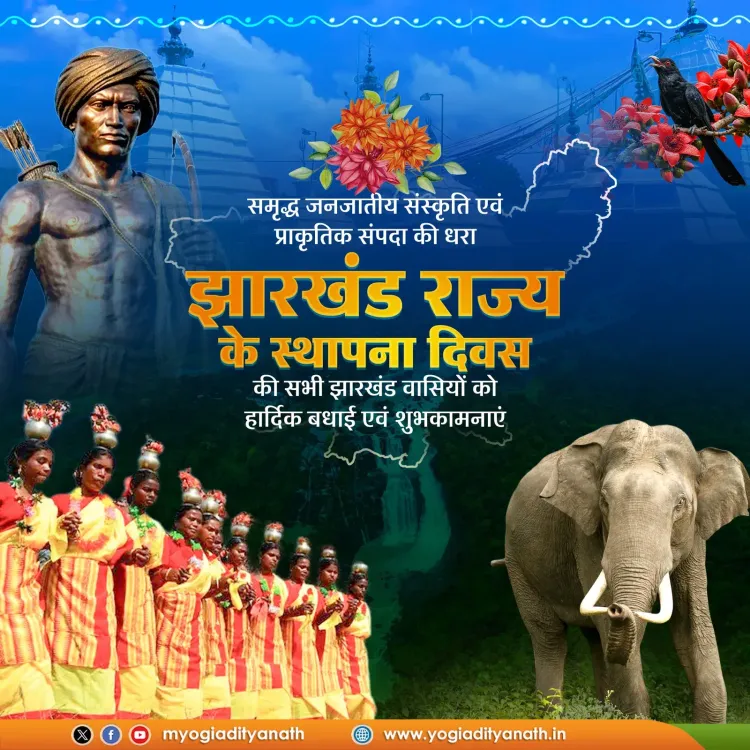
CM Yogi greets Jharkhand on its 26th Foundation Day
Synopsis
UP Chief Minister Yogi Adityanath marked Jharkhand's 26th Foundation Day with a Hindi post honouring tribal icons Birsa Munda and Phoolo-Jhano, and offering a prayer to Baba Baidyanath for the state's continued progress.
Key Takeaways
Jharkhand was formed on 15 November 2000 , carved from southern Bihar under the Bihar Reorganisation Act.
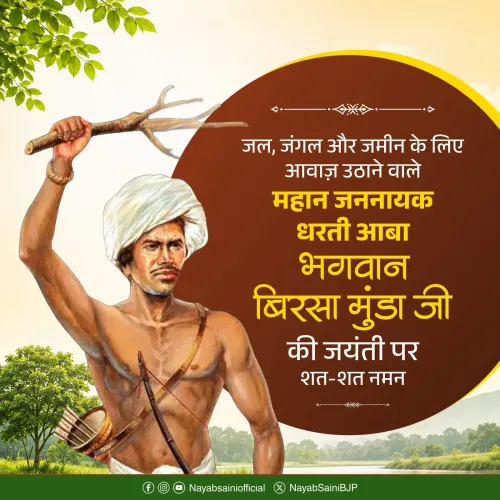
November 15 also marks the birth anniversary of tribal leader Birsa Munda , known as Dharti Aaba (Father of the Earth).
CM Yogi's post honoured Phoolo-Jhano , tribal women who resisted colonial rule in the Chotanagpur region.
The message concluded with a prayer to Baba Baidyanath , the Jyotirlinga shrine at Deoghar in Jharkhand.
The greeting is ceremonial and contains no new policy announcement or bilateral agreement.
On the day Jharkhand marks 26 years of statehood, Uttar Pradesh Chief Minister Yogi Adityanath offered warm greetings to the people of the state, invoking the memory of its greatest tribal icons and offering a prayer at one of its holiest shrines. The post, shared early Sunday morning, is a dignified nod across state lines on a date that carries deep historical weight for India's tribal heartland.
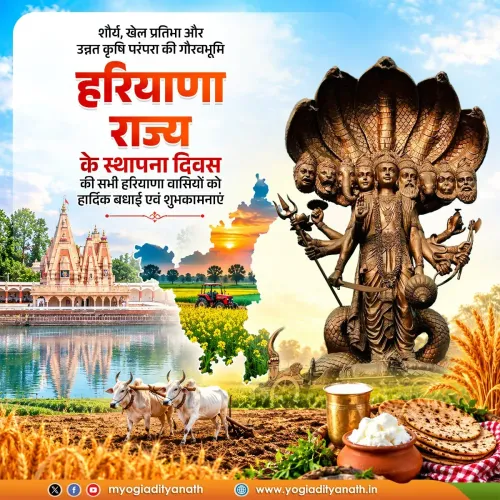
CM Yogi's message, written in Hindi, translates as: 'Heartfelt congratulations to all residents of Jharkhand on the Foundation Day of this sacred land of bravery, resilience, and rich tribal culture. May this state — glorified by the courage, self-respect, and sacrifice of great figures like 'Dharti Aaba' Bhagwan Birsa Munda and veerangana [warrior women] Phoolo-Jhano — continuously touch new heights of development, prosperity, and happiness. That is my prayer to Baba Baidyanath.'
A date that belongs to Birsa Munda as much as to the state
November 15 is doubly significant in Jharkhand: it is both the state's formation day — when it was carved out of southern Bihar on 15 November 2000 under the Bihar Reorganisation Act — and the birth anniversary of Birsa Munda, the late 19th-century tribal leader who led the Ulgulan uprising against British land policies. The choice of date was deliberate, anchoring the new state's identity in its most revered son. CM Yogi's reference to Munda by his honorific 'Dharti Aaba' [Father of the Earth] reflects that enduring reverence.
Phoolo-Jhano and the women of the Chotanagpur resistance
Alongside Birsa Munda, CM Yogi named Phoolo-Jhano — tribal women associated with 19th-century colonial-era resistance in the Chotanagpur region. Their inclusion signals a broader acknowledgement of women's roles in the tribal freedom struggle, a narrative that official messaging across parties has increasingly emphasised in recent years.
Baba Baidyanath: invoking Jharkhand's sacred geography
Closing his message with a prayer to Baba Baidyanath — the Jyotirlinga temple at Deoghar, one of the twelve sacred Shiva shrines in India — CM Yogi grounded his greetings in the state's spiritual landscape. It is a culturally precise touch: Deoghar sits at the heart of Jharkhand's religious identity, and invoking it lends the message a local resonance that goes beyond routine protocol.
Point of View
But the specific framing here is worth noting. By centering Birsa Munda and Phoolo-Jhano — tribal freedom fighters rather than mainstream nationalist icons — CM Yogi aligns with a broader BJP outreach strategy that has elevated indigenous heroes in official discourse. The prayer to Baba Baidyanath adds a Shaivite devotional layer consistent with CM Yogi's public persona as head of the Gorakhnath Math. The message carries no policy signal, but its cultural markers are carefully chosen for a state whose tribal electorate and sacred geography have become increasingly significant in national politics.
NationPress
15 Nov 2026
Frequently Asked Questions
When was Jharkhand formed and why on November 15?
Jharkhand was formed on 15 November 2000 from southern Bihar. The date was chosen to coincide with the birth anniversary of tribal icon Birsa Munda , honouring his legacy as the state's founding spirit.
Who is Birsa Munda and why is he called Dharti Aaba?
Birsa Munda was a late 19th-century tribal leader from the Chotanagpur region who led the Ulgulan uprising against British land policies. He is revered as Dharti Aaba , meaning 'Father of the Earth,' and is considered a central figure in Jharkhand's identity.
Who are Phoolo-Jhano, mentioned by CM Yogi?
Phoolo-Jhano were tribal women associated with 19th-century resistance against colonial rule in the Chotanagpur region of present-day Jharkhand , celebrated as symbols of indigenous courage.
What is Baba Baidyanath and where is it located?
Baba Baidyanath is one of the twelve Jyotirlinga shrines of Lord Shiva , located in Deoghar , Jharkhand , and is a major pilgrimage site central to the state's spiritual identity.
Why did CM Yogi Adityanath post greetings for Jharkhand's Foundation Day?
Indian chief ministers routinely offer cross-state greetings on Foundation Days as a gesture of cooperative federalism and national unity. CM Yogi's post was ceremonial and carried no new policy announcement.