CM Yogi Hails Double Engine Govt for Governance, Faith
Synopsis
Uttar Pradesh CM Yogi Adityanath on 22 July 2026 posted on X to assert that the BJP's double engine government delivers good governance, development, and respect for faith — a three-pillar framing that encapsulates the party's core electoral and governance narrative ahead of the next UP assembly cycle.
Key Takeaways
CM Yogi Adityanath posted on 22 July 2026 reaffirming the BJP's double engine governance thesis for Uttar Pradesh .
His post cited three pillars: sushasan (good governance), vikas (development), and aastha ka samman (respect for faith).
The 'double engine' model refers to the BJP holding power simultaneously at the Centre and in the state since 2017 .
BJP won re-election in Uttar Pradesh in 2022 , extending the aligned central-state governance framework.
The faith pillar reflects the government's positioning of cultural and religious priorities as integral to, not separate from, development.
Opposition scrutiny of project completion rates and public service delivery is expected to intensify ahead of the next assembly election.
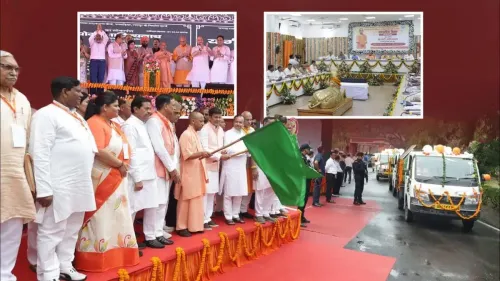
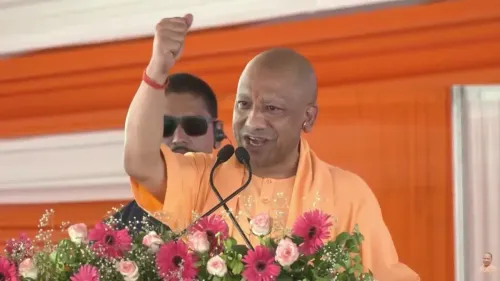
Uttar Pradesh Chief Minister Yogi Adityanath on Wednesday, 22 July 2026, took to X to assert that the BJP's 'double engine' government in Uttar Pradesh delivers good governance, development, and respect for faith simultaneously — a pointed articulation of the ruling party's core campaign thesis ahead of the next state electoral cycle.
In his post, CM Yogi wrote: 'Double engine ki BJP sarkar mein sushasan bhi hai, vikas bhi hai aur aastha ka samman bhi...' — translated as: 'In the BJP's double engine government, there is good governance, there is development, and there is also respect for faith.' The three-part formulation is deliberate, positioning the ruling dispensation as simultaneously competent, progressive, and culturally rooted.
Context
The phrase 'double engine government' refers to the Bharatiya Janata Party's argument that having the same party in power at both the Centre and in a state accelerates policy delivery, reduces friction, and unlocks faster fund flows. Uttar Pradesh, India's most populous state, has been under BJP rule since the 2017 assembly elections when Yogi Adityanath was first installed as Chief Minister. The party secured a second consecutive term in 2022, extending what it describes as an aligned governance framework.
The triad of sushasan (good governance), vikas (development), and aastha ka samman (respect for faith) is not incidental. Each pillar addresses a distinct voter constituency — the reform-minded citizen, the aspirational middle class, and the religiously devout — while presenting them as mutually reinforcing rather than competing priorities.
Policy Backdrop
Since 2017, the Yogi Adityanath-led government has pursued a twin-track approach: large-scale infrastructure investment alongside high-profile cultural and religious projects. The BJP has consistently used the double engine framing across multiple state elections since 2014 to contrast its model with previous non-aligned state governments, arguing that political divergence between Delhi and state capitals slows scheme implementation and Central transfers.
The explicit inclusion of 'respect for faith' as a governance deliverable reflects the party's position that cultural assertiveness and developmental ambition are complementary, not contradictory. This framing has become a signature of CM Yogi's public communication, particularly in the context of religious infrastructure projects and temple-town development in Uttar Pradesh.
Stakeholders and Impact
The primary audiences for this message are Uttar Pradesh's roughly 24 crore eligible voters, Hindu religious communities who form a significant share of the state's electorate, and the broader national BJP base watching the state as a political bellwether. Opposition parties have historically challenged the double engine claim by pointing to ground-level gaps in public service delivery, unemployment, and agrarian distress.
The post also carries weight for investors and policy observers who track Uttar Pradesh's trajectory as the state has sought to rebrand itself as a major destination for industrial and infrastructure capital over the past several years.
What's Next
With the next Uttar Pradesh assembly elections on the horizon, messaging of this kind is expected to intensify as the BJP seeks to consolidate its governance record into a coherent electoral narrative. State-level project completion rates, Centre-state fund utilisation data, and opposition responses to the double engine thesis will be the key metrics to watch in the months ahead. Whether the three-pillar framing — governance, development, faith — translates into sustained voter confidence will be tested at the ballot box.
Point of View
Development, and faith into one sentence, he signals that the party intends to contest the next UP election on all three fronts simultaneously rather than trade one off against another. This is consistent with a broader BJP pattern since 2014 of presenting cultural assertiveness not as a distraction from development but as evidence of a holistic governing philosophy. The timing and brevity of the post suggest it is as much about keeping the base energised as it is about making a new policy announcement.
NationPress
23 Jul 2026
Frequently Asked Questions
What is the double engine government concept in India?
The 'double engine government' is a BJP phrase describing the advantage of having the same party in power at both the Central government and a state government simultaneously, which the party argues enables faster fund flows, policy alignment, and scheme implementation.
What did CM Yogi Adityanath say in his 22 July 2026 post?
CM Yogi Adityanath posted on X that the BJP's double engine government in Uttar Pradesh delivers good governance, development, and respect for faith — summarised in Hindi as 'sushasan bhi hai, vikas bhi hai aur aastha ka samman bhi.'
How long has BJP been in power in Uttar Pradesh?
The BJP has governed Uttar Pradesh continuously since the 2017 assembly elections, with Yogi Adityanath as Chief Minister, and secured a second term after the 2022 state elections.
What does 'aastha ka samman' mean in CM Yogi's governance framework?
'Aastha ka samman' translates to 'respect for faith' and refers to the BJP-led Uttar Pradesh government's policy of treating religious and cultural priorities as a legitimate and integral component of its governance agenda, alongside infrastructure and economic development.
When is the next Uttar Pradesh assembly election?
The next Uttar Pradesh assembly election is expected in early 2027, and political messaging around the double engine governance record is anticipated to increase in the lead-up to that contest.