CM Yogi credits PM Modi's call for 2017 UP government formation
Synopsis
Uttar Pradesh Chief Minister Yogi Adityanath credited Prime Minister Narendra Modi's call for the BJP's 2017 government formation in the state, saying the double engine administration worked two steps ahead of public aspirations. The post revives a key BJP framing ahead of the 2027 state elections.
Key Takeaways
UP CM Yogi Adityanath credited PM Narendra Modi's call for the BJP's 2017 government formation in Uttar Pradesh.
He said the double engine government worked two steps ahead of public aspirations.
The BJP first formed government in UP in 2017 and returned to power in 2022.
The double engine framing refers to BJP rule at both the Centre and state levels.
The messaging comes ahead of the next Uttar Pradesh assembly elections due in 2027.
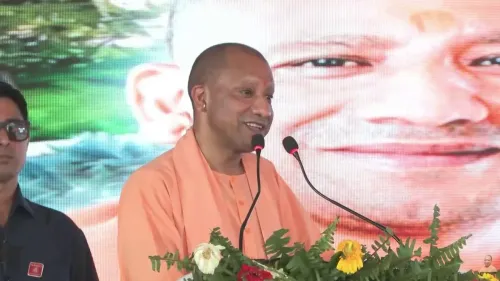
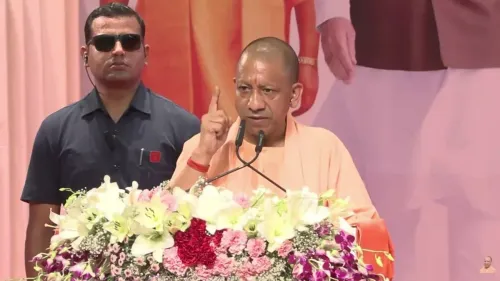
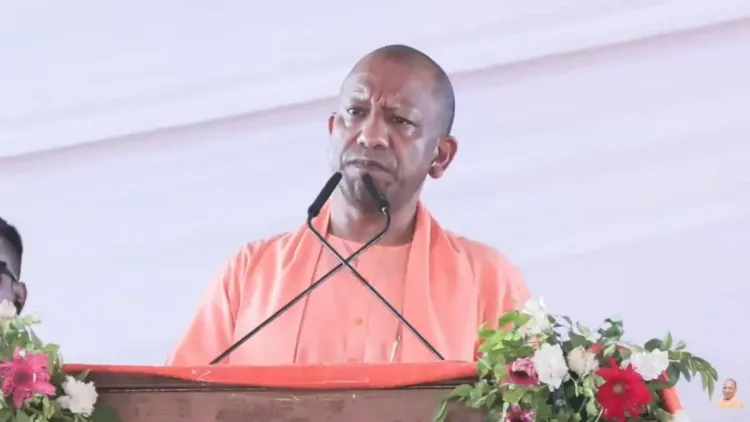
Uttar Pradesh Chief Minister Yogi Adityanath on Wednesday credited Prime Minister Narendra Modi's appeal for the formation of the Bharatiya Janata Party (BJP) government in Uttar Pradesh in 2017, asserting that the 'double engine' administration had moved 'two steps ahead' of public expectations. The remarks were shared via a video post on his official X handle, invoking a recurring BJP narrative of Centre-state synergy.
In the post, written in Hindi, the Chief Minister said: 'Aadarniya Pradhan Mantri Shri @narendramodi ji ke aahvaan par varsh 2017 mein UP mein sarkar bani' ('On the call of the honourable Prime Minister Shri Narendra Modi ji, the government was formed in UP in 2017'). He added that 'whatever the aspirations of the people were, the double engine government worked by going two steps ahead of them'.
Context
The BJP returned to power in Uttar Pradesh after the 2017 assembly elections with a sweeping majority, and Yogi Adityanath, the head of the Gorakhnath Math in Gorakhpur, was named Chief Minister. The state administration was renewed for a second consecutive term following the 2022 assembly polls, making him the first Uttar Pradesh Chief Minister to complete a full term and return with a majority in recent decades.
The 'double engine' phrase, used widely by BJP leaders since 2014, refers to political alignment between a BJP-led Union government and a BJP state government, framed as enabling faster implementation of welfare and infrastructure programmes.
Policy backdrop
Following Prime Minister Narendra Modi's 2014 Lok Sabha victory, the BJP expanded its footprint across several state legislatures, with Uttar Pradesh emerging as its largest electoral prize. Central schemes spanning housing, sanitation, rural electrification, direct benefit transfers and road connectivity have since been routed through state delivery machinery in BJP-ruled states.
The Chief Minister's framing positions the state's post-2017 record — covering law and order, expressway construction, investment summits and welfare rollouts — as a continuation of national priorities rather than standalone state action. It is a message the party has consistently deployed in campaigns in states where it seeks to retain or reclaim power.
Stakeholders and impact
For the roughly 24 crore residents of Uttar Pradesh, the double-engine claim is tied to perceptions of scheme delivery, employment, and security. State administration officials, district magistrates and implementing agencies are positioned as the operational arms of this Centre-state coordination.
For the BJP organisation, the messaging consolidates the Chief Minister's profile as a senior party figure with a demonstrable governance record, while reinforcing the Prime Minister as the originating force behind the state mandate. Opposition parties in the state, including the Samajwadi Party, Bahujan Samaj Party and Congress, have periodically contested the double-engine claim, arguing that key socio-economic indicators require independent scrutiny.
What's next
Attention will turn to the next Uttar Pradesh assembly elections due in 2027, with the state government expected to highlight scheme completions, capital expenditure data and investment commitments from successive Global Investors Summits. Budget announcements and any cabinet-level rollouts in the coming months are likely to be packaged within the same double-engine framing.
The Chief Minister's post signals an early start to that narrative-building exercise, anchoring the BJP's state pitch to the partnership with the Prime Minister well ahead of the formal poll cycle.
Point of View
Anchoring the state record firmly to the Prime Minister's political brand. By invoking the 2017 mandate as a response to PM Modi's call, the Chief Minister both signals deference to the central leadership and claims operational credit through the double-engine framing. The phrasing — 'two steps ahead of aspirations' — is calibrated to pre-empt opposition critique on jobs, agrarian distress and law-and-order metrics. Expect this template to recur across BJP-ruled states as the party shifts into pre-poll messaging mode.
NationPress
18 Oct 2026
Frequently Asked Questions
What did Yogi Adityanath say about PM Modi and the 2017 UP government?
Uttar Pradesh Chief Minister Yogi Adityanath said the BJP government was formed in the state in 2017 on Prime Minister Narendra Modi's call, and that the double engine administration worked two steps ahead of public aspirations.
What is the double engine government in India?
The 'double engine' is a BJP framing that describes political alignment between a BJP-led Union government and a BJP-ruled state government, positioned as enabling faster delivery of welfare schemes and infrastructure projects.
When did Yogi Adityanath first become Chief Minister of Uttar Pradesh?
Yogi Adityanath became Chief Minister of Uttar Pradesh in March 2017 after the BJP won a sweeping majority in the state assembly elections, and was sworn in for a second consecutive term in 2022.
When are the next Uttar Pradesh assembly elections?
The next Uttar Pradesh assembly elections are due in 2027, when the current state government's five-year term concludes.
Who is the head of the Gorakhnath Math?
Yogi Adityanath, the Chief Minister of Uttar Pradesh, is the Mahant or head of the Gorakhnath Math, a prominent Nath sect monastery located in Gorakhpur, Uttar Pradesh.