CM Yogi pays tribute to Mahakavi Jaishankar Prasad on death anniversary
Synopsis
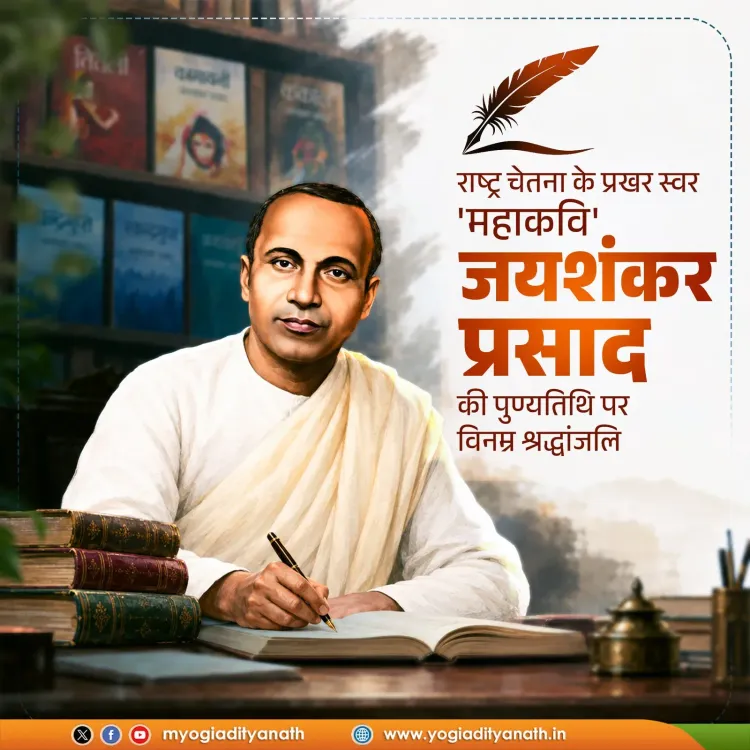
Uttar Pradesh Chief Minister Yogi Adityanath on 15 November 2026 paid tribute to Mahakavi Jaishankar Prasad on his death anniversary, honouring the Chhayavad poet's immortal contributions to Hindi literature including the epic Kamayani.
Key Takeaways
CM Yogi Adityanath paid tribute to Mahakavi Jaishankar Prasad on his death anniversary on 15 November 2026 .
Prasad ( 1889–1937 ) was a leading poet, playwright, and novelist — one of four pillars of the Chhayavad movement in Hindi literature.
His landmark works include the epic poem Kamayani and historical plays Chandragupta and Skandagupta .
CM Yogi described Prasad as 'a devoted seeker of Hindi literature and a foremost pillar of Chhayavad.' The tribute continues a pattern since 2017 of the UP government publicly honouring canonical Hindi literary figures on their anniversaries.
A poet who gave Hindi literature its soul — and who died nearly nine decades ago — was remembered on Sunday, 15 November 2026 by Uttar Pradesh Chief Minister Yogi Adityanath, who offered a solemn tribute to Mahakavi Jaishankar Prasad on his death anniversary.
In his post, CM Yogi described Prasad as 'हिंदी साहित्य के अनन्य साधक एवं छायावाद के प्रमुख स्तंभ' — 'a devoted seeker of Hindi literature and a foremost pillar of the Chhayavad movement' — and expressed that Prasad's immortal body of work would continue to inspire young writers and give new direction to Hindi literature for all time to come.
The poet who shaped an era: who was Jaishankar Prasad?
Jaishankar Prasad (1889–1937) was one of the four defining pillars of Chhayavad, the romantic and mystical movement that transformed Hindi poetry in the early twentieth century. Born in Varanasi, he gave the language some of its most enduring works — among them the epic poem Kamayani, widely regarded as a masterpiece of modern Hindi literature, and the celebrated historical plays Chandragupta and Skandagupta. He lived only 48 years, yet the range of his output — poetry, drama, fiction — placed him among the immortals of Indian literary tradition.
Yogi's consistent recognition of Hindi literary heritage
This tribute is not a one-off gesture. Since 2017, the Uttar Pradesh government under Yogi Adityanath has maintained a consistent pattern of publicly honouring canonical Hindi literary figures on their birth and death anniversaries. Prasad, as a son of Varanasi — a city that also holds deep significance in CM Yogi's own political and spiritual identity — occupies a particularly prominent place in that tradition of remembrance.
The homage reflects a broader state-level commitment to positioning Uttar Pradesh as the custodian of Hindi literary heritage, a role the government has signalled through cultural programmes, literary festivals, and institutional recognition of Chhayavad-era poets.
Nearly ninety years after his death, Jaishankar Prasad's verse still echoes in classrooms, on stages, and in the imagination of a new generation of Hindi writers — proof, perhaps, that the Mahakavi needed no government decree to remain immortal.
Point of View
Prasad's birthplace and PM Modi's parliamentary constituency, amplifies that symbolic geography. The pattern of such tributes since 2017 suggests they are as much about constructing a cultural narrative for the state as they are about personal literary reverence.
NationPress
15 Nov 2026
Frequently Asked Questions
Who was Jaishankar Prasad?
Jaishankar Prasad (1889–1937) was a celebrated Hindi poet, playwright, and novelist from Varanasi, best known for the epic poem Kamayani and plays such as Chandragupta and Skandagupta. He is regarded as one of the four foremost pillars of the Chhayavad movement in Hindi literature.
What is the Chhayavad movement in Hindi literature?
Chhayavad was a romantic and mystical literary movement that flourished in Hindi poetry during the early twentieth century. It emphasised individual emotion, nature, and spirituality, and transformed the language and form of Hindi verse. Jaishankar Prasad was one of its defining figures.
Why did CM Yogi Adityanath pay tribute to Jaishankar Prasad?
CM Yogi marked Jaishankar Prasad's death anniversary on 15 November 2026 with a tribute on X, calling him a devoted seeker of Hindi literature and a pillar of Chhayavad. The Uttar Pradesh government has maintained a consistent tradition of honouring canonical Hindi literary figures since 2017.
What is Kamayani, and why is it significant?
Kamayani is an epic poem written by Jaishankar Prasad, widely considered a masterpiece of modern Hindi literature. It draws on ancient Indian mythology and explores themes of human consciousness, emotion, and spiritual quest, and remains a foundational text in Hindi literary studies.
When did Jaishankar Prasad die?
Jaishankar Prasad died in 1937 at the age of 48 in Varanasi. Despite his short life, he produced a vast body of work spanning poetry, drama, and fiction that continues to be studied and celebrated across India.