CM Yogi: Kashi and Tamil Nadu are eternal cultural streams
Synopsis
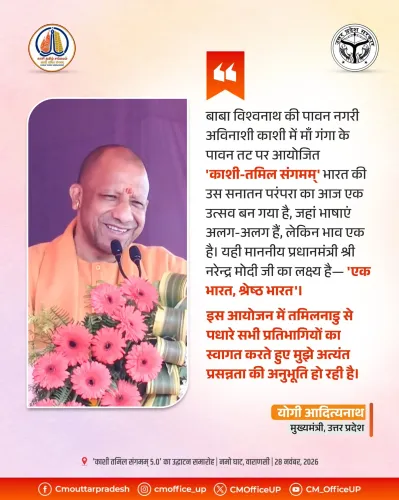
The Chief Minister's Office of Uttar Pradesh quoted CM Yogi Adityanath as saying Kashi and Tamil Nadu are eternal streams of Indian civilisation, with Tenkashi as living proof of their bond.
Key Takeaways
The Chief Minister's Office of Uttar Pradesh posted a statement quoting CM Yogi Adityanath on Kashi and Tamil Nadu.
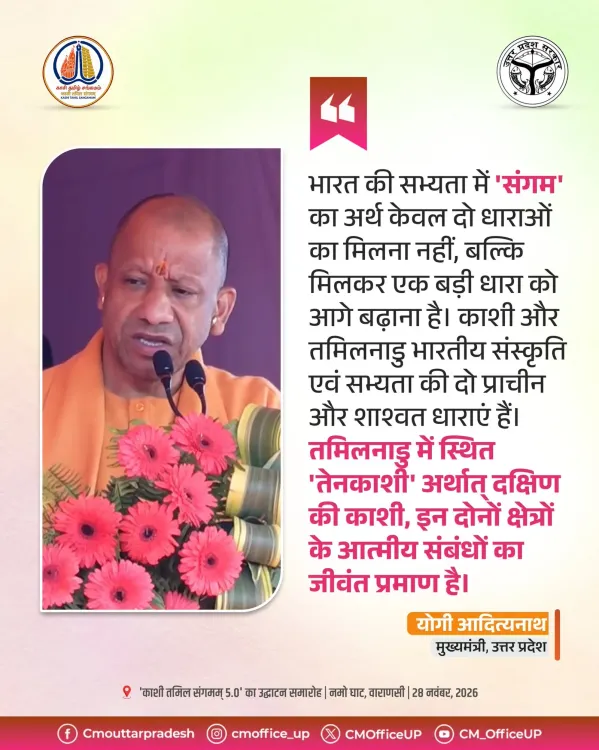
Yogi described sangam as streams joining to carry a larger current forward, not merely meeting.
He called Kashi and Tamil Nadu two ancient and eternal streams of Indian culture and civilisation.
Tenkashi in Tamil Nadu, meaning the Kashi of the South, was cited as living proof of ties between the regions.
The message did not announce a new scheme, visit, or joint programme.
Sangam, in India's civilisational vocabulary, is not two currents merely colliding. It is, the Chief Minister's Office of Uttar Pradesh said on Saturday, streams joining so that a larger river can move ahead — and that larger river, in this telling, runs between Kashi and Tamil Nadu.
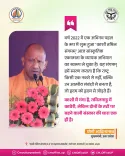
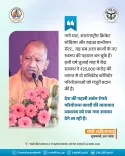
Quoting Chief Minister Yogi Adityanath, the office wrote that in India's civilisation the meaning of sangam is not merely the meeting of two streams, but coming together to carry a larger stream forward. Kashi and Tamil Nadu, the message said, are two ancient and eternal streams of Indian culture and civilisation.
The living proof, it added, sits in the south: Tenkashi, or dakshin ki Kashi — the Kashi of the South — described as evidence of the intimate bond between the two regions.
Tenkashi, the Kashi of the South
The town of Tenkashi, widely known as Tenkasi, takes its very name from that claim of kinship with Varanasi. For pilgrims and temple scholars, the Kashi Vishwanath tradition in the north and the Dravidian temple landscape in the south have long been treated as parallel inheritances rather than rival ones.
That pairing is not a sudden invention. Public discourse in India has, for decades, spoken of Dakshina Kashi shrines as southern mirrors of the Ganga city's sanctity — a religious geography that predates any one government's messaging.
North and south as one larger current
Statements of this kind form a familiar pattern in Uttar Pradesh public communication: shared civilisational symbols used to link northern and southern traditions. The sangam metaphor does cultural work without announcing a scheme, a visit, or a new fund.
It still lands with a clear claim. India's oldest maps, this argument says, were never drawn as north versus south — only as streams that grow when they refuse to stay in their own banks.
Point of View
Not pending in politics. The post offers no operational follow-up — no festival, no pact, no travel calendar — which keeps it in the realm of identity signalling rather than policy delivery. Watch whether Lucknow and Chennai convert the metaphor into joint cultural events; until then, it is a civilisational frame, not a programme.
NationPress
28 Nov 2026
Frequently Asked Questions
What did CM Yogi Adityanath say about Kashi and Tamil Nadu?
He said Kashi and Tamil Nadu are two ancient and eternal streams of Indian culture and civilisation. The Chief Minister's Office of Uttar Pradesh quoted him arguing that sangam means joining to carry a larger stream forward.
What is Tenkashi or Dakshina Kashi?
Tenkashi, also known as Tenkasi in Tamil Nadu, is traditionally called the Kashi of the South. Yogi Adityanath cited it as living proof of intimate cultural ties between Kashi and Tamil Nadu.
What does sangam mean in Yogi Adityanath's statement?
He said sangam in India's civilisation is not merely two streams meeting. It means coming together to take a larger stream forward.
Who issued the Kashi-Tamil Nadu statement?
The Chief Minister's Office of Uttar Pradesh posted the remarks, attributing them to Chief Minister Yogi Adityanath. It was cultural messaging, not a new scheme announcement.
Why is Tenkasi linked to Varanasi?
Tenkasi is traditionally associated with Varanasi through the Dakshina Kashi idea, a long-standing religious narrative. The CM's office used that link as evidence of north-south civilisational kinship.