CM Yogi Marks Partition Remembrance Day With Sharp Critique
Synopsis
On Partition Horrors Remembrance Day, UP CM Yogi Adityanath posted that political leaders gained while India was weakened by the 1947 Partition, and that innocent citizens bore the ultimate cost — a sharp BJP critique ahead of Independence Day.
Key Takeaways
Yogi Adityanath posted on 14 August 2026 , coinciding with Partition Horrors Remembrance Day .
He stated that 'political bread was toasted' for some while India was weakened by the 1947 Partition .
He said both India as a nation and its innocent citizens paid the price of Partition.
The Government of India declared 14 August as Partition Horrors Remembrance Day in 2021 .
The post continues a recurring BJP pattern of invoking Partition around Independence Day to draw a contrast with the Congress-era leadership.
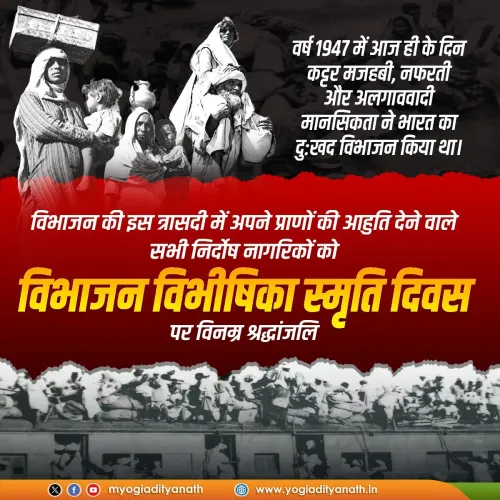
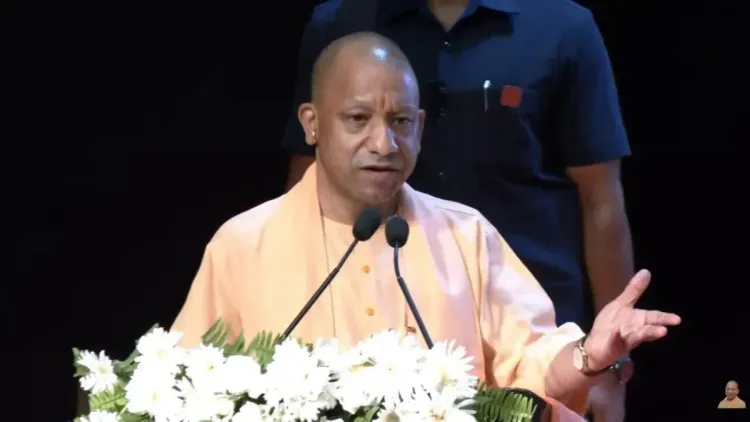
On the eve of India's Independence Day, Uttar Pradesh Chief Minister Yogi Adityanath turned to the wounds of 1947 — not to mourn quietly, but to indict. In a pointed post on 14 August 2026, coinciding with Partition Horrors Remembrance Day, he wrote that political bread was baked on the backs of a weakened India, and that the price of Partition was paid by the nation and its innocent citizens.
The post, in Hindi, states: 'Unki' rajnitik roti senki jaati rahi, lekin kamzor Bharat hua. Vibhajan ki keemat Bharat ko chukani padi, nirdosh nagrikon ko chukani padi... — 'Their political bread was toasted all along, but India was weakened. India had to pay the price of Partition. Innocent citizens had to pay the price.'
The Day India Chose to Remember Its Deepest Scar
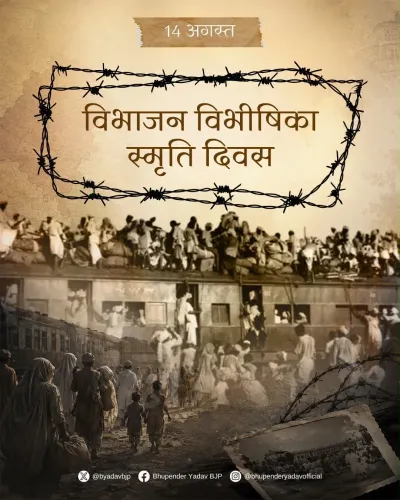
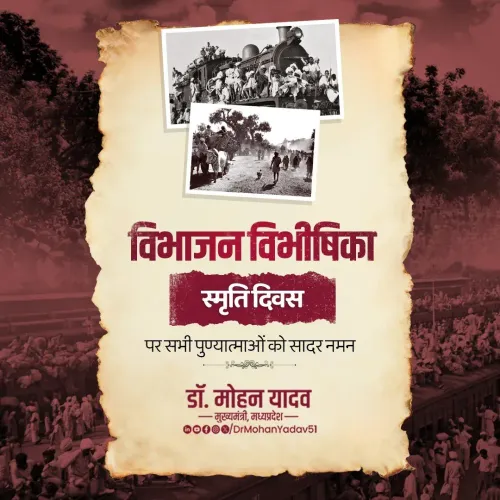
14 August is not just Pakistan's Independence Day on the Indian calendar. Since 2021, the Government of India has designated it Partition Horrors Remembrance Day — a formal occasion to recall the displacement of millions and the communal violence that claimed hundreds of thousands of lives when British India was divided into two nations. CM Yogi's remarks land squarely within that official frame.
The phrase 'unki rajnitik roti' — 'their political bread' — carries unmistakable directional weight. Without naming a party, the language points toward the Congress leadership of the pre-independence era, a target the BJP has returned to consistently around Independence Day, arguing that the acceptance of Partition was a political compromise that left India territorially diminished and socially scarred for generations.
A Recurring BJP Narrative, Sharpened Each August
This is not a one-off. Statements framing Partition as a historical error — one whose costs ordinary Indians still bear — have become a fixture of BJP political communication in the days bracketing 15 August. The argument is structural: contrast the sacrifices of citizens against the calculations of leaders, and let the listener draw the conclusion about who truly served the nation.
CM Yogi, as head of the Gorakhnath Math and one of the BJP's most prominent voices on questions of Hindu identity and national memory, carries particular weight when he invokes Partition. His framing — that the weak bore the cost of the powerful's choices — is designed to resonate both as historical grievance and as contemporary political contrast.
As India marks another Independence Day, the debate over who owns the memory of 1947 — and who answers for its costs — is far from settled.
Point of View
It keeps a historical grievance alive as a contemporary electoral argument. The choice of 14 August — Partition Horrors Remembrance Day — is deliberate, lending institutional legitimacy to what is also a partisan critique. This narrative has deepened since 2021, when the Centre formalised the day, giving BJP leaders a state-sanctioned platform to revisit 1947 on their own terms. The long-term effect is to embed the Congress's pre-independence decisions into present-day political identity contests.
NationPress
14 Aug 2026
Frequently Asked Questions
What is Partition Horrors Remembrance Day in India?
Partition Horrors Remembrance Day is observed on 14 August every year. The Government of India declared it in 2021 to commemorate the suffering, displacement of millions, and communal violence that accompanied the 1947 Partition of British India into India and Pakistan.
What did CM Yogi Adityanath say about the 1947 Partition?
CM Yogi said that while some people toasted their 'political bread,' India was weakened, and that the price of Partition was paid by India and its innocent citizens — an implicit critique of the Congress leadership that accepted Partition in 1947.
Why does the BJP raise the Partition issue around Independence Day?
The BJP regularly uses the 14-15 August period to argue that the 1947 Partition was a political compromise by the then-Congress leadership that left India territorially and socially damaged, contrasting it with the current government's approach to national security and unity.
Who is Yogi Adityanath?
Yogi Adityanath is the Chief Minister of Uttar Pradesh , a senior BJP leader, and the head of the Gorakhnath Math in Gorakhpur. He is one of the party's most prominent voices on issues of Hindu identity and national memory.
When was 14 August declared Partition Horrors Remembrance Day?
The Government of India declared 14 August as Partition Horrors Remembrance Day in 2021 , to ensure that the trauma and sacrifices of Partition victims are never forgotten.