CM Yogi: Metro runs in 7 UP cities, NW-1 links Varanasi to Haldia
Synopsis
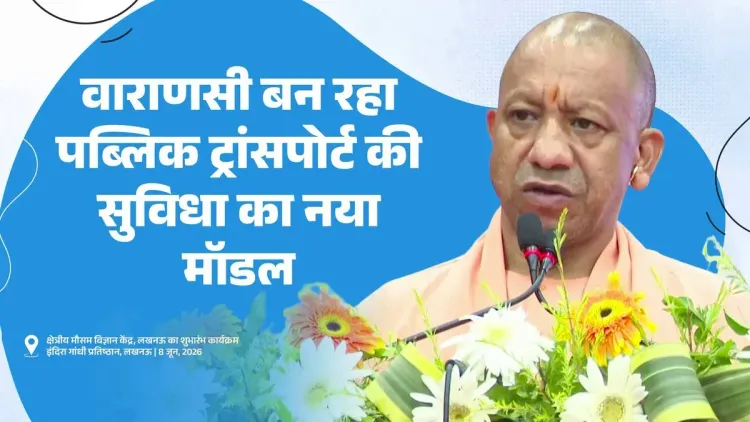
Chief Minister Yogi Adityanath has stated that metro services are now running in seven Uttar Pradesh cities and that India's first inland waterway between Varanasi and Haldia is successfully operational, marking a dual infrastructure milestone for the state.
Key Takeaways
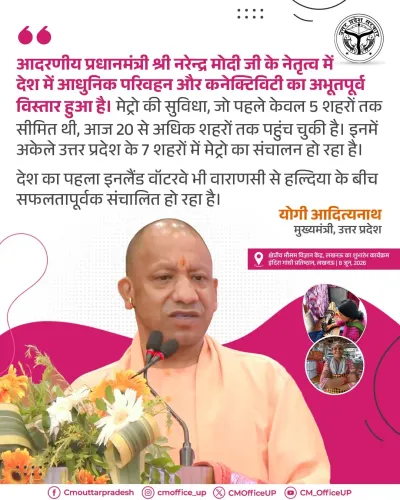
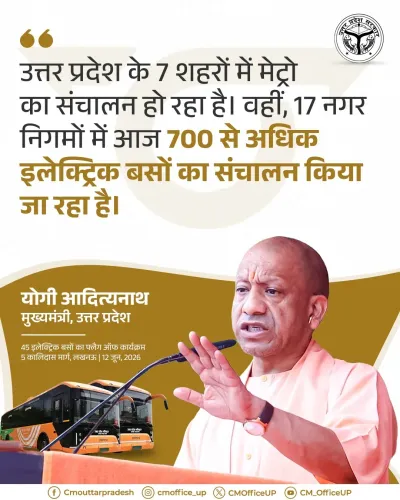
Metro rail is currently operational in 7 cities across Uttar Pradesh , according to Chief Minister Yogi Adityanath .
National Waterway 1 (NW-1) , India's first inland waterway, links Varanasi to Haldia and is described as successfully operational.
Lucknow Metro , launched in 2017 , was the first metro system in Uttar Pradesh; the network has since expanded to multiple cities.
NW-1 was formalised under the National Waterways Act, 2016 and developed through the Jal Marg Vikas Project .
The AMRUT mission and central budget allocations since 2014 have backed UP's metro and urban mobility expansion.
Key beneficiaries include urban commuters, logistics operators, and riverine traders along the Ganga corridor .
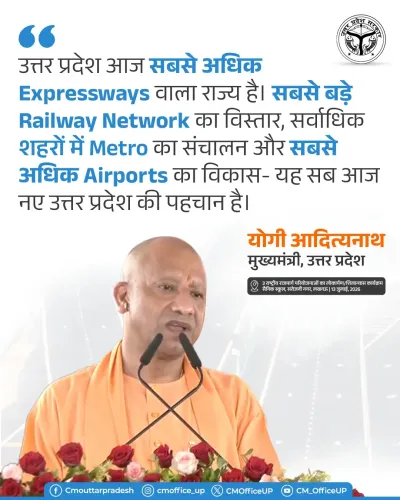
The Chief Minister's Office of Uttar Pradesh, citing Chief Minister Yogi Adityanath, on Friday, 12 June 2026, highlighted the state's twin infrastructure milestones: metro rail now operational across seven cities in Uttar Pradesh, and India's first inland waterway running successfully between Varanasi and Haldia.
Context
The post, attributed directly to Chief Minister Yogi Adityanath, states in Hindi: 'आज उत्तर प्रदेश के 7 शहरों में मेट्रो का संचालन हो रहा है' ('Today, metro services are running in 7 cities of Uttar Pradesh'). It further notes that 'देश का पहला इनलैंड वॉटरवे भी वाराणसी से हल्दिया के बीच सफलतापूर्वक संचालित है' ('The country's first inland waterway is also successfully operational between Varanasi and Haldia'). The statement frames both achievements as simultaneous markers of the state's urban and waterway connectivity growth.
Uttar Pradesh is India's most populous state and has historically lagged in urban mass-transit infrastructure. The claim of seven operational metro cities represents a significant expansion from the single metro system — Lucknow Metro — that began commercial operations in 2017 as the state's first.
Policy Backdrop
National Waterway 1 (NW-1), India's first designated inland waterway, runs along the Ganga river from Varanasi in eastern Uttar Pradesh to Haldia in West Bengal — a stretch of approximately 1,620 kilometres. It was formalised under the National Waterways Act, 2016, and developed through the Jal Marg Vikas Project with support from the Inland Waterways Authority of India (IWAI). A multi-modal terminal at Varanasi serves as the western anchor of this corridor.
Metro expansion across UP cities has been supported by the Atal Mission for Rejuvenation and Urban Transformation (AMRUT), launched in 2015, alongside dedicated central allocations from Union Budgets since 2014. Cities including Lucknow, Kanpur, Agra, and Meerut have been part of successive phases of metro rail planning and development in the state.
Stakeholders and Impact
Urban commuters across Uttar Pradesh are the primary beneficiaries of metro expansion, with reduced road congestion and improved last-mile connectivity cited as key outcomes. For logistics and freight operators, NW-1 offers a lower-cost alternative to road and rail for bulk cargo movement between the Gangetic heartland and eastern seaports.
Riverine traders and small businesses along the Ganga corridor also stand to gain from improved waterway infrastructure, while the broader Uttar Pradesh economy benefits from reduced logistics costs — a stated objective of both the Sagarmala and Bharatmala programmes at the central level.
What's Next
Attention will now turn to the commissioning of additional metro corridors and capacity utilisation at the Varanasi multi-modal terminal. Expansion of freight volumes on NW-1 and the pace of metro ridership growth across newer UP cities will be key indicators of whether the infrastructure investments are translating into measurable economic and commuter impact.
With Uttar Pradesh positioning itself as a model for multi-modal connectivity among India's large states, the government's ability to sustain operations, attract private logistics players to the waterway, and extend metro networks to smaller urban centres will define the next phase of this infrastructure push.
Point of View
Not merely a road-dependent economy. It aligns closely with the central government's Sagarmala and AMRUT frameworks, signalling continued political alignment between Lucknow and New Delhi on infrastructure spending. The specific invocation of NW-1 is notable: waterway freight has historically underperformed its targets, and the 'successfully operational' framing appears designed to counter that narrative. Taken together, the statement is as much a political positioning exercise ahead of continued infrastructure investment cycles as it is a factual update on project status.
NationPress
13 Sept 2026
Frequently Asked Questions
Which 7 cities in Uttar Pradesh have metro rail?
Chief Minister Yogi Adityanath has stated that metro services are operational in 7 Uttar Pradesh cities as of June 2026. Cities that have been part of UP's metro expansion include Lucknow, Kanpur, Agra, Meerut, and others under various phases of development.
What is India's first inland waterway?
India's first inland waterway is National Waterway 1 (NW-1), which runs along the Ganga river from Varanasi in Uttar Pradesh to Haldia in West Bengal, covering approximately 1,620 kilometres.
When did Lucknow Metro start operations?
Lucknow Metro began commercial operations in 2017, making it the first metro rail system in Uttar Pradesh.
What is the Jal Marg Vikas Project?
The Jal Marg Vikas Project is a central government initiative to develop National Waterway 1 on the Ganga, including multi-modal terminals at Varanasi and other locations, operated by the Inland Waterways Authority of India.
How does UP metro expansion connect to AMRUT?
The Atal Mission for Rejuvenation and Urban Transformation (AMRUT), launched in 2015, provides central funding support for metro rail and urban mobility projects in Uttar Pradesh cities as part of a broader urban infrastructure programme.