CM Yogi Directs UP to Build Integrated Health System

Synopsis
Chief Minister Yogi Adityanath has directed Uttar Pradesh's health department to develop a technology-driven, integrated health system spanning prevention, early detection, quality treatment, rehabilitation, mental health, yoga, and AYUSH services — moving decisively beyond a treatment-only model.
Key Takeaways
CM Yogi Adityanath directed that Uttar Pradesh's health system be restructured as a coordinated, technology-based model covering prevention, early detection, treatment, rehabilitation, and research.
The directive explicitly calls for ensuring adequate availability of specialist doctors, nursing staff, and paramedical personnel across the state.
AYUSH -based services — Ayurveda, Yoga, Unani, Siddha, and Homeopathy — are to be integrated alongside modern medicine within the public health delivery framework.
Mental health support and rehabilitation services were named as core components of the new integrated model, not optional add-ons.
The directive aligns with the National Health Policy 2017 and the Ayushman Bharat programme's goals of preventive and primary-care-first delivery.
Implementation focus will fall on district hospitals and the next UP state health budget for dedicated allocations.
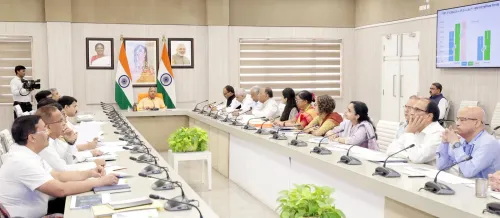
The Chief Minister's Office of Uttar Pradesh, posting on behalf of Chief Minister Yogi Adityanath, on Friday, 3 July 2026, directed that the state's health system be transformed from a treatment-only model into a comprehensive, technology-driven framework covering prevention, early detection, quality treatment, rehabilitation, research, and integrated care.
Addressing health officials, CM Yogi stated that the health system should not remain confined to treatment alone — 'केवल उपचार केंद्रित न रखकर' ('not limited to treatment alone') — but must evolve into a coordinated system built around prevention, timely diagnosis, quality care, rehabilitation, research, and technology. He also directed authorities to ensure the availability of specialist doctors, nursing staff, and paramedical personnel across the state.
Context
Uttar Pradesh, India's most populous state, has been scaling its health infrastructure over recent years, expanding medical colleges and deploying telemedicine networks at the district level. The Chief Minister's directive reflects a broader push to move beyond reactive, hospital-centric care toward a model that addresses the full continuum of a patient's health journey — from prevention through to long-term rehabilitation. The instructions specifically called for promoting modern medicine alongside AYUSH-based services — covering Ayurveda, Yoga, Unani, Siddha, and Homeopathy — as well as dedicated mental health support and rehabilitation services, integrating these into a single coordinated delivery system.Policy Backdrop
The direction aligns closely with the National Health Policy 2017, which set national goals for preventive care, early detection, and technology-integrated health systems. The policy called on states to shift emphasis from curative to promotive and preventive care, a mandate that Uttar Pradesh is now actively operationalising at the institutional level. The Ayushman Bharat programme, launched in 2018, further reinforced this trajectory by expanding primary health centres and linking secondary and tertiary care through insurance coverage. The National Mental Health Policy, updated in 2014, mandated that mental health services be embedded within general health delivery — a requirement that CM Yogi's latest directive explicitly echoes. Across Indian states, the post-2020 period has seen a marked increase in directives combining modern clinical medicine with AYUSH and yoga services, particularly within state health missions that operate district-level facilities.Stakeholders and Impact
The directive directly concerns healthcare professionals across Uttar Pradesh, including specialist physicians, nursing staff, and paramedical workers, whose deployment and availability the Chief Minister specifically flagged as a priority. For the state's residents — the largest population of any Indian state — the shift toward prevention and early detection holds the potential to reduce the disease burden and out-of-pocket medical expenditure over time. The inclusion of yoga and AYUSH-based services alongside rehabilitation and mental health support signals an intent to make district hospitals function as multi-modal care centres rather than purely acute-care facilities. Mental health, long underfunded in public systems, receives explicit mention as a co-equal component of the integrated model.What's Next
Attention will now turn to how these directives are translated into operational plans at the district hospital level and whether dedicated allocations appear in the next Uttar Pradesh state health budget. The rollout of integrated AYUSH, rehabilitation, and mental health services within existing public health infrastructure will serve as the key measure of implementation. If the state follows through with structural changes — staffing norms, facility upgrades, and technology platforms — this directive could mark a meaningful shift in how UP's public health system functions for crores of residents.Point of View
Ayushman Bharat, and the mental health integration push — into a single state-level operational instruction. The explicit mention of rehabilitation and mental health alongside AYUSH signals that Uttar Pradesh is attempting to reframe district hospitals as full-spectrum care centres, not just acute-care nodes. The political calculus is equally clear: a state with UP's demographic scale gains significant electoral and governance credibility by demonstrating measurable improvements in preventive and primary care. The real test will be whether budget allocations and staffing norms follow the rhetoric in the months ahead.
NationPress
2 Oct 2026
Frequently Asked Questions
What did CM Yogi say about UP's health system?
CM Yogi Adityanath directed that Uttar Pradesh's health system be developed beyond treatment alone into an integrated model covering prevention, early detection, quality treatment, rehabilitation, research, and technology — with AYUSH, yoga, and mental health services included.
What is AYUSH and why is it part of UP's health directive?
AYUSH is a government framework promoting Ayurveda, Yoga, Unani, Siddha, and Homeopathy alongside modern medicine. CM Yogi's directive includes AYUSH-based services as a formal component of Uttar Pradesh's integrated public health delivery system.
What is the National Health Policy 2017 and how does it relate to this directive?
The National Health Policy 2017 is a central government document that set goals for preventive care, early detection, and technology-driven health systems. CM Yogi's directive operationalises many of its recommendations at the state level in Uttar Pradesh.
Why did CM Yogi emphasise mental health in the UP health directive?
Mental health was explicitly named alongside rehabilitation and AYUSH services to ensure it is treated as a core component of the integrated health system, consistent with the National Mental Health Policy's mandate to embed mental health within general health delivery.
What will happen next after CM Yogi's health system directive in UP?
The focus will shift to how district hospitals implement integrated AYUSH, rehabilitation, and mental health services, and whether the next Uttar Pradesh state health budget includes dedicated allocations to support specialist hiring and facility upgrades.