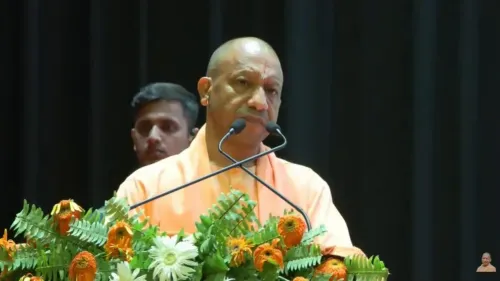
CM Yogi Pushes Village-Wise KCC Mapping to Boost Rural Credit
Synopsis
Chief Minister Yogi Adityanath has directed village-wise and farmer-wise mapping to ensure every eligible Uttar Pradesh farmer receives a Kisan Credit Card, while also ordering the design of a 'Rural Credit Conclave' to improve the state's credit-deposit ratio and deepen rural banking access.
Key Takeaways
CM Yogi Adityanath directed improvement in the credit-deposit ratio of banks in rural Uttar Pradesh on 27 September 2026 .
A village-wise and farmer-wise mapping exercise was ordered to identify all eligible Kisan Credit Card beneficiaries and link them to the banking system.
The Kisan Credit Card scheme, launched nationally in 1998 , provides short-term credit to farmers for cultivation and related needs.
The Chief Minister directed officials to frame a blueprint for a 'Rural Credit Conclave' to boost credit availability and banking effectiveness in rural areas.
Uttar Pradesh is India's most populous state with a predominantly agrarian economy, making rural credit access a high-stakes priority.
Every eligible farmer in Uttar Pradesh must hold a Kisan Credit Card — and the Chief Minister's Office of Uttar Pradesh wants the banking system to go village by village, farmer by farmer, until that goal is met. On Sunday, 27 September 2026, the office posted details of directions issued by Chief Minister Yogi Adityanath to strengthen the state's rural credit architecture, with a sharp focus on raising the credit-deposit ratio and plugging gaps in institutional lending.
The directive, shared in Hindi, states that the Chief Minister stressed improvement in the credit-deposit (CD) anupaat [credit-deposit ratio] of banks to strengthen the rural economy of the state. Farmers who qualify for a Kisan Credit Card (KCC) should actually receive one — a deceptively simple goal that has eluded full achievement for decades. To get there, CM Yogi ordered village-wise and farmer-wise mapping to identify every eligible cultivator and then connect them to the banking system.
Why the Credit-Deposit Ratio Is the Real Story
A low credit-deposit ratio in rural branches is one of the oldest complaints in Indian agricultural finance. Banks collect deposits from rural households but deploy proportionally less credit back into those communities — the money flows out, the farmers go under-served. Uttar Pradesh, India's most populous state with an overwhelmingly agrarian base, has long contended with this gap. When a chief minister specifically flags the CD ratio in a banking review, it signals that institutional lending in the countryside is a political and economic priority, not just a bureaucratic metric.
The Kisan Credit Card scheme, launched nationally in 1998, was designed precisely to channel short-term credit to cultivators for seeds, fertilisers, and related needs — cutting out exploitative moneylenders. Yet coverage has never been universal. The mapping exercise ordered by CM Yogi is an attempt at saturation: find who qualifies, prove it on paper, and bring them into the formal banking fold.
A 'Rural Credit Conclave' on the Drawing Board
Beyond the mapping drive, the Chief Minister also directed officials to frame the blueprint for a 'Rural Credit Conclave' — a proposed platform for expanding credit availability in rural areas and making the banking system more effective on the ground. The conclave format, if it materialises, would bring banks, officials, and farmer representatives into a structured conversation about delivery gaps and last-mile access.
The instruction is notable for its specificity. Rather than a general exhortation to 'do better', it tasks the administration with designing an event architecture — dates, structure, district-level rollout — that can be tracked and held accountable.
What Comes Next for UP's Farmers
Two concrete deliverables now sit on the administration's desk: the village-and-farmer-wise KCC mapping exercise, and the design of the Rural Credit Conclave. How quickly those translate into new cards issued and new credit lines opened will be the measure that actually matters for farmers across Uttar Pradesh's roughly 97,000 villages.
Credit on paper is a policy win. Credit in the hand of a cultivator before the rabi sowing season is the real one.
Point of View
Farmer-level KCC saturation, and a structured Rural Credit Conclave signals an attempt to convert financial inclusion from a headline metric into a granular administrative exercise. The village-and-farmer mapping directive echoes the 'beneficiary saturation' model his government has applied to schemes like housing and toilets — a strategy that trades broad ambition for measurable ground-level coverage. With assembly elections perpetually on the horizon in India's largest state, extending formal credit to the last eligible cultivator carries both genuine economic weight and obvious political logic. Whether the banking infrastructure can absorb the pace of the mandate is the critical open question.
NationPress
28 Sept 2026
Frequently Asked Questions
What did CM Yogi order regarding Kisan Credit Cards in Uttar Pradesh?
CM Yogi Adityanath ordered village-wise and farmer-wise mapping to identify every eligible farmer and ensure they receive a Kisan Credit Card, connecting them to the formal banking system.
What is the Kisan Credit Card scheme?
The Kisan Credit Card is a national scheme launched in 1998 that provides short-term credit to farmers through banks for cultivation, seeds, fertilisers, and related agricultural needs.
What is the Rural Credit Conclave mentioned by CM Yogi?
The Rural Credit Conclave is a proposed platform directed by CM Yogi for which officials have been asked to prepare a blueprint. It aims to expand credit availability and improve banking effectiveness in rural Uttar Pradesh.
Why is the credit-deposit ratio important for UP's rural economy?
A low credit-deposit ratio means rural bank branches collect deposits from communities but lend proportionally less back into them. Improving this ratio means more institutional credit reaches farmers instead of flowing out of rural areas.
How will the farmer mapping for KCC be carried out in Uttar Pradesh?
Officials have been directed to conduct a village-by-village and farmer-by-farmer mapping exercise to identify all cultivators eligible for the Kisan Credit Card and then facilitate their access to banking services.