CM Yogi: UP Contributes Over 26% of India's Mango Output
Synopsis
The Chief Minister's Office of Uttar Pradesh cited CM Yogi Adityanath on 3 July 2026, stating that UP leads India in mango production with a contribution exceeding 26 per cent of the country's total output, reinforcing the state's horticulture credentials.
Key Takeaways
Uttar Pradesh has been declared the country's leading state in mango production by the Chief Minister's Office.
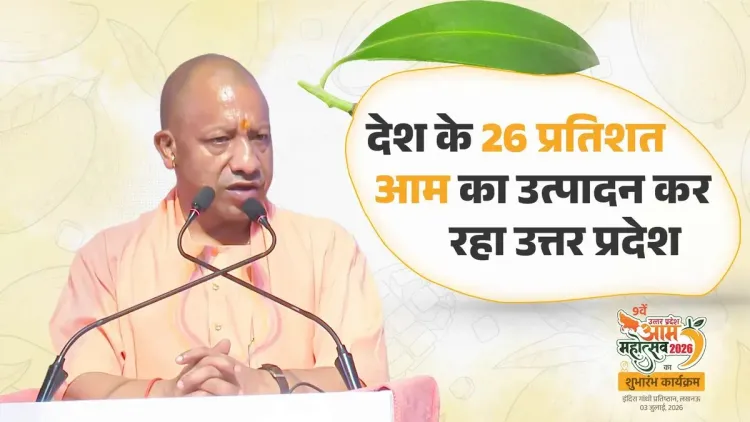
The state contributes more than 26 per cent of India's total mango output, according to the post quoting CM Yogi Adityanath .
Malihabad near Lucknow is one of UP's most prominent mango-growing belts, known for the GI-tagged Dasheri variety.
The central government's Mission for Integrated Development of Horticulture (MIDH) , launched in 2014 , supports mango cultivation and post-harvest infrastructure across states including UP.
Mango farming supports a wide ecosystem of farmers, processors and logistics workers across districts such as Lucknow , Hardoi , Unnao and Saharanpur .
Updated national horticulture statistics from the Ministry of Agriculture are awaited to corroborate the production share figure.
The Chief Minister's Office of Uttar Pradesh, citing Chief Minister Yogi Adityanath, declared on Friday, 3 July 2026 that Uttar Pradesh is the country's leading state in mango production, contributing more than 26 per cent of India's total mango output.
Context
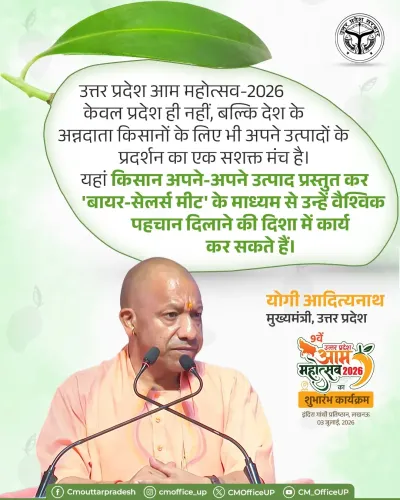
The post, shared from the official CMO handle, quotes CM Yogi Adityanath directly: 'आम उत्पादन में उत्तर प्रदेश देश का अग्रणी राज्य है' ('Uttar Pradesh is the leading state in the country in mango production'). The statement underscores the state government's emphasis on its agricultural identity and horticulture strength at a time when kharif-season crop messaging is routine across major producing states.
Uttar Pradesh is home to some of India's most celebrated mango-growing belts, including Malihabad near Lucknow, which produces the famed Dasheri variety and holds a Geographical Indication tag. The state's agro-climatic conditions across the Gangetic plain support large-scale orchards that supply both domestic markets and export channels.
Policy Backdrop
Horticulture promotion in Uttar Pradesh has been supported by the central government's Mission for Integrated Development of Horticulture (MIDH), launched in 2014, which funds area expansion, productivity improvement, post-harvest infrastructure and marketing linkages for fruit crops including mango.
Under CM Yogi Adityanath, who has been in office since 2017, the state has consistently highlighted agricultural productivity as a pillar of its economic narrative. Investments in cold-chain logistics, farmer-producer organisations and export-readiness have formed part of that broader push, with mango clusters frequently cited as success stories.
Stakeholders and Impact
The primary beneficiaries of this sector's growth are the state's mango growers and horticulture farmers, who depend on pricing, market access and processing infrastructure for their livelihoods. A dominant national share in production gives Uttar Pradesh leverage in price discovery and export negotiations, particularly for premium varieties like Dasheri, Langra and Chausa.
Beyond the farm gate, the mango economy supports ancillary industries — packaging, transportation, pulp processing and retail — that employ a significant rural and peri-urban workforce across districts such as Lucknow, Hardoi, Unnao and Saharanpur. State-level recognition of this share can also strengthen the case for enhanced central allocations under MIDH and allied schemes.
What's Next
Observers will watch for follow-up announcements from the state government on mango processing clusters, export facilitation or farmer-income support tied to this production milestone. The Ministry of Agriculture and Farmers Welfare is expected to release updated horticulture area and production statistics that will either validate or contextualise the 26 per cent figure cited by the Chief Minister's Office.
If the state converts this production leadership into value-addition infrastructure — cold storage, pulp units and direct export corridors — the economic multiplier for mango-belt districts could be substantial, making this statement a potential precursor to a larger horticulture policy announcement.
Point of View
Positioning UP not merely as an agrarian state but as a horticulture powerhouse. Coming mid-season, the statement likely sets the stage for a follow-on policy announcement, whether on export clusters, processing units or farmer-income schemes tied to the mango belt. It also fits a broader pattern under CM Yogi Adityanath of quantifying state achievements to build a governance narrative ahead of electoral cycles. The real test will be whether the production leadership translates into verifiable income gains for the farmers who grow the mangoes.
NationPress
3 Jul 2026
Frequently Asked Questions
Which state produces the most mangoes in India?
According to the Chief Minister's Office of Uttar Pradesh, UP is the leading mango-producing state in India, accounting for more than 26 per cent of the country's total mango output. Other major producing states include Andhra Pradesh and Maharashtra.
What is the famous mango-growing region in Uttar Pradesh?
Malihabad , located near Lucknow , is UP's most celebrated mango belt and is known for the Dasheri variety, which holds a Geographical Indication (GI) tag. Districts like Hardoi, Unnao and Saharanpur are also significant mango-growing areas.
What is the Mission for Integrated Development of Horticulture?
The Mission for Integrated Development of Horticulture (MIDH) is a central government scheme launched in 2014 that funds area expansion, productivity improvement, post-harvest infrastructure and marketing support for horticultural crops including mangoes across Indian states.
What did CM Yogi Adityanath say about mango production?
CM Yogi Adityanath, as quoted by the Chief Minister's Office of Uttar Pradesh on 3 July 2026 , stated that UP is the country's leading state in mango production and contributes more than 26 per cent of India's total mango output.
How does UP's mango production benefit farmers?
UP's dominant share in national mango production gives farmers in the state stronger market leverage and pricing power. It also supports ancillary sectors like packaging, cold storage and pulp processing, creating employment across mango-belt districts.