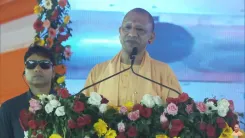
CM Yogi: UP Now Hosts Over 35,000 Large Factories
Synopsis
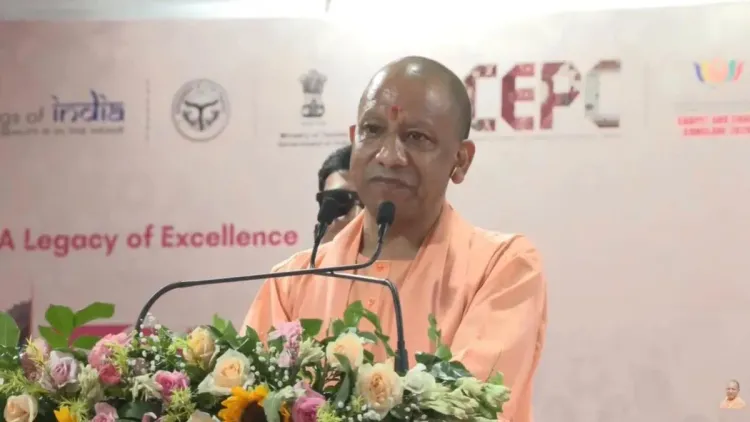
Uttar Pradesh Chief Minister Yogi Adityanath declared on October 4, 2026 that UP now houses more than 35,000 large factories, framing the milestone as evidence of the state's sweeping industrial transformation under his administration.
Key Takeaways
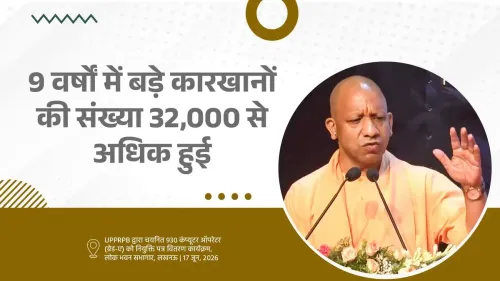
CM Yogi Adityanath announced on October 4, 2026 that Uttar Pradesh now has over 35,000 large factories .
The figure is being presented as a benchmark of the state's ongoing industrial and investment push.
UP has hosted successive Invest UP summits to attract domestic and foreign manufacturers across sectors including defence, electronics, and textiles.
Uttar Pradesh is home to roughly 240 million people , making its industrial trajectory a significant variable for India's national economy.
The announcement comes as the BJP government in UP seeks to cement a narrative of economic revival ahead of future electoral cycles.
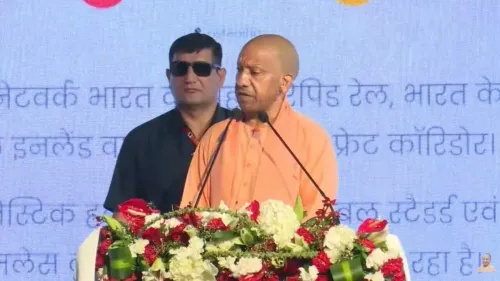
A number that would have seemed improbable a decade ago is now Uttar Pradesh's new industrial headline: more than 35,000 large factories operating across the state, a figure that Uttar Pradesh Chief Minister Yogi Adityanath cited on Sunday, October 4, 2026, as proof of a manufacturing transformation reshaping India's most populous state.
35,000 factories — what the number signals
In his post, CM Yogi wrote: '35,000 से अधिक बड़े-बड़े कारखाने आज यूपी के पास हैं...' — 'More than 35,000 large factories now belong to UP.' The phrasing is pointed: the word paas hain ('belong to' or 'are with') frames the factories not as arrivals from outside but as assets the state has earned and owns. That rhetorical choice matters in a political climate where every investment corridor is contested terrain.
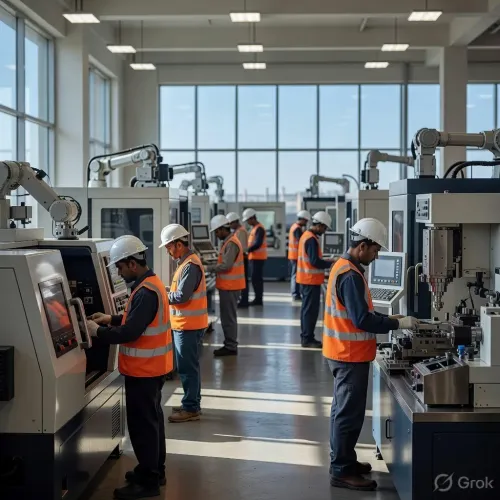
Uttar Pradesh, long associated with agrarian distress and industrial stagnation, has spent recent years aggressively courting domestic and foreign investors through successive Invest UP summits. A tally of more than 35,000 large-scale manufacturing units, if substantiated, would represent a dramatic shift in the state's industrial profile and its share of India's overall factory output.
Why UP's factory count carries national weight
Uttar Pradesh is home to roughly 240 million people — larger than Brazil — and its economic trajectory has outsized consequences for India's overall growth story. For years, the state exported labour to Maharashtra, Delhi, and Gujarat. A rising factory count points to the possibility that work is now coming to UP workers, rather than the reverse.
CM Yogi has positioned industrial expansion as a central pillar of his administration, pointing to investments in sectors ranging from defence manufacturing in the Bundelkhand Defence Corridor and the Purvanchal corridor to electronics, food processing, and textiles. The 35,000-plus factories figure appears to be the cumulative registered large-industry count the state government is now highlighting as a benchmark of that push.
The road from 'BIMARU' to boardroom pitch
The transformation narrative CM Yogi is pushing runs directly against the 'BIMARU' tag — the pejorative economists once applied to Bihar, Madhya Pradesh, Rajasthan, and Uttar Pradesh for chronic underdevelopment. Every large factory added to the roster is one more data point his government uses to retire that label. Whether global investors and domestic entrepreneurs read the 35,000 figure as a reason to double down in UP — or scrutinise the fine print of land, logistics, and law-and-order — will define what the next chapter of this industrial story looks like.
With state elections on the horizon and economic credibility at a premium, CM Yogi's decision to lead with a factory count rather than a policy announcement is itself a signal: the BJP's UP playbook is now betting that numbers move voters as powerfully as narratives.
Point of View
000-plus large factories is less a policy announcement than a scorecard moment — a deliberate effort to quantify an economic transformation that his administration has staked its political identity on. The statistic, placed on social media rather than a formal policy platform, is designed to circulate as a talking point in UP's hyperactive political discourse. It fits squarely into the BJP's broader national narrative of turning historically laggard states into engines of manufacturing-led growth. The real test, however, is whether the factory count translates into measurable wage gains and employment absorption for UP's vast labour pool — a question the post leaves wide open.
NationPress
4 Oct 2026
Frequently Asked Questions
How many large factories does Uttar Pradesh have in 2026?
According to CM Yogi Adityanath's post on October 4, 2026, Uttar Pradesh now has more than 35,000 large factories .
What sectors are driving UP's industrial growth?
UP's industrial expansion has been driven by sectors including defence manufacturing (via the Bundelkhand and Purvanchal Defence Corridors), electronics, food processing, and textiles, supported by the state's Invest UP summits.
Why is Uttar Pradesh's factory growth nationally significant?
With a population of roughly 240 million , UP's economic performance has a major impact on India's overall growth. A rising factory count could reduce labour migration out of the state and boost India's manufacturing output.
What is the 'BIMARU' tag and why does it matter for UP?
'BIMARU' was an economic term applied to Bihar, Madhya Pradesh, Rajasthan, and Uttar Pradesh to describe chronic underdevelopment. The Yogi government's industrial figures are aimed at challenging that legacy perception.