CM Yogi: UP Now a Revenue Surplus State After 9 Years
Synopsis
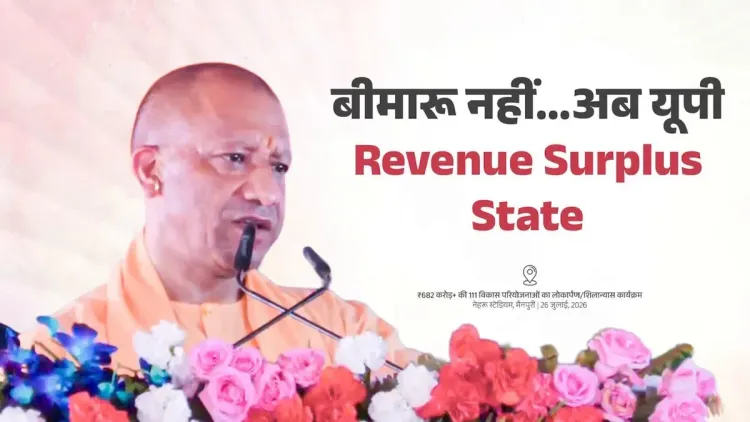
Chief Minister Yogi Adityanath's office announced on 27 July 2026 that Uttar Pradesh has become a Revenue Surplus State after nine years of fiscal reform, marking the state's exit from the long-standing BIMARU grouping of economically lagging states.
Key Takeaways
The Chief Minister's Office of Uttar Pradesh declared on 27 July 2026 that the state is now a Revenue Surplus State .
CM Yogi Adityanath credited 9 years of governance reform since taking office in March 2017 for the turnaround.
Uttar Pradesh was historically grouped in the BIMARU category — coined in the 1980s to denote India's most fiscally and developmentally lagging states.
A Revenue Surplus State earns more in revenue receipts than it spends on revenue expenditure, signalling reduced dependence on borrowings for day-to-day operations.
The claim awaits independent confirmation by the Comptroller and Auditor General of India through official audit reports.
The milestone has implications for investor confidence, central transfers, and the state's capacity to fund capital infrastructure without compressing welfare spending.
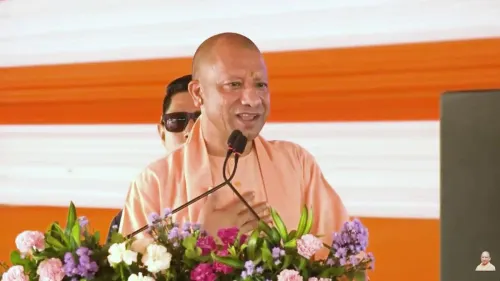
The Chief Minister's Office of Uttar Pradesh, citing Chief Minister Yogi Adityanath, declared on Sunday, 27 July 2026 that Uttar Pradesh has successfully shed its long-standing 'BIMARU' tag and emerged as a Revenue Surplus State — a milestone the government attributes to nine years of sustained fiscal reform.
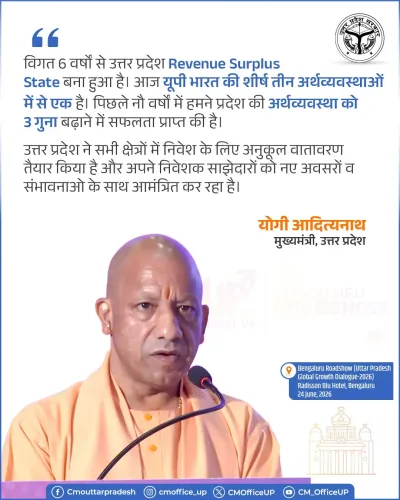
Posting on X, the CMO quoted Chief Minister Yogi Adityanath as saying: 'हमने विगत 9 वर्षों में उत्तर प्रदेश को बीमारू राज्य की श्रेणी से उबारने में सफलता प्राप्त की है।' ('In the past 9 years, we have succeeded in pulling Uttar Pradesh out of the BIMARU category. Today, Uttar Pradesh has become a Revenue Surplus State.')
Context
The term BIMARU was coined in the 1980s by demographer Ashish Bose as an acronym for Bihar, Madhya Pradesh, Rajasthan, and Uttar Pradesh — four states characterised by lower per-capita income, high population growth, and lagging development indicators. Being placed in this category carried significant reputational and investment consequences for the state. The Yogi Adityanath government, which took office in March 2017, has consistently positioned breaking out of this grouping as a central governance objective. A Revenue Surplus State is one where the government's own revenue receipts exceed its revenue expenditure, meaning the state is no longer dependent on borrowings or central transfers to fund its day-to-day operations. This is considered a key marker of fiscal health and administrative efficiency.Policy Backdrop
Since 2017, the Uttar Pradesh government has pursued a 'double-engine' development model — aligning state-level policy priorities with central government schemes — to accelerate GSDP (Gross State Domestic Product) growth and improve own-tax revenue buoyancy. Successive state budgets have emphasised widening the tax base, cracking down on revenue leakage, and attracting private investment through investor summits such as the Global Investors Summit held in Lucknow. The broader pattern mirrors moves by several states to publicise improved fiscal metrics as a signal of governance quality and investment readiness. Transitioning from a revenue-deficit to a revenue-surplus position requires either raising receipts, compressing non-capital expenditure, or both — and the claim, if confirmed by independent audit, would represent a structural shift in the state's finances.Stakeholders and Impact
Uttar Pradesh is India's most populous state, home to more than 24 crore people. A revenue-surplus status has direct implications for state taxpayers and the investment climate: it signals that the government has headroom to fund capital expenditure — roads, power, irrigation — without crowding out social spending. For businesses and investors evaluating entry into the state, fiscal credibility reduces perceived risk. For the broader federal fiscal architecture, a healthier UP reduces pressure on central transfers and the Finance Commission's devolution formula, potentially freeing resources for other states. The claim will be closely watched by credit rating agencies and multilateral development institutions that track sub-national fiscal performance in India.What's Next
The definitive validation of the revenue-surplus claim will come from the Comptroller and Auditor General of India's audit reports and the state's forthcoming budget documents. Independent economists and opposition parties in Uttar Pradesh are likely to scrutinise the methodology — whether the surplus is calculated on a cash or accrual basis, and whether it accounts for off-budget liabilities. The government's ability to sustain this status through the next fiscal cycle, while maintaining welfare expenditure in a state with a large rural population, will be the real test of the fiscal turnaround narrative.Point of View
Reinforcing a governance-and-growth narrative that has been central to the BJP's political pitch in Uttar Pradesh since 2017. The BIMARU framing is politically potent: shedding it allows the ruling party to contrast the present with decades of perceived misgovernance by predecessor administrations. However, the credibility of the claim will hinge on CAG-audited accounts — past instances in other states have shown a gap between budgeted surplus figures and audited outcomes. If independently validated, the shift would mark a genuine structural inflection for India's largest state by population and a significant data point in the debate over whether 'double-engine' governance delivers measurable fiscal dividends.
NationPress
25 Oct 2026
Frequently Asked Questions
What does it mean for Uttar Pradesh to become a Revenue Surplus State?
A Revenue Surplus State collects more in revenue receipts — taxes, fees, and grants — than it spends on revenue (day-to-day) expenditure, meaning it does not need to borrow to fund routine operations. For Uttar Pradesh , this signals improved fiscal discipline and greater capacity to invest in infrastructure without crowding out welfare spending.
What was the BIMARU category and why was UP included?
BIMARU was a term coined by demographer Ashish Bose in the 1980s for Bihar, Madhya Pradesh, Rajasthan, and Uttar Pradesh — states characterised by low per-capita income, high population growth, and lagging human development indicators. Uttar Pradesh was included due to its historically low economic output relative to its large population.
How long has Yogi Adityanath been Chief Minister of Uttar Pradesh?
Yogi Adityanath has been Chief Minister of Uttar Pradesh since March 2017 , having been re-elected for a second consecutive term in 2022 . The CMO's post credits 9 years of his government's policies for the fiscal turnaround.
Will the revenue surplus claim be independently verified?
Yes. The authoritative verification will come from the Comptroller and Auditor General of India 's audit of state finances and the state's official budget documents. Economists and opposition parties are expected to examine the methodology and any off-budget liabilities before accepting the claim as definitive.
What is the double-engine development model in Uttar Pradesh?
The 'double-engine' model refers to the alignment of Uttar Pradesh 's state government policies with central government schemes, premised on the idea that having the same party in power at both levels accelerates project approvals, fund flows, and implementation. The Yogi Adityanath government has used this framework to attract investment and push infrastructure development since 2017 .