CM Yogi Calls UP India's Growth Engine, Top 3 Economy
Synopsis
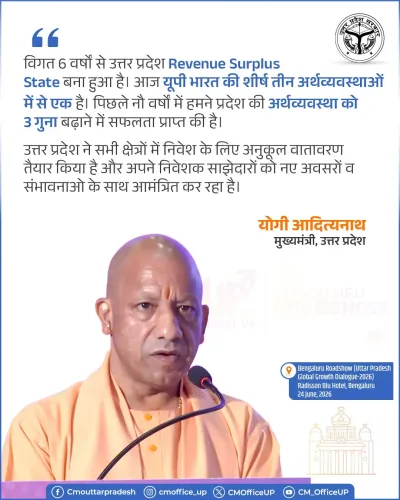
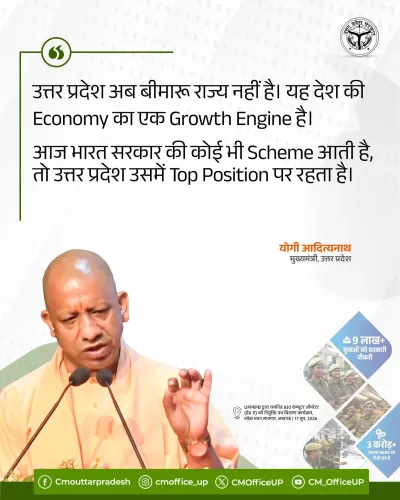
Chief Minister Yogi Adityanath declared on 30 June 2026 that Uttar Pradesh has shed its BIMARU label — blamed on Congress and SP rule — to become India's growth engine and a top-3 state economy, sharpening the BJP's governance pitch ahead of future elections.
Key Takeaways
CM Yogi Adityanath posted on 30 June 2026 that Uttar Pradesh is now among India's top 3 economies .
He attributed the state's past underdevelopment to the governance record of Congress and the Samajwadi Party .
UP was historically grouped under the BIMARU label, a 1980s classification for lagging Indian states.
The state has hosted major investor summits and developed key expressway and logistics infrastructure under the current administration.
The post sharpens the BJP 's political contrast with opposition parties ahead of future state electoral contests.
Critics argue aggregate GDP rankings must be weighed against per-capita income, employment, and human development indicators.
Uttar Pradesh Chief Minister Yogi Adityanath on Tuesday, 30 June 2026, declared that Uttar Pradesh — once labelled a 'BIMARU' state — has now established itself among India's top three economies, crediting the transformation to a decisive break from what he described as the misgovernance of the Congress and the Samajwadi Party.
Context
In his post on X, CM Yogi wrote: 'उत्तर प्रदेश, जो कांग्रेस और सपा के पाप के कारण कभी बीमारू था, आज वह भारत की अर्थव्यवस्था का ग्रोथ इंजन बनकर Top 3 Economy के रूप में स्वयं को स्थापित कर रहा है...' — translated: 'Uttar Pradesh, which was once BIMARU due to the sins of Congress and SP, is today establishing itself as a Top 3 Economy, becoming the growth engine of India's economy.' The remark is a pointed political contrast between the current BJP-led administration and the state's previous governments.
The term BIMARU — an acronym coined in the 1980s for Bihar, Madhya Pradesh, Rajasthan, and Uttar Pradesh — was used by demographers to describe states characterised by low economic output, high fertility rates, and poor governance indicators. CM Yogi has repeatedly invoked this label to mark what he presents as a historical turning point under BJP rule since 2017.
Policy Backdrop
Uttar Pradesh has in recent years pursued aggressive investor outreach, including successive editions of the Global Investors Summit held in Lucknow, which generated investment intent worth several lakh crore rupees. The state government has also highlighted improvements in law and order, infrastructure development along the Purvanchal Expressway, Bundelkhand Expressway, and Ganga Expressway, and the operationalisation of new airports as markers of economic momentum.
The state's gross domestic product has grown substantially over the past several years, with the government positioning Uttar Pradesh as a rival to Maharashtra and Tamil Nadu for the second spot among India's largest state economies. Industrial corridors, including segments of the Delhi-Mumbai Industrial Corridor and the Dedicated Freight Corridor, pass through the state, adding to its logistics and manufacturing appeal.
Stakeholders and Impact
The political messaging is directed at multiple audiences simultaneously. For BJP supporters and the broader electorate of Uttar Pradesh — India's most populous state with over 24 crore people — it reinforces the party's governance narrative ahead of future electoral cycles. For investors and industry, it signals continued policy continuity and administrative intent.
The opposition — particularly the Samajwadi Party led by Akhilesh Yadav and the Congress — is likely to contest the framing, arguing that growth metrics must be weighed against employment quality, farmer welfare, and per-capita income figures. The BIMARU characterisation itself remains contested, with critics noting that aggregate GDP rankings do not fully capture human development outcomes for the state's large rural and marginalised populations.
What's Next
CM Yogi Adityanath, who also heads the Gorakhnath Math in Gorakhpur, has consistently used economic milestones as a platform to consolidate BJP's political standing in the state. As Uttar Pradesh eyes the next assembly election, the 'growth engine' narrative is expected to anchor the ruling party's campaign messaging. Whether the state can sustain and deepen its economic momentum — particularly in job creation and rural income — will be the central test of this claim in the months ahead.
Point of View
Positioning BJP as the sole agent of the state's transformation. By invoking the BIMARU label and attributing it explicitly to Congress and SP, he sets up a binary that is likely to dominate opposition discourse in the run-up to the next assembly election. The claim also fits a broader BJP pattern of using state-level economic rankings as proof of concept for its national governance model. However, the durability of this narrative will depend on whether growth translates into measurable improvements in employment and rural welfare — the metrics opposition parties are most likely to contest.
NationPress
29 Sept 2026
Frequently Asked Questions
Is Uttar Pradesh really a top 3 economy in India?
The Uttar Pradesh government has claimed the state has risen to among India's top three state economies by GDP, driven by infrastructure investment and industrial outreach. Independent verification of the precise current ranking would require the latest official GDP estimates from national statistical authorities.
What does BIMARU mean and why was UP called a BIMARU state?
BIMARU is an acronym coined in the 1980s for Bihar, Madhya Pradesh, Rajasthan, and Uttar Pradesh, states identified as lagging in economic output, health, and governance indicators. Uttar Pradesh was included due to its low per-capita income, high population growth, and weak administrative performance at the time.
What has CM Yogi Adityanath done for UP's economy?
Under CM Yogi Adityanath's tenure since 2017, Uttar Pradesh has hosted multiple Global Investors Summits, built several expressways including the Purvanchal and Bundelkhand corridors, operationalised new airports, and pursued law-and-order reforms that the government credits with improving the investment climate.
Why is CM Yogi criticising Congress and SP on UP's economy?
CM Yogi's post attributes the state's historical BIMARU status to the governance of Congress and the Samajwadi Party, which have led state governments in the past. This is a recurring BJP political argument that contrasts its own administration's economic record with that of predecessor governments.
What is Gorakhnath Math and what is CM Yogi's connection to it?
Gorakhnath Math is a prominent Hindu monastery in Gorakhpur, Uttar Pradesh. CM Yogi Adityanath serves as its chief priest (Mahant), a religious role he holds alongside his position as Chief Minister, making him one of India's few sitting heads of government who also lead a major religious institution.