CM Yogi Invokes BIMARU Past to Claim UP's Transformation
Synopsis
Chief Minister Yogi Adityanath invoked the BIMARU label on 31 October 2026, accusing predecessors of reducing Uttar Pradesh to a lagging state while asserting his government has delivered on a promise of transformation — a recurring pillar of BJP's UP narrative.
Key Takeaways
CM Yogi Adityanath posted on 31 October 2026 contrasting UP's BIMARU past with its present trajectory.
The BIMARU acronym was coined in the 1980s by demographer Ashish Bose to flag Bihar, Madhya Pradesh, Rajasthan, and Uttar Pradesh for poor development indicators.
The Hindi word bimaru means 'sick,' giving the label a double political charge when deployed in debate.
CM Yogi's messaging consistently frames UP's development as a before-and-after story anchored to the BJP 's arrival in power in 2017 .
The unnamed 'they' in the post is a standard rhetorical device pointing toward predecessor state governments without naming them.
State economic surveys and investment reports remain the factual arena where such governance claims will be tested.
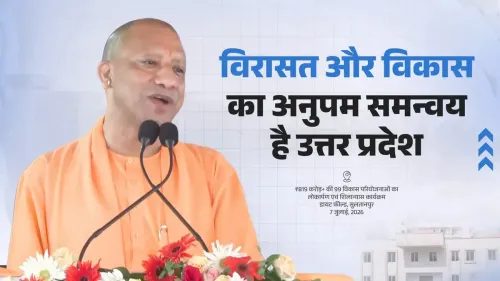
A state once written off by demographers as a basket case of Indian governance is now, in Uttar Pradesh Chief Minister Yogi Adityanath's telling, living proof that the script can be rewritten. On Saturday, 31 October 2026, the Chief Minister posted a pointed reminder of where UP stood — and where he says it is headed.
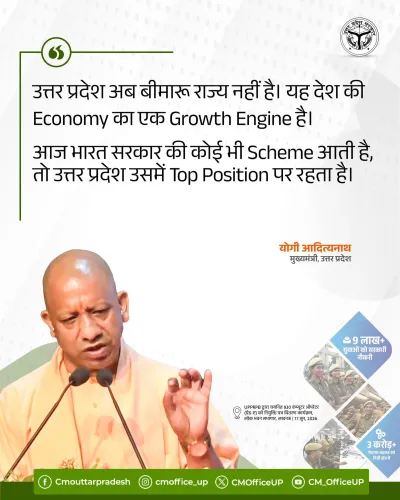
In the post, CM Yogi said in Hindi: 'Unhone UP ko BIMARU bana diya tha... hum logon ne kaha tha ki UP zaroor badlega...' — 'They had turned UP into a BIMARU state... we had said that UP will certainly change.' The statement is a direct invocation of one of Indian politics' most loaded labels, and a deliberate contrast between an inherited legacy and a promised future.
The Weight of the BIMARU Label
The acronym BIMARU — standing for Bihar, Madhya Pradesh, Rajasthan, and Uttar Pradesh — was coined in the 1980s by demographer Ashish Bose. It was a clinical diagnosis: these four states dragged on national development indicators, from literacy and infant mortality to per-capita income. The word itself, in Hindi, means 'sick.' For decades, the tag stuck to UP like a political wound.
By invoking it now, CM Yogi is doing something precise — he is naming the accusation and then daring the audience to compare then and now. The unnamed 'they' in the post is a familiar rhetorical device in Indian political discourse, pointing without naming toward predecessor governments.
Governance Messaging as Political Architecture
This is not the first time the Chief Minister has reached for this contrast. Yogi Adityanath's public communication has consistently framed Uttar Pradesh's development story as a before-and-after narrative — a state rescued from misgovernance and now on an upward trajectory. The messaging targets a specific political memory: the years before the BJP came to power in Lucknow in 2017, when law-and-order concerns and sluggish economic growth defined the state's national image.
Whether the numbers fully bear that story out is a question state economic surveys and investment reports will continue to answer. What is clear is that the BIMARU frame has become a recurring pillar of the ruling party's narrative architecture in UP — a way of anchoring present claims in a past the opposition cannot easily disown.
For Uttar Pradesh's 240 million residents, the debate is not merely rhetorical. It maps onto real questions about jobs, roads, schools, and safety. And with every such post, the Chief Minister is essentially daring his critics to argue about the baseline — because whoever controls the baseline controls the story of progress.
Point of View
He shifts the debate from absolute performance metrics to a relative baseline that favours his government. This before-and-after architecture has been a consistent feature of BJP's UP strategy since 2017, designed to make every governance gain feel like a rescue rather than routine administration. The risk is that the BIMARU frame, by now familiar, may be losing its shock value with voters who increasingly measure outcomes in concrete terms — jobs, inflation, infrastructure — rather than historical comparisons. How UP performs on the next round of state economic surveys will determine whether the narrative holds.
NationPress
31 Oct 2026
Frequently Asked Questions
What does BIMARU mean and which states does it include?
BIMARU is an acronym coined in the 1980s by demographer Ashish Bose for Bihar, Madhya Pradesh, Rajasthan, and Uttar Pradesh — states that lagged on development indicators. The word also means 'sick' in Hindi, giving it a sharp political charge.
What did CM Yogi Adityanath say about Uttar Pradesh in his October 2026 post?
CM Yogi said predecessors had turned Uttar Pradesh into a BIMARU state, while his side had promised and worked toward changing UP's fortunes — a contrast between inherited misgovernance and present-day progress.
Who coined the BIMARU acronym and when?
The BIMARU acronym was coined by Indian demographer Ashish Bose in the 1980s to highlight poor socio-economic and demographic indicators in four major Indian states.
Why does CM Yogi frequently reference UP's BIMARU past?
It is a core part of the BJP's UP governance narrative — framing the period before 2017 as one of decline and positioning the current administration as the agent of transformation, making every improvement appear as a rescue from a low baseline.
How can UP's development progress be objectively measured?
State economic surveys, investment reports, and national indices tracking literacy, per-capita income, law-and-order, and infrastructure spending are the primary factual benchmarks against which UP's governance claims can be assessed.