Chhattisgarh CMO pays tribute to Lokmanya Tilak on death anniversary
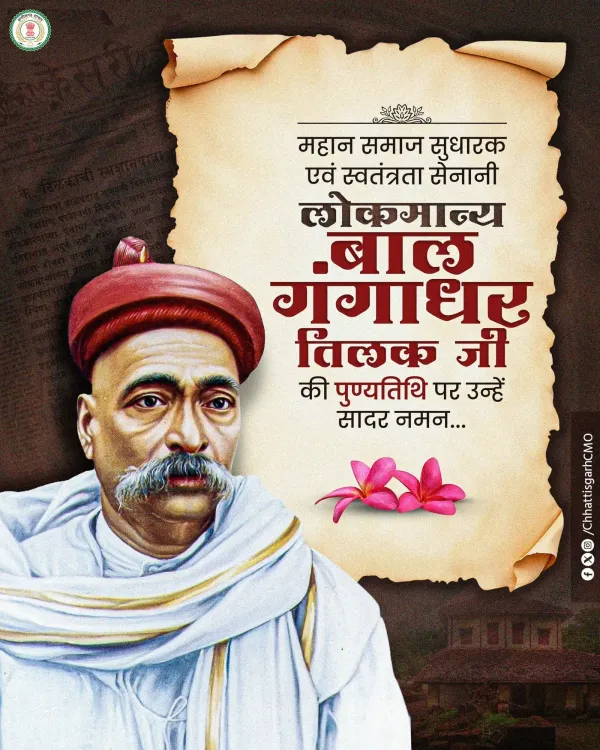
Synopsis
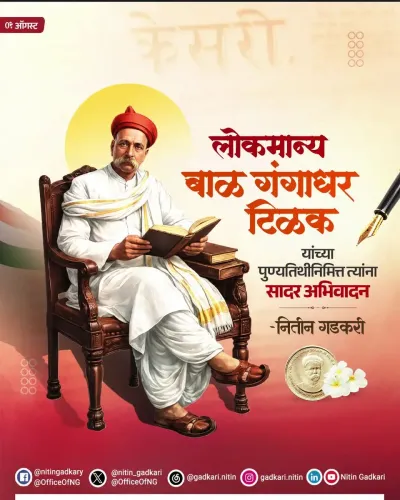
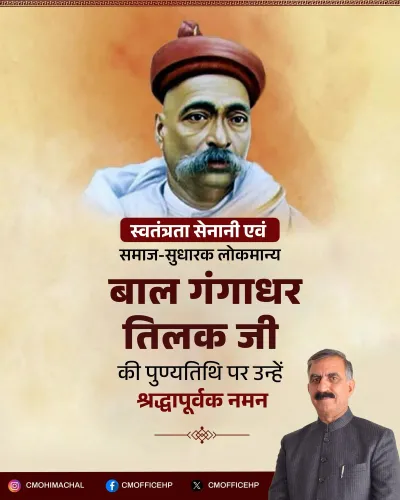
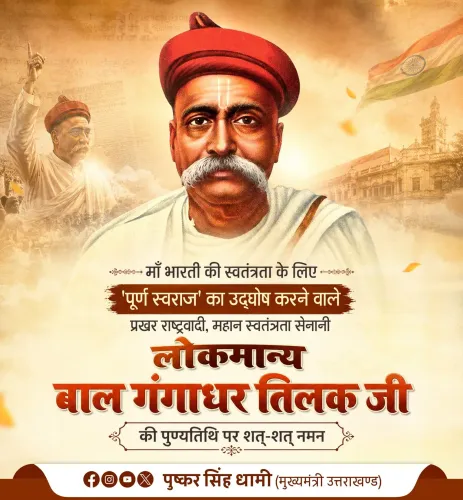
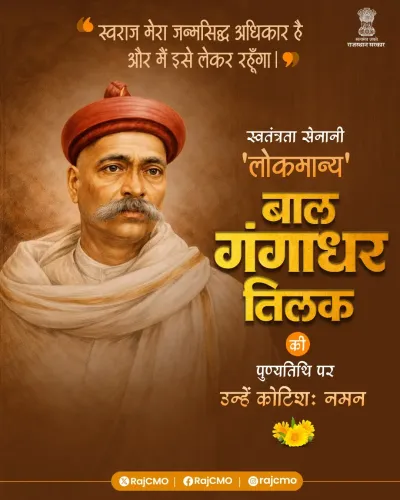
The Chief Minister's Office of Chhattisgarh offered respectful tribute to Lokmanya Bal Gangadhar Tilak on his death anniversary on 1 August 2026, honouring the nationalist leader and social reformer who championed complete Indian self-rule and coined the iconic phrase 'Swaraj is my birthright.'
Key Takeaways
The Chhattisgarh CMO paid official tribute to Bal Gangadhar Tilak on his death anniversary, 1 August 2026 .
Tilak ( 1856–1920 ) was a nationalist leader, social reformer and freedom fighter known by the honorific Lokmanya .
He was among the first Indian leaders to demand complete Swaraj (self-rule), not mere colonial reform.
His slogan 'Swaraj is my birthright, and I shall have it' became a defining cry of the independence movement.
Tilak popularised Ganesh Chaturthi as a public nationalist gathering and used newspapers to spread the freedom movement's message.
Official tributes to independence-era figures on their anniversaries are a standard practice across Indian state governments.
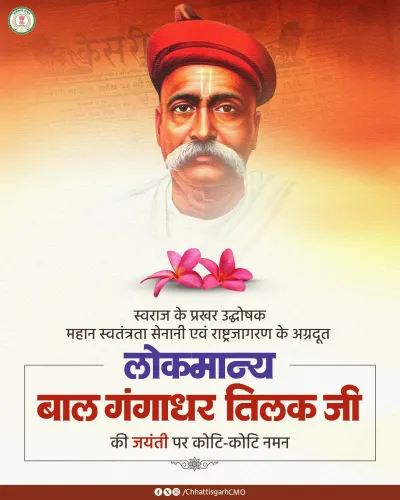
On the death anniversary of one of India's most defiant voices for self-rule, the Chief Minister's Office of Chhattisgarh paid solemn homage to Bal Gangadhar Tilak — the man who told a colonial empire that 'Swaraj is my birthright.'
The official CMO handle posted on 1 August 2026, offering respectful tribute — 'sadar naman' (a respectful bow) — to Tilak on his punyatithi (death anniversary), describing him as a 'mahan samaj sudharak evam swatantrata senani' — a great social reformer and freedom fighter.
Who was Lokmanya Tilak?
Bal Gangadhar Tilak (1856–1920) earned the honorific Lokmanya — 'accepted by the people as their leader' — through decades of unrelenting agitation against British rule. Born in Ratnagiri, Maharashtra, he was among the earliest nationalist voices to demand not mere reform but complete Swaraj — self-governance. His slogan, 'Swaraj is my birthright, and I shall have it,' became a rallying cry that echoed across the subcontinent. He died on 1 August 1920 — a date that Indian governments and public institutions mark each year in his memory. Beyond politics, Tilak reshaped public life: he popularised the Ganesh Chaturthi festival as a community gathering to build nationalist consciousness, and founded newspapers to carry the independence movement's message directly to ordinary people.A standard commemoration — and what it signals
Official tributes from state governments on the anniversaries of independence-era figures are a consistent feature of Indian political culture, cutting across party lines. The Chhattisgarh CMO's post follows this established national practice, signalling the state's alignment with the broader commemorative tradition that keeps the memory of the freedom movement alive in public discourse. As 1 August arrives each year, similar tributes from state capitals and the Centre mark the occasion — a collective act of institutional memory for a leader whose ideas about popular sovereignty remain woven into India's constitutional identity.Point of View
Assertive nationalism rather than elite constitutionalism. Tilak's legacy is periodically contested between political formations that each claim his mantle, making even ceremonial tributes a quiet act of positioning. The consistency of such commemorations across party lines also reflects how the Indian state uses the freedom movement's memory as a source of shared legitimacy. What stands out in 2026 is simply the continuity: 106 years after his death, Tilak's name still commands institutional reverence.
NationPress
15 Sept 2026
Frequently Asked Questions
Why is 1 August observed as Bal Gangadhar Tilak's death anniversary?
Bal Gangadhar Tilak died on 1 August 1920 in Mumbai. Each year on this date, governments, institutions and citizens across India observe his punyatithi with tributes and remembrances.
Who was Lokmanya Bal Gangadhar Tilak?
Lokmanya Bal Gangadhar Tilak ( 1856–1920 ) was an Indian nationalist leader, social reformer and freedom fighter. He was among the first to demand complete self-rule ( Swaraj ) and coined the famous slogan 'Swaraj is my birthright, and I shall have it.'
What does 'Lokmanya' mean?
Lokmanya is a Sanskrit honorific meaning 'accepted by the people as their leader.' It was conferred on Bal Gangadhar Tilak in recognition of his mass following and his role in galvanising ordinary Indians against British rule.
Why did the Chhattisgarh CMO post a tribute to Tilak?
The Chief Minister's Office of Chhattisgarh posted the tribute as part of the standard national practice of official commemoration on the death and birth anniversaries of major independence-era figures. Such tributes are issued by state governments across political parties.
What is Bal Gangadhar Tilak's most famous contribution?
Tilak is best known for the slogan 'Swaraj is my birthright, and I shall have it,' for popularising the Ganesh Chaturthi festival as a nationalist public gathering, and for using newspapers to spread the independence movement's message to a mass audience.