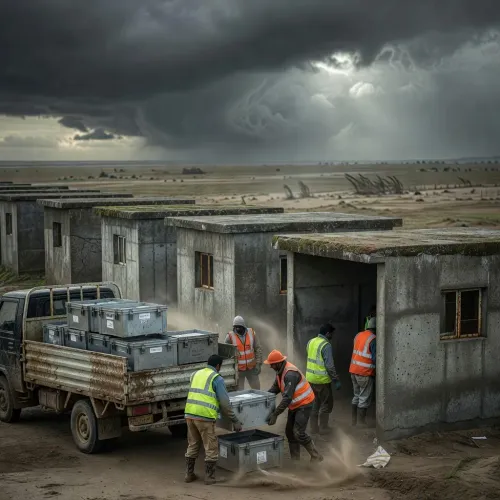
CM Majhi: Coast Guard Helicopters Join Cyclone Arnab Relief Ops

Synopsis
Odisha CM Mohan Charan Majhi confirms on 29 October 2026 that Indian Coast Guard helicopters have begun aerial rescue missions during Cyclone Arnab, as ground teams simultaneously work to restore communications and clear blocked roads across the storm-hit state.
Key Takeaways
Indian Coast Guard helicopters have been deployed for aerial rescue missions during Cyclone Arnab in Odisha.
Ground rescue teams are actively clearing road blockages and restoring severed communication links .
CM Mohan Charan Majhi confirmed the multi-agency response in a post on 29 October 2026 .
Odisha's disaster management framework was rebuilt after the 1999 Super Cyclone , establishing the layered response now in use.
Damage assessments and a potential request for additional central NDRF support remain pending.
As Cyclone Arnab batters Odisha's coastline, rescue teams are on the ground clearing blocked roads and restoring snapped communication links — and now the Indian Coast Guard has joined the operation from the air. Odisha Chief Minister Mohan Charan Majhi confirmed the multi-agency response on Thursday, 29 October 2026, signalling an escalation in the state's relief machinery.
Helicopters in the Sky, Teams on the Ground
In his post, CM Majhi stated that rescue teams are deployed to restore connectivity and clear road blockages caused by the cyclone. Crucially, he added that Coast Guard helicopter-based rescue operations have also begun — a move that typically indicates ground access has been severely compromised in at least some affected zones. 'Public safety and safe movement are being continuously ensured,' he wrote.
Aerial evacuation via Indian Coast Guard helicopters is reserved for situations where roads are either washed out or blocked by debris and fallen trees — making this detail the clearest signal yet of the storm's ground-level impact. The Coast Guard operates under the Ministry of Defence and has a well-established protocol for cyclone response along India's eastern coast.
Why Odisha Moves Fast on Cyclones
Odisha's disaster response muscle was built the hard way. The 1999 Super Cyclone — one of the deadliest in Indian history — claimed nearly 10,000 lives and prompted a wholesale overhaul of the state's emergency architecture. The Odisha State Disaster Management Authority was created in its aftermath, and annual pre-monsoon preparedness drills became standard practice. The result: successive governments — regardless of party — have prioritised rapid restoration of road connectivity as a non-negotiable first step in any cyclone response.
That institutional memory is visible in CM Majhi's update. The simultaneous deployment of ground-level rescue teams for road clearance and Coast Guard helicopters for aerial access mirrors the layered response framework Odisha has refined over two decades. State police, NDRF units, and Coast Guard assets typically operate in parallel during major cyclone events here.
What the Next 24 Hours Will Determine
The key unknowns are the storm's final landfall coordinates, the scale of coastal inundation, and whether the state will formally request additional central assistance. An official damage assessment — covering infrastructure, agriculture, and displacement figures — will sharpen the picture considerably. With Coast Guard helicopters now airborne, the operational tempo suggests authorities are not waiting for the full picture before scaling up.
Odisha has survived some of the subcontinent's worst storms. The machinery built from that experience is running. The question now is how much Cyclone Arnab has left for it to undo.
Point of View
Operational, and action-forward — designed to signal state command without amplifying public panic. The decision to explicitly mention Coast Guard helicopters is significant: it tells affected communities that no zone is considered unreachable, and it signals to Delhi that the state is managing the response without yet formally requesting central intervention. For a BJP government in Odisha still in its second year, demonstrating institutional competence during a major natural disaster carries real political weight, but the post itself stays scrupulously in the lane of governance, not politics. The real test arrives with the damage assessment.
NationPress
29 Oct 2026
Frequently Asked Questions
What is Cyclone Arnab and where has it hit?
Cyclone Arnab is a storm that struck Odisha's coastline around 29 October 2026 . The exact landfall location is still being officially assessed, but the storm has caused road blockages and communication disruptions across affected areas.
What rescue operations are underway in Odisha during Cyclone Arnab?
Ground rescue teams are deployed to clear blocked roads and restore communication links, while Indian Coast Guard helicopters have begun aerial rescue missions in areas where ground access is compromised.
What did Odisha CM Mohan Charan Majhi say about Cyclone Arnab?
CM Mohan Charan Majhi confirmed on 29 October 2026 that multi-agency rescue teams, including Coast Guard helicopters, are operational, and that ensuring public safety and safe movement remains the government's ongoing priority.
Why is the Indian Coast Guard involved in Odisha cyclone relief?
The Indian Coast Guard , which operates under the Ministry of Defence, is routinely deployed for helicopter-based search and rescue during cyclones along India's eastern coast, especially when ground routes are blocked or washed out.
How has Odisha prepared for cyclones historically?
After the devastating 1999 Super Cyclone , Odisha overhauled its disaster management system, creating the Odisha State Disaster Management Authority and institutionalising annual preparedness drills, making the state one of India's most organised cyclone-response models.