Does Kerala Sahitya Akademi Chief's Stance on Power Continuity Spark a Controversy?
Synopsis
The recent remarks by K. Satchidanandan, President of the Kerala Sahitya Akademi, on the necessity for governmental alternation have ignited a fiery debate across Kerala. His defense of democratic ideals rooted in Marxist thought against the backdrop of a politically charged atmosphere highlights the critical intersection of literature and politics in the region.
Key Takeaways
Governmental Alternation: Emphasizes the need for periodic changes in leadership.
Marxist Ideology: Advocates for empowering the marginalized in society.
Democratic Principles: Stresses the importance of amplifying unheard voices.
Political Discourse: Highlights the intersection of literature and politics.
Historical Context: Satchidanandan's political journey informs his current views.
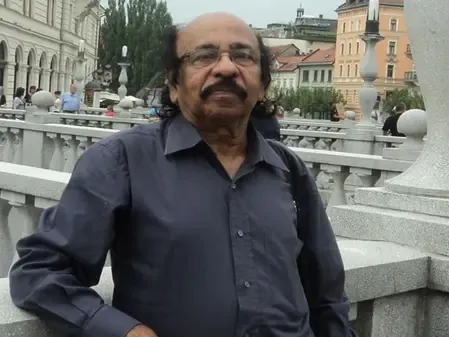
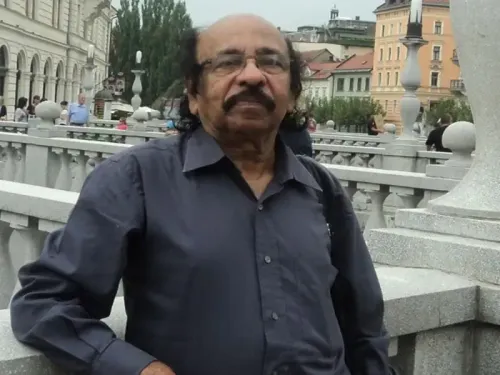
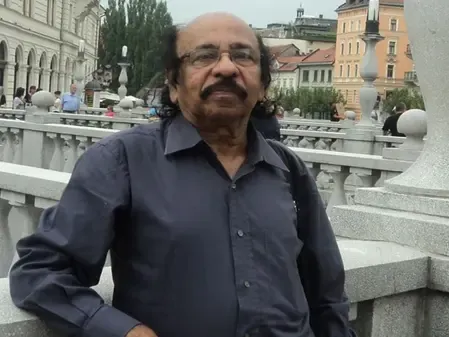
Thiruvananthapuram, Feb 10 (NationPress) The ongoing dispute surrounding the prominent poet, critic, and President of the Kerala Sahitya Akademi, K. Satchidanandan, regarding his assertions on the necessity for governmental alternation in power, has stirred significant debate within the political and cultural realms of the state.
In the wake of his initial statement that incited vigorous reactions, the former Secretary of the Sahitya Akademi took to social media on Tuesday with an extensive post, aiming to contextualize his views within a broader ideological and democratic framework.
Satchidanandan’s original statement, made earlier this week, was interpreted by many as a challenge to the Pinarayi Vijayan-led Left Democratic Front’s assertion that it merits a third consecutive term.
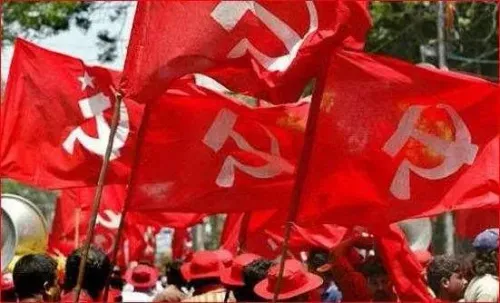
The comment faced intense backlash on social media, particularly from factions associated with the CPI(M), who accused the poet of undermining the Left at a pivotal political moment.
The discussion soon transcended party affiliations, evolving into a wider discourse on loyalty, ideology, and dissent.
In his Tuesday post, Satchidanandan clarified that his stance is founded on Marxist principles and democratic theory, rather than mere electoral strategies.
He referenced contemporary Marxist thinker Jacques Rancière, particularly the idea of subaltern democracy as a safeguard against fascism and totalitarianism.
According to him, democracy should illuminate the invisible and amplify the voices of the unheard.
He contended that Marxism can only remain pertinent today by empowering the underprivileged, workers, farmers, and minorities, rather than adopting development models that favor the upper middle class while exacerbating inequality.
He also cited significant works such as 'Hatred of Democracy' and 'How Democracies Die', cautioning against the perils of power monopolization and the degradation of democratic alternatives.
In a pointed response to online critics, Satchidanandan reminded audiences of his own political journey, including his involvement in workers’ and tribal movements, his detention during the Emergency, persistent warnings about the rise of fascism since the 1980s, and his resignation from the Sahitya Akademi following the assassination of scholar Kalburgi.
He emphasized that he has never sought positions or favors, asserting that his literary accolades are solely based on merit.
As Kerala approaches an election season characterized by heightened polarization, Satchidanandan’s remarks have ensured that discussions surrounding power, ideology, and democratic revitalization remain at the forefront of public discourse.
Point of View
It's crucial to acknowledge the significance of K. Satchidanandan’s comments in the context of Kerala's political dynamics. His insights reflect a broader ideological battle that transcends party lines, urging a reevaluation of power structures and democratic principles. The ongoing discourse should be seen as an essential aspect of a healthy democracy, fostering debate and reflection.
NationPress
2 Oct 2026
Frequently Asked Questions
Who is K. Satchidanandan?
K. Satchidanandan is a renowned poet and critic, currently serving as the President of the Kerala Sahitya Akademi.
What did Satchidanandan say about power alternation?
He emphasized the need for governments to alternate in power, prompting significant political debate.
Why did his comments receive backlash?
His remarks were perceived as a challenge to the current ruling party's claim to a third consecutive term, drawing criticism from CPI(M) supporters.
What philosophical ideas did he reference?
Satchidanandan invoked Marxist thought and the concept of subaltern democracy, stressing the importance of empowering marginalized voices.
How has this controversy affected the political climate in Kerala?
His comments have reignited discussions about ideology and power dynamics, keeping the discourse alive in the lead-up to elections.