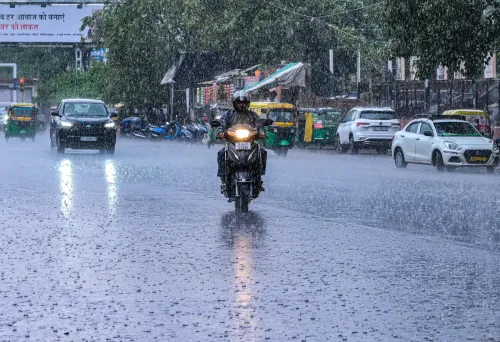
Cyclone Arnab brings rain to Rajasthan, temperatures drop 3°C
Synopsis
Cyclone Arnab, born in the Bay of Bengal, has pushed unseasonal heavy rain deep into Rajasthan — a landlocked state — dropping temperatures by up to 3°C and blanketing the sky just in time for Karwa Chauth. IMD says the system peaks Thursday–Friday before easing on 31 October.
Key Takeaways
Cyclone Arnab , originating in the Bay of Bengal , has triggered rainfall across Rajasthan as of 29 October 2026 .
Affected districts include Jaipur , Dholpur , Dausa , Tonk , Alwar , and Karauli ; temperatures have fallen by up to 3 degrees Celsius .
IMD has issued yellow and orange alerts across districts, with the strongest cyclone impact expected on Thursday and Friday .
Sikar recorded its coldest night of the season at 10 degrees Celsius ; Barmer was the hottest at 36.3 degrees Celsius on Wednesday.
Conditions are expected to begin improving from 31 October , according to the Meteorological Department.
Dense cloud cover may make moon-sighting difficult for those observing Karwa Chauth on Thursday evening.
Cyclone Arnab, which formed over the Bay of Bengal, has triggered widespread rainfall across Rajasthan as of 29 October 2026, affecting districts including Jaipur, Dholpur, Dausa, Tonk, and Alwar. Temperatures across impacted areas have fallen by up to 3 degrees Celsius, with the India Meteorological Department (IMD) warning that the system's influence could persist for three days.
Rainfall Across Districts
Heavy rain near Narayan Singh Circle in Jaipur caused disruption for two-wheeler riders on Thursday, with a lighter spell also recorded around 11 am. In Bandikui, Dausa district, heavy rain fell between 8 am and 8.30 am on Thursday. Behror in Kotputli-Behror district witnessed intermittent rain from approximately 10 am, while Alwar city received light rain at around 5 am followed by another spell at 8.30 am.
In Dholpur's Bari area, the weather changed around noon, bringing temperatures down and adding a notable chill. Karauli district saw intermittent rain through the day, with temperatures falling by up to 2 degrees Celsius there.
Met Department Alerts and Forecast
The Meteorological Department has issued both yellow and orange alerts across different districts, warning of medium to heavy rainfall and strong winds. A yellow alert for heavy rain remains in place for Jaipur on Friday. According to Radheshyam Sharma, 'Cloudy conditions are expected to continue through the night and persist on Friday.'
The department has indicated that the cyclone's strongest impact is expected on Thursday and Friday, with conditions likely to begin improving from 31 October. Rain accompanied by strong winds remains possible over the three-day window.
Temperature Records Across Rajasthan
On Wednesday, Barmer was the only location in the state to record a maximum temperature above 35 degrees Celsius, with the mercury reaching 36.3 degrees Celsius. Sirohi logged the state's lowest maximum at 29.4 degrees Celsius. Nighttime temperatures dropped by as much as 10 degrees in some areas, with Sikar recording its coldest night of the season at a minimum of 10 degrees Celsius. The IMD has cautioned that temperatures could fall further as rainfall and cloud cover continue.
Impact on Daily Life and Karwa Chauth
The combination of persistent rain, strong winds, and dense cloud cover is expected to keep conditions cool across several districts over the coming days. Notably, for women observing Karwa Chauth, the heavy cloud cover presents an added challenge — sighting the moon may prove difficult this evening. Residents across affected districts have been advised to remain prepared for continued disruption.
Point of View
The human dimension of this forecast goes beyond disrupted commutes. The IMD's three-day warning window is credible, but what is underreported is how quickly nighttime temperatures can swing — a 10-degree drop in a single night is a cold-chain and health risk for rural districts with limited preparedness. Authorities would do well to treat the orange alerts as an operational, not merely advisory, trigger.
NationPress
29 Oct 2026
Frequently Asked Questions
What is Cyclone Arnab and where did it form?
Cyclone Arnab is a cyclonic system that formed over the Bay of Bengal and has moved inland, triggering heavy rainfall across several districts of Rajasthan. Its influence is expected to last approximately three days, with conditions beginning to improve from 31 October.
Which districts in Rajasthan are affected by Cyclone Arnab?
The districts currently affected include Jaipur, Dholpur, Dausa, Tonk, Alwar, Karauli, and Kotputli-Behror. Rain and strong winds have been reported across these areas since Thursday morning.
What alerts has the IMD issued for Rajasthan?
The India Meteorological Department has issued yellow and orange alerts across different districts of Rajasthan, warning of medium to heavy rainfall and strong winds. A yellow alert for heavy rain specifically remains in place for Jaipur on Friday.
How much have temperatures dropped due to Cyclone Arnab?
Temperatures have dropped by up to 3 degrees Celsius in most affected areas, and by up to 2 degrees Celsius in Karauli district specifically. Sikar recorded its coldest night of the season at 10 degrees Celsius, and some areas saw nighttime temperatures fall by as much as 10 degrees.
When will weather conditions in Rajasthan return to normal?
According to the Meteorological Department, Cyclone Arnab's strongest impact is expected on Thursday and Friday, with conditions likely to begin improving from 31 October. Cloudy skies and rain may continue for another one to two days beyond that.