Delhi HC raps agencies over Mahipalpur waterlogging, sets Oct 30 deadline
Synopsis
The Delhi High Court has had enough of meetings that produce paperwork but no accountability. After months of task-force deliberations over Mahipalpur's chronic flooding — a bottleneck on the airport-Gurugram corridor — the court has issued a hard deadline of 30 October and warned NHAI and DIAL that stringent directions will follow if a credible, agency-tagged action plan is not on the table.
Key Takeaways
The Delhi High Court on 20 September 2026 directed the Delhi Chief Secretary to identify which agency is responsible for each waterlogging-relief measure in Mahipalpur .
All agencies must file status reports with firm timelines by the next hearing on 30 October 2026 ; two further meetings must be held by 15 October .
NHAI was sharply criticised for sending an unprepared virtual counsel with no official physically present; the court called its approach 'callous'.
DIAL has given an in-principle commitment to build a 3.5-km storm water drain along NH-48 from Shankar Vihar to Radisson Circle , but described it only as a 'good faith proposal' at the hearing.
Drainage capacity in the area was compromised by large-scale development in Aerocity , according to a status report before the court.
The court warned it will pass 'stringent directions' if no proper proposal is submitted by 30 October .
The Delhi High Court on 20 September 2026 sharply pulled up city government agencies over the chronic waterlogging and traffic congestion in the Mahipalpur area near Indira Gandhi International Airport, observing that despite multiple meetings, 'there appears to be no responsibility fixed' for implementing any of the proposed remedial measures. The court directed the Delhi Chief Secretary to identify which agency is accountable for each short-term and long-term fix, with all status reports due by the next hearing on 30 October 2026.
What the Court Directed
A division bench of Justice Prathiba M. Singh and Justice Manmeet Pritam Singh Arora ordered the Chief Secretary to convene two further meetings by 15 October and submit a comprehensive report mapping each remedial measure to a specific responsible agency or entity. By 30 October, all assigned agencies must file status reports detailing steps to be taken along with firm timelines.
The bench also made it mandatory for responsible officials from all agencies to be physically present at the next hearing — along with counsel capable of making substantive submissions and answering the court's queries on the spot.
Why Mahipalpur Keeps Flooding
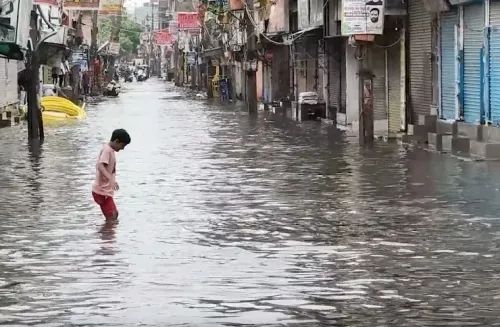
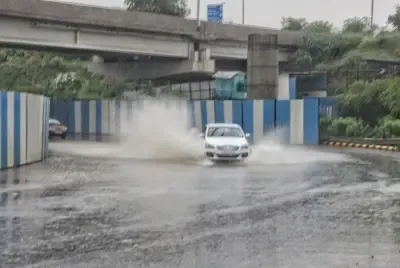
The petition, filed by civil rights group Social Jurist, concerns an area that sits on the main access corridor between Indira Gandhi International Airport and Gurugram, making its waterlogging not merely a local inconvenience but a daily disruption to a nationally significant traffic artery. According to a status report placed before the court, the effective carrying capacity of the existing drainage network was severely compromised following large-scale development works in the Aerocity area, which choked discharge into the Najafgarh Drain.
A high-level meeting chaired by the Chief Secretary on 3 August recorded that redevelopment along the national highway had materially worsened conditions. The Chief Secretary had accordingly directed all executing agencies on large-scale infrastructure projects to ensure integrated drainage connectivity so that surrounding corridors do not suffer stagnation.
Proposed Short-Term and Long-Term Measures
Between 4 August and 7 September, the Special Task Force — supervised by the Delhi Chief Secretary and constituted in a separate court matter — held several meetings involving the Municipal Corporation of Delhi (MCD), the Delhi Development Authority (DDA), the National Highways Authority of India (NHAI), the Delhi Jal Board, the Delhi Metro Rail Corporation, the Public Works Department, and airport operator GMR Group. Based on these meetings, NHAI and Delhi International Airport Limited (DIAL) jointly proposed the following:
Short-term measures include setting up pumping stations at Samalkha and Mahipalpur Junction, along with deploying stationary and PTO pumps and clearing drain inlets to prevent waterlogging during the monsoon season.
Long-term measures include eliminating the hydraulic choke point in the Mahipalpur Drain, re-planning the drainage system of the Dwarka Expressway with suitable connectivity to the Mahipalpur Drain, regular cleaning and desilting of the Samalkha Drain and Najafgarh Drain, and improving the railway drainage system to prevent uncontrolled inflow towards the Dwarka Expressway tunnel.
DIAL also gave an in-principle commitment to construct a 3.5-km storm water drain along NH-48 from Shankar Vihar to Radisson Circle. However, at the hearing, DIAL characterised this commitment as only a 'good faith proposal' while seeking an adjournment — a stance the court recorded with visible displeasure.
Court's Displeasure at NHAI and DIAL
The bench singled out NHAI for particular criticism, noting that no official from the authority was physically present. Its counsel, who appeared virtually, was reportedly unprepared to make substantive submissions and merely sought an adjournment. 'The callous approach of NHAI in the appearance today before the Court is completely not appreciated,' the bench said.
The court further noted that while meeting minutes had assigned actions to various agencies, the principal short-term and long-term proposals had originated from NHAI, which 'appears to be the agency responsible for the said area.' The bench warned that if a proper proposal is not placed before it by the next date, 'the Court would be constrained to pass some stringent directions in this regard.'
What Happens Next
The matter is listed for hearing on 30 October 2026. The Chief Secretary must submit a report by then clearly delineating agency-wise responsibility and timelines. Notably, this is not the first time the Delhi High Court has had to step in on monsoon-related infrastructure failures in the capital — similar directions have been issued in prior years concerning waterlogging in Minto Road, Pul Prahaladpur, and other chronic flash-flood zones. The pattern of extensive paperwork and diffused accountability, the court has now made explicit, will no longer be tolerated as a substitute for on-ground action.
Point of View
But the structural problem runs deeper than any single agency's negligence. Mahipalpur's chronic flooding is a product of uncoordinated large-scale development — Aerocity, NH-48 widening, Metro construction — where each project improved its own footprint while offloading drainage burden onto downstream infrastructure that was never upgraded to absorb it. The court's insistence on agency-tagged responsibility is the right corrective, but it also exposes a systemic gap: India's major urban infrastructure projects still lack mandatory, enforceable drainage-impact assessments before breaking ground. Until that changes, the courts will keep filling the accountability void that planning agencies leave behind.
NationPress
20 Sept 2026
Frequently Asked Questions
Why has the Delhi High Court pulled up agencies over Mahipalpur waterlogging?
The Delhi High Court found that despite multiple task-force meetings held after its earlier orders, no agency had been formally assigned responsibility for implementing either short-term or long-term drainage fixes in Mahipalpur. The court directed the Chief Secretary to correct this and set a hard deadline of 30 October 2026 for agencies to submit action plans with timelines.
What are the short-term and long-term measures proposed for Mahipalpur?
Short-term measures include setting up pumping stations at Samalkha and Mahipalpur Junction and clearing drain inlets. Long-term measures include eliminating the hydraulic choke point in the Mahipalpur Drain, re-planning drainage along the Dwarka Expressway, desilting the Samalkha and Najafgarh Drains, and improving the railway drainage system. DIAL has also committed in principle to building a 3.5-km storm water drain along NH-48.
Why does Mahipalpur flood repeatedly?
According to a status report before the Delhi High Court, large-scale development works in the Aerocity area and along the national highway severely reduced the carrying capacity of the existing drainage network and choked discharge into the Najafgarh Drain. The Delhi government confirmed that redevelopment in Aerocity and on the highway contributed materially to the persistent waterlogging.
What action has the court threatened if agencies fail to comply?
The Delhi High Court warned that if NHAI and DIAL do not submit a proper proposal by the next date of hearing on 30 October 2026, it 'would be constrained to pass some stringent directions.' The court has also made it mandatory for senior officials to be physically present at the next hearing.
Who filed the petition about Mahipalpur waterlogging?
The petition was filed by Social Jurist, a civil rights group, which brought the issue of severe and recurring waterlogging in Mahipalpur — a key corridor between Indira Gandhi International Airport and Gurugram — to the attention of the Delhi High Court.