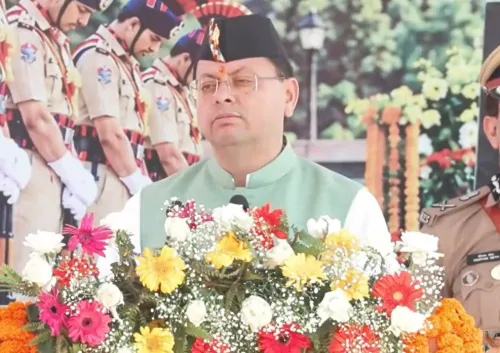
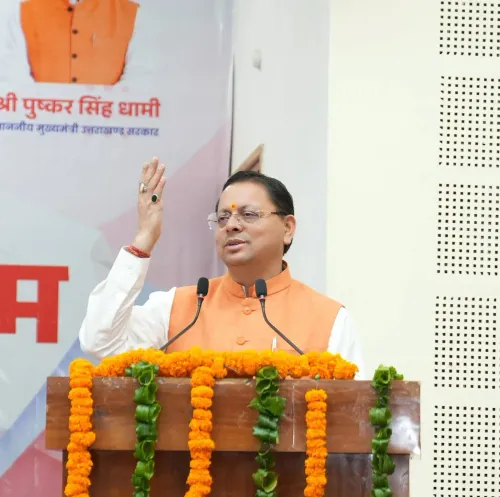
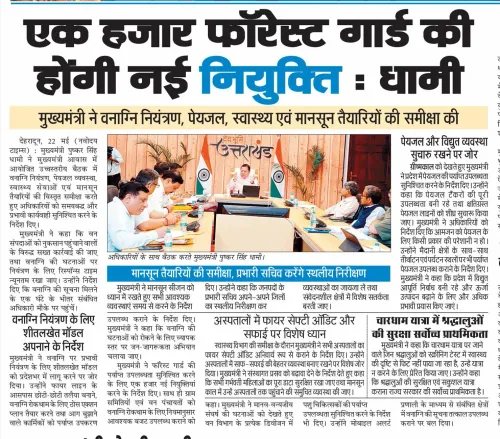
CM Dhami Announces 1,600 Police Recruitment Posts in Uttarakhand

Synopsis
Uttarakhand Chief Minister Pushkar Singh Dhami announced recruitment for 1,600 vacant uniformed police posts and a wider drive to modernise the state force with advanced technology, cyber-crime capability, and improved training.
Key Takeaways
1,600 vacant posts across uniformed units of Uttarakhand Police to be filled through a recruitment process starting 'shortly' .
CM Pushkar Singh Dhami made the announcement on October 21, 2026 , alongside multiple other police-department declarations.
The modernisation drive targets cyber-crime response capability , advanced technology, modern equipment, and better training.
India's national CCTNS project (launched 2009) provides the digital backbone that state-level upgrades like this build upon.
An official notification with eligibility criteria and timeline is still awaited to move from announcement to implementation.
Uttarakhand Chief Minister Pushkar Singh Dhami declared on Wednesday, October 21, 2026, that his government will soon launch a recruitment drive to fill 1,600 vacant posts across various uniformed units of the Uttarakhand Police — pairing the hiring push with a broader pledge to modernise the force through technology and enhanced training.
What Dhami announced — and why the 1,600 figure matters
Posting on X, the Chief Minister wrote: 'hamaari sarkar police bal ko aadhunik, saksham aur taknik-sampann banane ke liye nirantar karya kar rahi hai' — ('Our government is continuously working to make the police force modern, capable, and technology-equipped.'). The announcement goes beyond a staffing exercise: Dhami explicitly linked the recruitment to an overarching push for cyber-crime capability, advanced equipment, and better training pipelines, signalling that the new hires will enter a force being structurally re-tooled.
Filling 1,600 uniformed vacancies would represent a meaningful injection into a state police cadre that serves a population spread across some of India's most challenging Himalayan terrain. The Chief Minister indicated that a formal recruitment process will begin 'shortly' — with an official notification and timeline still to be watched.
Technology and cyber-crime capability at the centre of the upgrade
The announcement is framed around three pillars: modern equipment, upgraded technology with a dedicated focus on countering cyber offences, and more rigorous training. That framing is deliberate. Digital crime has emerged as one of the fastest-growing law-enforcement challenges across Indian states, and Uttarakhand — a state that sees heavy tourist footfall and a significant non-resident population — has not been immune.
India's Crime and Criminal Tracking Network and Systems (CCTNS) project, operational since 2009, laid the national template for digitising police records and investigation workflows. State-level upgrades like the one Dhami outlined build on that foundation but go further — targeting real-time cyber-crime response capacity that CCTNS alone was never designed to deliver.
A pattern playing out across Indian states
Uttarakhand's move tracks a wider national pattern: state governments periodically deploy twin levers — recruitment to address headcount gaps and technology investment to raise per-officer effectiveness — as digital offences multiply and public expectations of policing rise. For Uttarakhand, a state whose law-enforcement needs span pilgrimage corridors, border districts, and fast-growing urban pockets like Dehradun, both levers carry real operational weight.
The residents and officers of Uttarakhand Police will now wait for the official gazette notification. When it comes, it will tell the real story — which units get the posts, what the eligibility criteria look like, and whether the technology commitments carry a budget and a deadline. That is when a promise becomes a programme.
Frequently Asked Questions
How many police posts will be filled in Uttarakhand under CM Dhami's announcement?
Chief Minister Pushkar Singh Dhami announced that 1,600 vacant posts across various uniformed units of the Uttarakhand Police will be filled through a recruitment process to be launched shortly.
What is the focus of Uttarakhand's police modernisation drive?
The drive focuses on three areas: equipping the force with modern resources and advanced technology, building dedicated cyber-crime response capability, and improving officer training standards.
When will the Uttarakhand police recruitment notification be released?
CM Dhami said the process will begin 'shortly', but as of October 21, 2026, an official notification with dates and eligibility criteria had not yet been released.
What is CCTNS and how does it relate to Uttarakhand police upgrades?
CCTNS, the Crime and Criminal Tracking Network and Systems, is a national project launched in 2009 to digitise police records and investigations. State-level upgrades like Uttarakhand's build on this foundation but extend further into real-time cyber-crime response.
Is Uttarakhand the only state doing police recruitment and modernisation?
No. Across India, state governments regularly launch recruitment drives to fill police vacancies and invest in technology upgrades, particularly as cyber crime rises — Uttarakhand's announcement follows a broader national pattern.