CM Dhami Hails BJP's Landslide Win in Gujarat Civic Polls
Synopsis
Uttarakhand Chief Minister Pushkar Singh Dhami hailed BJP's landslide wins in Gandhinagar Municipal Corporation and the Okha and Thara municipal councils on October 13, 2026, calling it a public endorsement of development politics while warning Congress against blaming institutions for electoral defeats.
Key Takeaways
BJP swept civic polls in Gandhinagar Municipal Corporation and the municipal councils of Okha and Thara in Gujarat on October 13, 2026 .
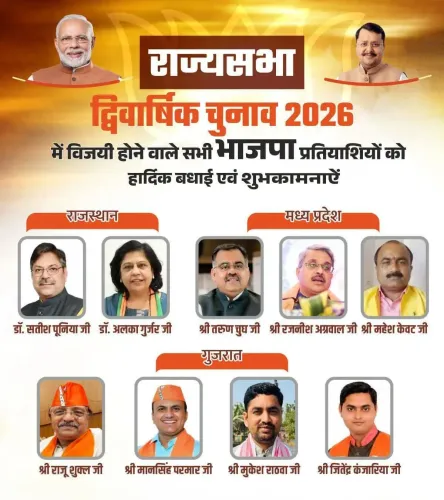
Uttarakhand CM Pushkar Singh Dhami publicly congratulated all BJP office-bearers and workers across the party's handles.
Dhami described the wins as 'the people's seal on unshakeable faith and politics of development.' He directly warned Congress that questioning constitutional institutions and blaming others after defeats will not earn public trust.
BJP has governed Gujarat uninterruptedly since 1995 , with the 2022 assembly elections cementing the party's dominance at every level.
Formal seat tallies and margins are subject to official declaration by the Gujarat State Election Commission .
Gujarat's municipal map turned saffron again on Tuesday, October 13, 2026, as the Bharatiya Janata Party swept civic elections across Gandhinagar Municipal Corporation and the municipal councils of Okha and Thara — and from the hills of Uttarakhand, Chief Minister Pushkar Singh Dhami was among the first senior BJP voices to mark the moment.
Dhami offered congratulations to all party office-bearers and workers, calling the result 'janata ke atoot vishwaas aur vikas ki rajneeti par unki muhr' — 'the people's seal of approval on politics of unshakeable faith and development.' The wins span the state capital's corporation to two smaller coastal and northern Gujarat municipalities, signalling the party's grip at every tier of local governance.
Gujarat: BJP's Unbroken Fortress Since 1995
For context, BJP has governed Gujarat without interruption since 1995 — a three-decade stranglehold that was only reinforced by the party's decisive sweep in the 2022 Gujarat Legislative Assembly elections. Municipal wins in the state capital Gandhinagar carry symbolic weight: the city that houses the Secretariat and Vidhan Sabha is seen as a political bellwether for the ruling establishment's grassroots machinery. Every civic poll cycle becomes a stress test of BJP's ground game — and every win becomes a data point the national party circulates.
That is precisely why a CM from Uttarakhand weighing in matters. Dhami's public congratulations are part of an established BJP playbook: leaders across states amplify Gujarat victories to project the party's pan-India organisational strength and reinforce its 'vikas' (development) narrative ahead of a crowded electoral calendar.
Dhami's Sharp Message to Congress
Dhami did not stop at celebration. He used the platform to fire a pointed political broadside at the Indian National Congress: 'Congress must now understand that questioning the electoral process repeatedly, casting doubt on constitutional institutions, and blaming others for their defeats cannot win the people's trust.' The lines were crisp, deliberate, and clearly aimed at a pattern BJP leaders have repeatedly highlighted — that Congress, after losing elections, questions the credibility of the Election Commission or the counting process rather than examining its own campaign failures.
The critique lands in a familiar groove. After the 2022 Gujarat assembly rout, opposition parties questioned the scale of the margin; BJP has since made 'institutional trust vs. institutional doubt' a recurring rhetorical frame whenever it scores a win. Dhami's post today reprises that frame for a local-body context, keeping the pressure on Congress's credibility in a state the party last governed in the 1990s.
Gandhinagar's Civic Significance
Of the three civic bodies in contention, Gandhinagar Municipal Corporation draws the most attention. As Gujarat's planned capital — a city built from scratch after the state's formation in 1960 — Gandhinagar is home to a relatively educated, government-service-heavy voter base. A BJP majority here is a signal that the party's core professional constituency remains intact. Okha, a port town on the Saurashtra coastline known for its fishing community and proximity to the Dwarka pilgrimage circuit, and Thara, a municipality in North Gujarat's Banaskantha district, represent very different socioeconomic profiles — making a sweep across all three a broader statement about the party's cross-demographic appeal in the state.
The tally of wins will be confirmed by the Gujarat State Election Commission, and formal result declarations are expected to sharpen the picture of margins and ward counts. Congress's response — and whether it follows the pattern Dhami anticipates — will be the next political signal to watch.
Point of View
Delivered without provocation in a congratulatory post, suggests BJP intends to make 'institutional trust' a durable attack line rather than a one-off rebuttal.
NationPress
13 Oct 2026
Frequently Asked Questions
Which Gujarat municipalities did BJP win in October 2026?
BJP won civic polls in Gandhinagar Municipal Corporation and the municipal councils of Okha and Thara in Gujarat on October 13, 2026 , according to CM Pushkar Singh Dhami's post on X.
Why did Uttarakhand CM Dhami comment on a Gujarat civic election?
Dhami is a senior BJP leader who, like other party leaders across states, publicly celebrated the Gujarat wins to project the party's national organisational strength and reinforce its development narrative.
What did CM Dhami say about Congress after the Gujarat results?
Dhami said Congress must understand that 'questioning the electoral process repeatedly, casting doubt on constitutional institutions, and blaming others for defeats cannot win the people's trust.'
How long has BJP governed Gujarat?
BJP has governed Gujarat continuously since 1995 , a run reinforced by its decisive victory in the 2022 Gujarat Legislative Assembly elections .
What is the significance of Gandhinagar Municipal Corporation elections?
Gandhinagar , Gujarat's planned state capital, has an educated, government-service-heavy voter base, and a BJP win there signals that the party's core urban constituency remains solidly behind it.