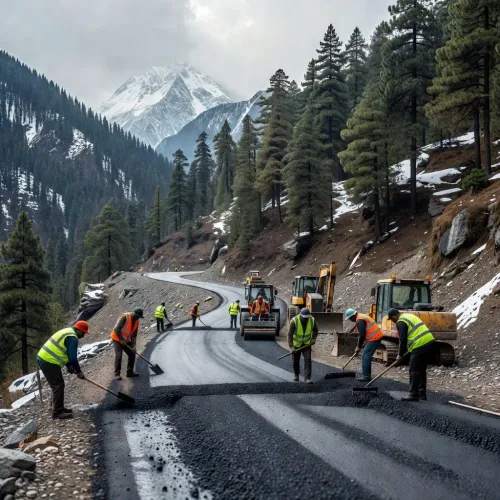
CM Dhami Inspects Highway Slope Works on Srinagar-Devprayag NH
Synopsis
Chief Minister Pushkar Singh Dhami stopped to inspect ongoing slope-remediation work on the Srinagar-Devprayag National Highway while returning from the Gairsain assembly session, directing engineers to uphold quality standards and complete works on schedule for safer hill travel.
Key Takeaways
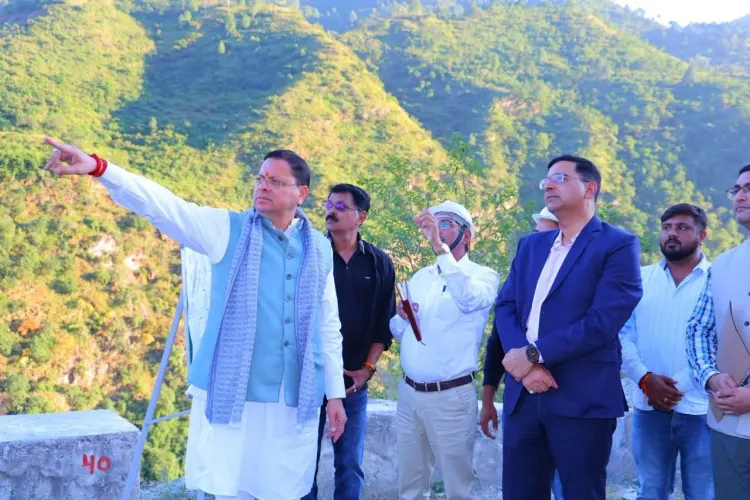
CM Pushkar Singh Dhami personally inspected remedial slope-stabilisation work on the Srinagar-Devprayag National Highway on 28 October 2026 .
The inspection took place on his return journey from the legislative assembly session held at Gairsain in Chamoli district.
Dhami briefed himself on current construction progress and the forward work plan directly from on-site engineers.
He directed officials to prioritise quality, technical standards, and timely completion to ensure safe passage for residents, tourists, and pilgrims.
The CM spoke directly with labourers, underlining their role in building Uttarakhand's infrastructure.
The government reaffirmed its commitment to making state road facilities 'safe, smooth, and high-quality.'
On his way back to Dehradun from the legislative assembly session at Gairsain, Chief Minister Pushkar Singh Dhami made an unscheduled stop on the Srinagar-Devprayag National Highway to personally inspect remedial slope-stabilisation work underway on the hill stretch — a signal that Uttarakhand's most accident-prone corridors are under direct political watch.
What Dhami found on the highway
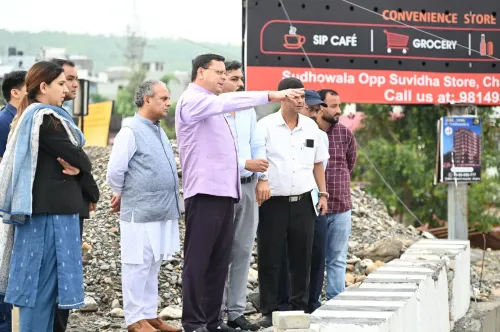
CM Dhami reviewed the progress of ongoing construction work and held a detailed briefing with engineers on site, asking specifically about current status and the forward work plan. He also spoke directly with the labourers on the ground, acknowledged their contribution, and posed for photographs with the team — an unusual gesture that underlined his message about the human effort behind infrastructure.
Speaking at the site, the Chief Minister said roads in the state are 'not just a means of movement, but are extremely important for tourism, the local economy, and connectivity of remote areas.' He directed engineers and officials to maintain strict quality and technical standards, and to ensure progress aligns with the agreed timeline.
Why this stretch demands constant attention
The Srinagar-Devprayag section of NH-7 runs through some of Uttarakhand's most geologically unstable terrain. Himalayan slope failures — triggered by monsoon rains and seismic activity — have repeatedly severed this corridor, cutting off pilgrims headed for the Char Dham circuit, hill residents, and supply chains for interior districts. Successive governments have invested in remedial engineering here, but completing works before each monsoon season remains a perennial race against time.
Gairsain, the Chamoli district town where the assembly session was held, itself represents Uttarakhand's long-standing commitment to administrative decentralisation — the state has periodically convened its legislature there since formation in 2000 to ensure hill regions feel represented. Dhami's inspection on the return leg connected two symbols of governance outreach in a single trip.
Quality, timelines, and what Dhami told officials
The Chief Minister's instructions were pointed: remedial works must be 'effective and durable,' departments and executing agencies must coordinate closely, and road safety measures must be taken with 'special vigilance in line with technical requirements.' He stated plainly that 'the success of any construction work is determined by its quality, timeliness, and utility.'
Officials were directed to set up regular monitoring of road improvement and remedial work so that every project is completed within its deadline without compromising standards — giving ordinary citizens safer travel on mountain roads.
With monsoon performance of freshly-treated slopes now the metric to watch, the pressure on executing agencies to deliver lasting fixes — not just seasonal patches — has never been more explicit.
Point of View
Dhami threads two distinct governance narratives — decentralisation and connectivity — into a single day. The real test will come when monsoon 2027 stress-tests the treated slopes; until then, quality assurances remain a promise to hold the administration to.
NationPress
28 Oct 2026
Frequently Asked Questions
Why did CM Dhami inspect the Srinagar-Devprayag National Highway?
CM Dhami stopped to review ongoing slope-stabilisation and remedial construction work on the highway while returning to Dehradun from the Gairsain assembly session, seeking updates on progress and issuing quality directives to engineers.
What is remedial or slope-stabilisation work on a Himalayan highway?
Slope-stabilisation work involves engineering interventions — such as rock bolting, retaining walls, drainage channels, and netting — to prevent landslides and hill cuts from blocking or damaging roads in geologically unstable mountain terrain.
Why is the Srinagar-Devprayag NH section important for Uttarakhand?
This section of NH-7 is a key artery for pilgrims on the Char Dham circuit, hill residents, and tourists. Landslides here regularly cut off interior districts, making slope stabilisation critical for safety, tourism revenue, and local livelihoods.
Why does Uttarakhand hold assembly sessions in Gairsain?
Gairsain in Chamoli district is periodically used as a session venue since state formation in 2000 to promote administrative decentralisation and ensure that hill communities feel represented in governance.
What instructions did CM Dhami give to highway engineers?
Dhami directed engineers and officials to maintain strict quality and technical standards, ensure regular monitoring, coordinate across departments, and complete all remedial works within the scheduled timeline so the public receives safe road access.