Dibrugarh becomes Assam's first 'Surakshit District' for HIV control
Synopsis
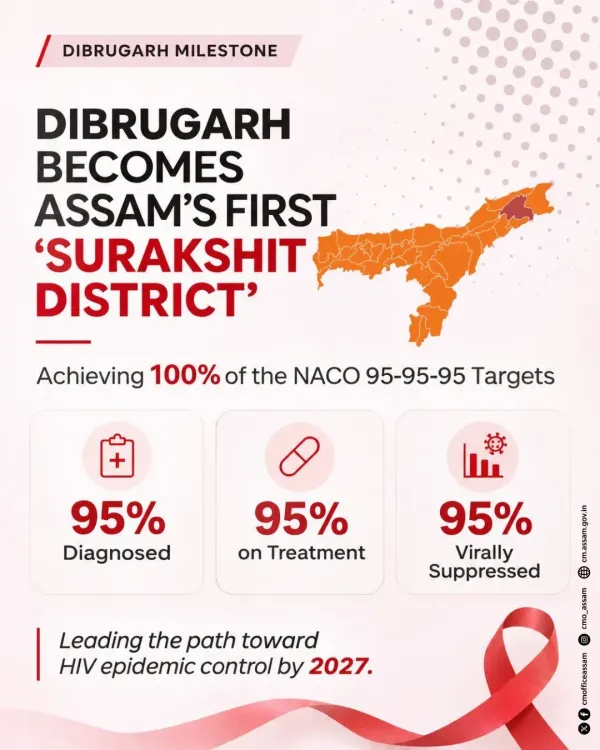
Dibrugarh has become Assam's first 'Surakshit District' after achieving all three NACO 95-95-95 HIV targets — 95% diagnosed, 95% on treatment, and 95% virally suppressed — marking a milestone in Assam's push for HIV epidemic control by 2027.
Key Takeaways
Dibrugarh is Assam's first district to earn the 'Surakshit District' designation for HIV control .
The district has met all three NACO 95-95-95 targets : 95% diagnosed, 95% on antiretroviral treatment, and 95% virally suppressed.
NACO's 95-95-95 framework is part of India's National AIDS Control Programme Phase-V (2021–2026) , aligned with global UNAIDS goals.
Assam is targeting HIV epidemic control by 2027 , ahead of the global UNAIDS 2030 deadline.
The achievement positions Dibrugarh as a replicable model for the remaining districts in Assam .
A district in eastern Assam has just cleared a bar that most of India is still chasing. Dibrugarh has become Assam's first 'Surakshit District' — a designation marking full achievement of the NACO 95-95-95 targets for HIV control, the Chief Minister's Office of Assam announced on Sunday, 15 November 2026.
What the 95-95-95 numbers actually mean
The targets, set by UNAIDS and adopted by India's National AIDS Control Organisation (NACO) under its National AIDS Control Programme Phase-V (2021–2026), define the minimum threshold for epidemic control: 95% of all people living with HIV diagnosed, 95% of those diagnosed on antiretroviral treatment, and 95% of those on treatment achieving viral suppression. Hit all three, and the chain of transmission begins to break. Dibrugarh has now hit all three. That is not incremental progress — that is the finish line.
Dibrugarh's path to the 'Surakshit' label
The district's achievement places it at the leading edge of Assam's implementation of national HIV guidelines under central NACO monitoring. District health teams — often working in geographically difficult terrain across eastern Assam — have had to reach not just urban populations but dispersed communities to bring diagnosis, treatment-linkage and viral-load monitoring all above the 95% mark simultaneously. Doing all three in tandem is the hard part; most districts stall at the first or second threshold.
India's 2027 target and the race to replicate Dibrugarh
Assam has set an internal target of achieving HIV epidemic control by 2027 — three years ahead of the global UNAIDS 2030 deadline. Dibrugarh is now the template. The immediate question for the state's health machinery is how quickly additional districts can be brought to 'Surakshit' status, and whether NACO's next annual progress report will show a cluster effect across the northeast.
One district has proved it can be done. The clock on the other 34 in Assam is now ticking louder.
Point of View
District-level approach to epidemic control — a model NACO has been pushing since Phase-V began. For Assam, announcing a 2027 epidemic-control target puts the state three years ahead of the global curve, raising the political stakes for sustained health-system investment. The 'Surakshit District' label, if backed by transparent data and regular NACO auditing, could become a powerful accountability tool for other states watching the northeast's progress. The harder test will be whether Assam can replicate Dibrugarh's performance across its more remote and resource-constrained districts before the 2027 deadline.
NationPress
15 Nov 2026
Frequently Asked Questions
What is a 'Surakshit District' for HIV in Assam?
A 'Surakshit District' is a designation awarded to districts that achieve 100% of the NACO 95-95-95 HIV control targets — meaning 95% of people living with HIV are diagnosed, 95% of those diagnosed are on antiretroviral treatment, and 95% of those on treatment are virally suppressed. Dibrugarh is the first district in Assam to earn this status.
What are the NACO 95-95-95 targets?
The NACO 95-95-95 targets, adopted from the global UNAIDS framework, require that 95% of all people living with HIV be diagnosed, 95% of those diagnosed be on antiretroviral treatment, and 95% of those on treatment achieve viral suppression. India incorporated these targets into its National AIDS Control Programme Phase-V (2021–2026).
When does Assam aim to achieve full HIV epidemic control?
Assam has set a target of achieving HIV epidemic control by 2027, three years ahead of the global UNAIDS deadline of 2030.
What does viral suppression mean in HIV treatment?
Viral suppression means a person living with HIV has such a low level of the virus in their blood — achieved through consistent antiretroviral therapy — that it is undetectable or below the threshold for onward transmission. It is the third and final benchmark in the 95-95-95 framework.
Which organisation oversees HIV control targets in India?
The National AIDS Control Organisation (NACO), under India's Ministry of Health and Family Welfare, oversees HIV prevention and treatment programmes and monitors district and state-level progress against the 95-95-95 targets.