How are DoT and UNDP Advancing Circular Economy in Telecom?
Click to start listening
Synopsis
Discover how the Department of Telecommunications and UNDP are championing the circular economy in India's telecom sector. This national workshop unites key stakeholders to drive sustainability and innovation, emphasizing the crucial need for actionable steps and collaboration.
Key Takeaways
- Collaboration among stakeholders is essential for implementing circular economy practices.
- The telecom sector must move from discussions to tangible actions.
- Digital tools play a crucial role in enabling the transition.
- Policy frameworks need to support sustainability initiatives.
- Shared ownership of the transition is vital for success.
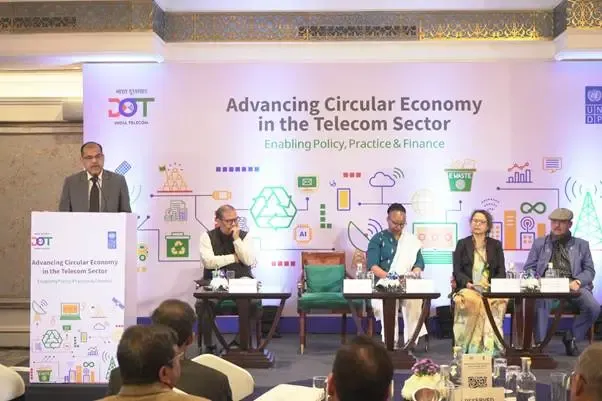
New Delhi, Dec 19 (NationPress) The Department of Telecommunications (DoT), in collaboration with the United Nations Development Programme (UNDP), hosted a national workshop on Friday focused on fostering the implementation of circular economy practices within India’s telecom sector.
This workshop, entitled "Promoting Circular Economy in the Telecom Sector: Enabling Policy and Practices," convened a diverse group of policymakers, industry leaders, technology innovators, educators, global organizations, and other stakeholders from the value chain. The goal was to explore strategies for enhancing sustainability, resource efficiency, and environmental accountability in the telecom industry, as highlighted by a statement from the Communications Ministry.
Key discussions revolved around re-evaluating the telecom supply chain to boost circularity. Topics included sustainable design, component reuse, strategic procurement, and the necessary policy actions to tackle current obstacles. Participants also examined government efforts that facilitate circular practices and the industry's role in implementing scalable solutions.
A significant segment of the workshop focused on the integration of digital tools to facilitate the shift towards a circular economy. Keynote speakers emphasized how digital platforms, data-driven tools, and cutting-edge technologies such as blockchain, artificial intelligence (AI), and the Internet of Things (IoT) can enhance traceability, optimize material recovery, and improve transparency in extended producer responsibility (EPR) execution.
Officials and specialists also shared insights from the Central Pollution Control Board on utilizing digital systems for efficient monitoring, alongside the application of data analytics to bolster decision-making throughout the telecom value chain.
In the final session, participants emphasized that the telecom industry in India must progress from dialogue to tangible action. The necessity for coordinated, ecosystem-wide initiatives was underscored, along with the critical need to establish an enabling policy landscape and enhance multi-stakeholder collaboration.
The workshop concluded with a collective call for shared responsibility in the transition process—where the government sets strategic direction and conditions, the industry spearheads innovation and implementation, and partners facilitate execution, capacity building, and financing to ensure that the principles of a circular economy are effectively integrated into India’s rapidly growing telecom sector.
Point of View
I observe that the initiative by DoT and UNDP signifies a pivotal moment for India's telecom sector. The emphasis on a circular economy reflects an urgent need for sustainable practices amidst rapid technological advancements. It is crucial that all stakeholders collaborate effectively to translate discussions into real-world applications that will benefit both the economy and the environment.
NationPress
24/12/2025
Frequently Asked Questions
What is the purpose of the workshop held by DoT and UNDP?
The workshop aims to accelerate the adoption of circular economy practices in India's telecom industry, focusing on sustainability and resource efficiency.
Who participated in the workshop?
The event brought together policymakers, industry executives, technology providers, academics, and international organizations.
What topics were discussed at the workshop?
Topics included sustainable design, component reuse, digital tools, and policy interventions needed for circular economy practices.
How can digital tools aid in the transition to a circular economy?
Digital tools can enhance traceability, improve material recovery, and increase transparency in extended producer responsibility efforts.
What is the expected outcome of this initiative?
The goal is to create an enabling policy framework and foster collaboration among stakeholders to embed circular economy principles in the telecom sector.