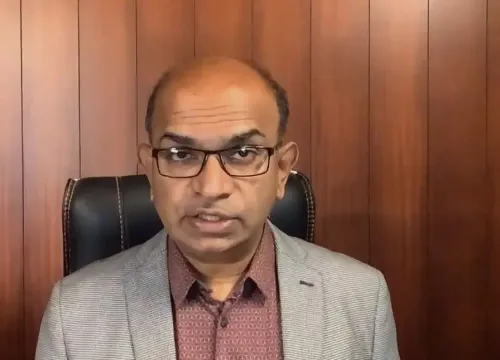
Dr. Raman Gangakhedkar Discusses HMPV: Not Fatal, No Evidence of Severe Spread (IANS Interview)

New Delhi, Jan 6 (NationPress) The Human Metapneumovirus (HMPV) is certainly not lethal, and as of now, there is no indication of mortality or significant transmission rates, asserted Dr. Raman Gangakhedkar, a former scientist from the Indian Council of Medical Research (ICMR), on Monday.
As India reported three cases—two in Karnataka and one in Gujarat—the scientist informed IANS that infections from this virus are generally mild, primarily affecting children under five years old.
Among serious respiratory conditions including influenza and respiratory syncytial virus (RSV), the global prevalence of HMPV is approximately 4 percent, according to him.
"We can confidently state that HMPV is not lethal. Most infections are mild, particularly in children under five and those over 65. The virus may lead to cold-like symptoms lasting for about 4 to 5 days," Gangakhedkar remarked.
"While the virus can potentially induce pneumonitis-like illness, the mortality rates remain largely unknown at this point. HMPV has a global prevalence estimated at around 4 percent," he explained to IANS.
The seasoned scientist also mentioned that it is currently unclear if the cases identified in India are connected to the outbreak reported in China.
"There is no available information on phylogenetics or the genetic profile of this virus from China. Therefore, there is no basis to assume it originated from there," Gangakhedkar noted, adding that the ICMR is likely planning to conduct genome sequencing tests to ascertain the virus strain.
Highlighting the deficiency of studies on HMPV in India due to its mild nature, he advocated for research into "the shifts in the behavior of this virus in humans, specifically whether it causes severe disease or heightens mortality risk."
First discovered in 2001, HMPV belongs to the Pneumoviridae family alongside RSV. Symptoms associated with HMPV typically include cough, fever, nasal congestion, and shortness of breath.
Gangakhedkar referenced a study conducted by the National Institute of Virology (NIV) from 2016 to 2008, which involved 16,000 individuals admitted with acute respiratory infections.
NIV researchers discovered that the prevalence rate of HMPV is about 3.4 percent. Among those hospitalized for acute respiratory infections, the prevalence was found to be around 2.6 percent.
"This indicates the virus is indeed present," Gangakhedkar said, noting that it typically reappears during winter.
The epidemiologist stated that HMPV has long been present in India without posing any public health threat, and there is no evidence of lung-related illnesses in children.
Additionally, he remarked that this suggests individuals are likely to experience reinfections, with each subsequent infection providing partial protection that may lessen severity.
He recommended that parents keep their children at home if they exhibit cold symptoms.
For adults, Gangakhedkar advised, "If you find yourself with cold-like symptoms, please adhere to Covid etiquette, which I believe people are now accustomed to. They understand what precautions are necessary."