Dr. Jitendra Singh sets CSIR's 2047 sovereignty agenda at 85th Foundation Day
Synopsis
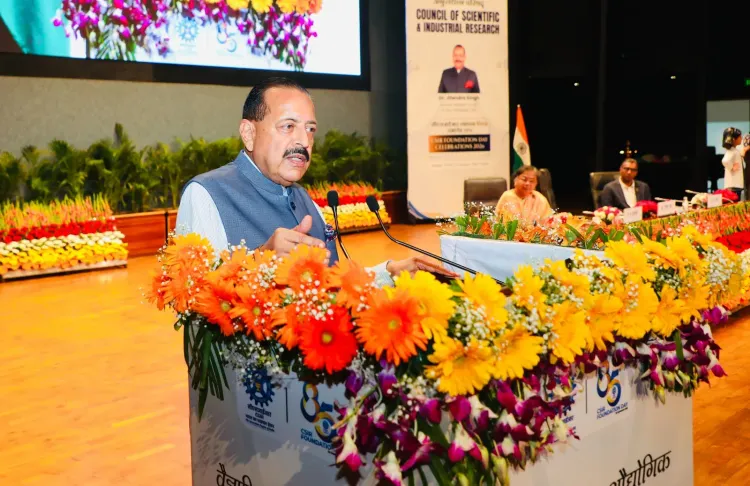
Union Science Minister Dr. Jitendra Singh addressed CSIR's 85th Foundation Day in New Delhi on 25 September 2026, invoking the body's 1942 founding and laying out a technological sovereignty agenda for 2047 as the defining mission of India's largest public R&D organisation.
Key Takeaways
CSIR turned 85 on 25 September 2026 ; Dr.
Jitendra Singh delivered the keynote at the C.
Subramaniam Hall, NASC Complex, Pusa, New Delhi .
CSIR was founded in 1942 , predating Indian independence, and spans domains from aerospace and healthcare to the Aroma Mission and leather technology.
The minister stressed that individual CSIR institutes have become part of the identity of the states and UTs where they operate.
Singh credited the last decade, under CSIR President Narendra Modi , with significantly improving the visibility and public reach of scientific achievements.
The overarching goal set for 2047 is 'technological sovereignty,' framed as inseparable from national sovereignty.
The challenge identified for CSIR is continuous renewal of its scientific work to meet current and future national requirements.
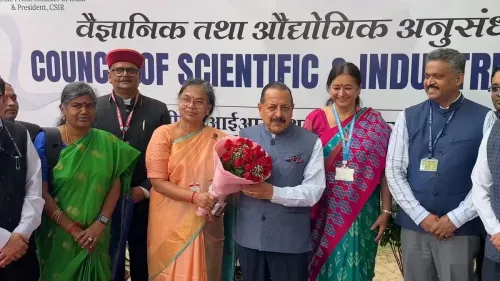
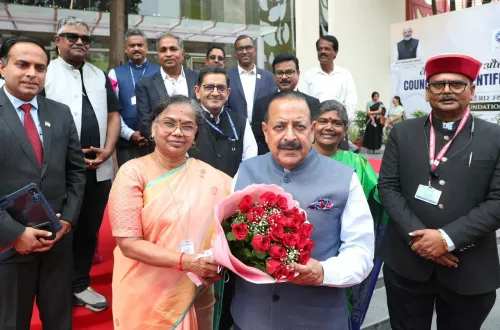
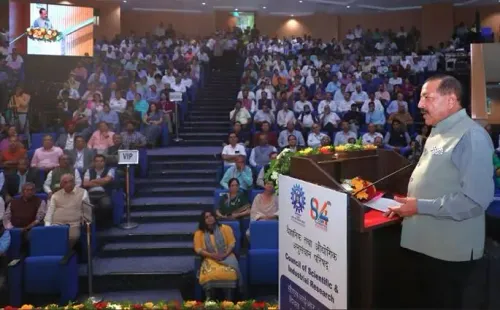
India's largest public-sector research network turned 85 on Friday — and the minister in charge used the milestone not to celebrate the past, but to define a mission for the future. Union Minister of State (Independent Charge) for Science and Technology Dr. Jitendra Singh delivered the keynote address at the 85th Foundation Day of the Council of Scientific and Industrial Research (CSIR), held at the C. R. Subramaniam Hall, NASC Complex, Pusa, New Delhi on 25 September 2026.
Eight decades of science — and the weight that comes with them
Dr. Singh opened on a striking historical note: CSIR predates Indian independence itself. 'CSIR is among the few institutions that have led India's post-independence journey, having come into existence in 1942, before the country became independent,' he said. That lineage — over eight decades of applied research across domains as varied as leather technology, jewellery, healthcare, agriculture, road engineering, food technology, aerospace, and the flagship Aroma Mission — is, by the minister's framing, both an asset and an obligation. The challenge is not to rest on legacy, but to continuously renew scientific and technological work to meet 'current and futuristic requirements of the country.'
CSIR was formally established under the Societies Registration Act as India's central civilian R&D agency, and it has since grown into a sprawling network of laboratories that touch virtually every sector of the economy. Its work on aromatic crops under the Aroma Mission, for instance, has created direct income pathways for farmers across multiple states — the kind of laboratory-to-field translation that governments have long sought but rarely achieved at scale.
Labs that now belong to the states they serve
One of the sharper observations from the minister's address was about identity: individual CSIR institutes have become so embedded in their host regions that their success stories are now 'associated with the identity of the State or UT where they exist.' That is a meaningful shift in how public R&D is perceived — from a distant central government enterprise to a locally-rooted engine of economic and industrial capability.
Dr. Singh also credited the last decade — under CSIR President and Prime Minister Narendra Modi — with a decisive change in visibility. 'The work in the CSIR labs was happening earlier also, but its success stories are now reaching the people for whom they are meant,' he noted. The distinction matters: scientific output without public awareness has limited multiplier effect; communicating breakthroughs to citizens and industries amplifies adoption.
Technological sovereignty as the 2047 north star
The address built toward a single, pointed ambition: 'For 2047, we aim at technological sovereignty, which is crucial to national sovereignty.' The framing deliberately links science policy to the broader Viksit Bharat (Developed India) vision that anchors the government's centenary-of-independence agenda. In the minister's telling, you cannot have a self-reliant nation without a self-reliant technology base — and CSIR, with its breadth across critical domains, is the institution best positioned to deliver it.
What that roadmap looks like at the institute level — specific targets, timelines, and partnerships — remains the work ahead. But the direction is unambiguous: CSIR's next chapter is not about incremental output but about building the kind of deep, indigenous technological capability that reduces strategic dependence in sectors from aerospace to pharmaceuticals.
Eighty-five years after its founding, India's premier research body has been handed a mandate that matches the scale of its history. The clock to 2047 has started.
Point of View
Not a ceremonial speech: framing 'technological sovereignty' as a precondition for 'national sovereignty' hardwires science policy into the government's centenary-of-independence narrative. The emphasis on regional identity of CSIR labs is a politically astute move to build constituency-level ownership of federal R&D spending. Crediting the last decade's visibility gains under PM Modi as CSIR President also reinforces the administration's broader communication strategy — that scientific progress achieved under earlier governments only reached citizens under the current one. The 2047 horizon gives CSIR an aspirational deadline, but the specific roadmaps and accountability mechanisms will determine whether the ambition translates into measurable technological depth.
NationPress
25 Sept 2026
Frequently Asked Questions
When was CSIR founded and why is it significant?
CSIR was founded in 1942 under the Societies Registration Act, making it one of the few Indian institutions that predate independence. It is India's largest public-sector R&D organisation, with laboratories spanning aerospace, healthcare, agriculture, food technology, and more.
What did Dr. Jitendra Singh say about CSIR at the 85th Foundation Day?
Dr. Jitendra Singh said CSIR must live up to its eight-decade legacy by continuously renewing its work to meet current and future national needs, and set 'technological sovereignty by 2047' as the organisation's defining mission.
What is the CSIR Aroma Mission?
The Aroma Mission is a CSIR programme that promotes the cultivation of aromatic crops and essential oil production across Indian states, creating direct income pathways for farmers and linking laboratory research to rural livelihoods.
Who is the President of CSIR?
The Prime Minister of India serves as the President of CSIR by convention. Currently, Narendra Modi holds that position alongside his role as Prime Minister.
What does 'technological sovereignty by 2047' mean for India?
'Technological sovereignty by 2047' refers to India's goal of developing deep, indigenous capabilities in critical technology sectors — reducing strategic dependence on foreign technology — by the centenary of its independence, as articulated by Dr. Jitendra Singh at CSIR's 85th Foundation Day.