Shiv Sena (UBT) calls Maharashtra drug-free pledge a 'hypocritical spectacle'
Synopsis
Shiv Sena (UBT)’s Saamana editorial didn’t just critique a policy — it indicted a decade of governance. By naming Nashik, Pune, and Satara drug busts and alleging BJP patronage of liquor and narcotics networks, the Thackeray camp has reframed Maharashtra’s drug-free pledge as a political liability for CM Fadnavis ahead of the 2029 accountability window.
Key Takeaways
Shiv Sena (UBT) called Maharashtra’s drug-free 2029 pledge a ‘hypocritical and event-driven spectacle’ in a Saamana editorial on 3 September .
The party alleged that drug traffickers, liquor manufacturers, and contraband suppliers operate under BJP political patronage in Maharashtra.
CM Devendra Fadnavis , who heads the state Home Department , was accused of suppressing investigations into illicit drug factories in Nashik , Pune , and Satara .
The editorial warned that Nashik and Pune risk becoming an ‘Udta Maharashtra’ amid worsening substance abuse.
Massive drug seizures at a Gujarat port linked to Afghanistan and Pakistan were cited as evidence of porous trade corridors.
The party urged citizens to hold the BJP leadership accountable when the 2029 drug-free deadline arrives.
Shiv Sena (Uddhav Balasaheb Thackeray) on Thursday, 3 September launched a sharp attack on the Bharatiya Janata Party (BJP) over the Maharashtra government's pledge to make the state drug-free by 2029, dismissing the initiative as a “hypocritical” and “event-driven spectacle”. The broadside appeared in an editorial published in the party’s mouthpiece Saamana, questioning why the ruling establishment had failed to contain the narcotics trade despite holding power for over a decade.
The Core Allegation
The Thackeray camp argued that Prime Minister Narendra Modi’s government has been in office in New Delhi since 2014, while Chief Minister Devendra Fadnavis has wielded significant authority in Maharashtra for roughly the same period. Against that backdrop, the editorial questioned the credibility of a drug-free deadline set for 2029, urging citizens to mark the date and hold the current leadership accountable when the timeline expires.
Political Patronage Claims
The editorial levelled grave allegations against the state administration, claiming that illicit drug networks, liquor manufacturers, and contraband suppliers operate under explicit political patronage. Referring to past busts of illicit manufacturing units in Nashik, Pune, and Satara, the Shiv Sena (UBT) accused the state Home Department — headed by CM Fadnavis — of suppressing critical investigations into land allocations and chemical pill factories.
“Currently, all drug traffickers, alcohol manufacturers, cigar and cigarette vendors, and bhang-ganja sellers in Maharashtra are under the patronage of the BJP. The wheels of BJP’s politics run on this drug trade, yet these very people have set out to make Maharashtra ‘drug-free’,” the editorial stated.
Udta Maharashtra Warning
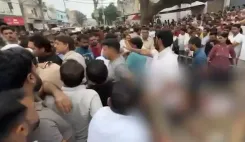
Describing the worsening law-and-order situation, the editorial warned that regions like Nashik and Pune are turning the state into an “Udta Maharashtra” — a pointed reference to the 2016 film that exposed Punjab’s drug crisis. The party also condemned BJP leaders for allegedly mocking local citizens who took to the streets to protest against growing substance abuse.
Alcohol and Sugar Factory Angle
Raising questions about the official definition of “intoxication”, the editorial highlighted that numerous sugar factory owners who produce alcohol have reportedly aligned themselves with the BJP. It questioned whether CM Fadnavis would issue stern warnings to these “liquor barons” or attempt to reframe the classification of alcohol to dilute the campaign’s mandate.
Gujarat Drug Corridor Cited
The attack extended beyond state borders, citing massive drug seizures at a Gujarat port originating from Afghanistan and Pakistan. The editorial alleged that despite claims of high-level security, narcotics continue to flow unhindered into Maharashtra through these trade corridors. Concluding its broadside, the Thackeray camp asserted that addiction in the state is not limited to illegal substances such as charas, ganja, and brown sugar. “Intoxication and drunkenness stem not just from substances, but also from corruption and money — and Maharashtra will have to be freed from that intoxication as well,” the editorial declared.
Point of View
Shiv Sena (UBT) has created a measurable yardstick it can deploy in every future election cycle. The allegations of political patronage — linking sugar factory owners to alcohol production and BJP membership — are serious and unverified, but their political potency lies in the specificity of the named districts. What mainstream coverage misses is the structural contradiction at the heart of Maharashtra’s drug problem: enforcement agencies report to the Home Department, which is led by the same Chief Minister championing the drug-free campaign. That institutional conflict of interest is the real story, and no editorial — however sharp — resolves it.
NationPress
3 Sept 2026
Frequently Asked Questions
What did Shiv Sena (UBT) say about Maharashtra's drug-free 2029 pledge?
Shiv Sena (UBT) called the pledge a ‘hypocritical and event-driven spectacle’ in a Saamana editorial published on 3 September. The party argued that the BJP has been in power for over a decade — both at the Centre and in Maharashtra — yet the narcotics trade has flourished, making the 2029 deadline ring hollow.
What allegations did Saamana make against the BJP and CM Fadnavis?
The editorial alleged that drug traffickers, liquor manufacturers, and contraband suppliers operate under explicit BJP political patronage in Maharashtra. It further accused CM Devendra Fadnavis’s Home Department of suppressing investigations into illicit drug and chemical pill factories in Nashik, Pune, and Satara.
What is the 'Udta Maharashtra' reference in the Saamana editorial?
The editorial warned that Nashik and Pune are turning Maharashtra into an ‘Udta Maharashtra’, drawing a parallel to Punjab’s drug crisis depicted in the 2016 Bollywood film Udta Punjab. It was used to signal that the state’s substance abuse problem has reached a critical, film-worthy scale.
Why did the editorial mention Gujarat port drug seizures?
The Saamana editorial cited massive drug seizures at a Gujarat port — with consignments traced to Afghanistan and Pakistan — to argue that narcotics continue to flow into Maharashtra through established trade corridors despite government claims of high-level border security.
How does the BJP’s alcohol industry connection feature in the editorial?
The editorial claimed that numerous sugar factory owners who produce alcohol have aligned themselves with the BJP, questioning whether CM Fadnavis would issue warnings to these ‘liquor barons’ or attempt to redefine alcohol’s classification to water down the drug-free campaign’s scope.